Accuracy and quality control
Most A polymer is a large molecule formed from many identical smaller molecules (monomers). Polymers can be natural or synthetic. Plastics are long chains of polymers. products that are Molten material forced into a mould. are made by machines with very little human intervention. This ensures that each product is made to a fine The amount by which a measurement can vary without affecting the ability of the product to be manufactured accurately. if the mould has been made correctly - a formed product is only as good as the mould or injection-moulding tool.
If machines are maintained and stocked with the required material, the product will be near perfect as machines follow the same motion every time. On-screen The artificial recreation of an event or activity, eg flight simulation software. reduces the need to produce trial runs and can eliminate errors before production starts.
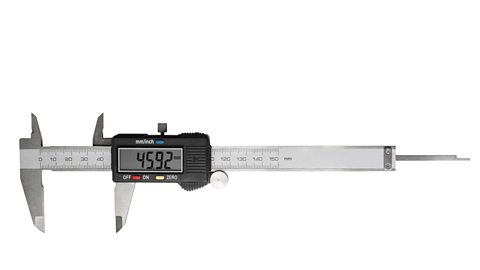
A precision tool used to measure thickness. can be used to measure the width of a material and A digital device for measuring with accuracy. can be used to measure the outside width, inside Sizes and measurements. and depth of holes. Both tools measure to 1/100th of a millimetre (mm) and can be read quickly because of the digital screen.
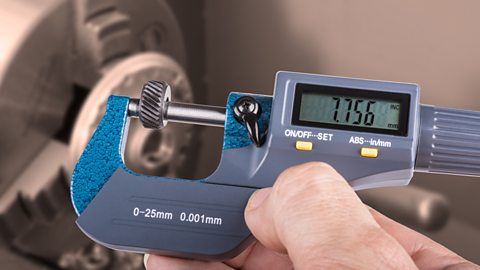
Image caption, Digital micrometer
1 of 2
A set of checks intended to ensure that a product will meet the specified customer requirements once it has been manufactured. These procedures are followed before work is complete, as opposed to afterwards. takes place during the manufacture of any product, but, since polymer parts are engineered to a fine tolerance, there are specific quality control tools to ensure that polymer parts have been made correctly - one such tool is called a A quality control tool used to check tolerance.. The ‘go-no-go gauge’ has a ‘go’ side and a ‘no-go’ side - when testing the product one side must pass and one side must fail.
Example
It is common to hear engineers say they can work to a tolerance of ‘one thou’, meaning 1/1,000th of an inch.
1 inch = 25.4 mm
25.4 ÷ 1,000 = 0.0254 mm, so:
‘one thou’ = 0.03 mm (to 2 decimal places)
If an engineer was asked to mill a 30 mm slot in a block of acrylic, it would be possible to check whether the slot was correct by using a ‘go-no-go gauge’:
30 mm - 0.03 mm = 29.97 mm
This side of the gauge must be able to slide into the milled slot.
30 mm + 0.03 mm = 30.03 mm
This side of the gauge must not be able to slide into the milled slot.
Question
If 0.5 m lengths of acrylic tube were cut +/- 5%, what would the range of tolerance be?
0.5 m = 500 mm
1% = 500 ÷ 100
= 5 mm
5% = 5 mm × 5
= 25 mm
Range of tolerance = 25 mm either side of the 0.5 m mark
= 25 mm × 2
= 50 mm
