Using the dative
When you want to say that you live in a town or village, you use the preposition in. This means you have to remember the gender of the word you are using and then use it with the dative case after in, eg
ein Vorort (m) > in einem Vorort– in a suburb
eine Stadt (f) > in einer Stadt– in a town
ein Dorf (nt) > in einem Dorf– in a village
The prepositions auf (on) and am (at) also take the dative case, eg when used with die Insel (the island) or die Küste (the coast):
auf einer Insel– on an island
an der Küste– on the coast
Question
How would you say these sentences in German?
- I live in a village.
- I live in a city.
- I live in a suburb of Bremen.
- I live in a small town.
Ich wohne in einem Dorf.– I live in a village.
Ich wohne in einer Großstadt.– I live in a city.
Ich wohne in einem Vorort von Bremen.– I live in a suburb of Bremen.
Ich wohne in einer Kleinstadt.– I live in a small town.
You can also enhance your answer with some geographical detail.
Hilfsvokabeln– Helpful vocabulary
Listen to the pronunciation to practise these phrases:
im Norden (von)– in the north (of)
im Osten (von)– in the east (of)
im Süden– in the south
im Westen (von)– in the west (of)
in der Mitte (von)– in the middle (of)
in den Bergen– in the mountains
an der Küste– on the coast
auf dem Lande– in the country
in der Nähe (von)– near (to)
zehn Kilometer von der Stadt entfernt– ten kilometres from the town
Question
How would you answer this question? Try recording your answer and then compare it to the sample answers.
Wohnst du auf dem Lande?
- Ja, ich wohne in einem Dorf. – Yes, I live in a village.
- Ja, ich wohne in einem Dorf, zehn Kilometer von Dresden entfernt. – Yes, I live in a village ten kilometres from Dresden.
- Ja, ich wohne in Eggerberg. Das ist ein Dorf in der Nähe von Brig. – Yes, I live in Eggerberg. That is a village near Brig.
- Nein, ich wohne nicht auf dem Lande. – No, I don't live in the country.
- Nein, ich wohne in einer Stadt. – No, I live in a town.
- Nein, ich wohne in einem Vorort von Wien. – No, I live in a suburb of Vienna.
Did you know?
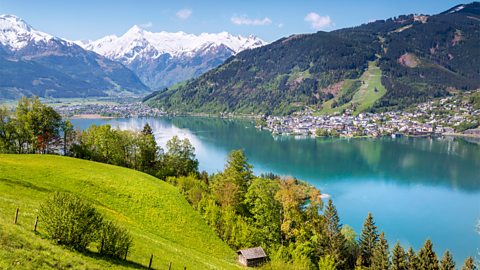
The name of the Austrian town Zell am See tells us a lot about its history and geography.
Founded by monks in the eighth century, the name Zell comes from Zelle, meaning cell or monk's cell. The second part of the name am See means 'on the lake' from an (meaning 'at') + the word for 'lake' - der See - which is masculine. The dative needed after an, changes der to dem, becoming an dem, which in turn is shortened to am.
The meaning of the place is 'the monk's cell (or monastery) on the shores of the lake'. The freshwater is known as der Zeller See in German.