The late 18th and early 19th centuries
During the late 18th and 19th centuries, a more scientific approach to the study of medicine was adopted. Scientists and medical professionals began to use observations, carry out experiments and record their findings.
Though many doctors still based their treatment on the four humours, the works of AD129-203 approx. Revived Hippocrates' ideas and encouraged bloodletting as a treatment, after learning about anatomy from treating injured gladiators. and other ancient writers gradually became less important.
Smallpox
The greatest medical development before 1850 was the discovery by Edward Jenner of a successful method of preventing smallpox, one of the deadliest diseases of the time. He was, therefore, a pioneer in preventive medicine.
Smallpox epidemics occurred every few years, leaving many dead. It killed about 30 per cent of those infected, while survivors were left horribly marked. In the 1730s, a young Welsh poet, Cadwaladr Roberts described himself as this grubby elf with perforated skin
and thought that only a keen witch
would now marry him.
In Turkey, Lady Mary Montague saw a method of inoculation which involved giving people a mild dose of the smallpox disease to make them immune. She introduced the idea to Britain. However, Putting a low dose of a disease into the body to help it fight against a more serious attack of the disease. involved risks. Some died of the mild dose they were given, while the poor could not afford the inoculation. Among those inoculated was eight-year-old Edward Jenner. He survived but at the expense of a lifetime of poor health.
Edward Jenner and vaccination
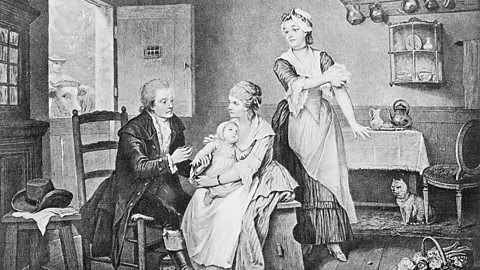
In the late 18th century, Edward Jenner, a doctor in Gloucester, observed that the local dairy maids, and other people who worked with cows, seemed to be immune from smallpox.
He believed that people who had caught a disease called cowpox seemed to have immunity. He carried out a series of experiments to test his idea.
He inoculated a boy called James Phipps with cowpox. When Jenner was sure that the inoculation had worked, he deliberately gave the boy smallpox but the disease had no effect. Jenner had proved his idea.
In 1798, Jenner sent his findings to The leading national organisation for the promotion of scientific research in Britain., but they rejected his work. They were not the only objectors.
- Some people were suspicious of the idea of using cowpox to cure a human disease.
- Doctors were making money out of inoculations and did not want to lose that income.
- Vaccination was seen as dangerous – but this was because doctors often used infected needles.
Instead, Jenner published his findings himself. He called his technique vaccination, from the Latin word for cow, vacca. Parliament was obviously impressed and gave Jenner £30,000 to open a vaccination clinic in London. By 1803, doctors in America were using his idea and in 1805, Napoleon had his soldiers vaccinated.
