The alchemists
Many medieval scholars were interested in alchemy. The main aim of the alchemist was to turn base metals like iron into gold. Some also searched for the elixir of life, a potion which they believed would ward off disease and keep you young forever.
Needless to say, they were unsuccessful, but in the process alchemists did develop new equipment and new technology for extracting chemicals, refining liquids and mixing potions. These became useful in preparing herbal remedies.
Attempts to avoid the Black Death
The Black Death proved a particular challenge to medical professionals, who were unable to explain its cause. There was a whole range of ideas about how to avoid the plague.
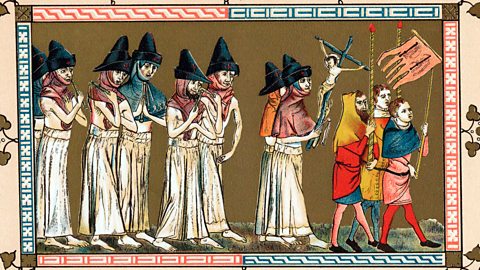
- The Church said that it was a punishment from God. People were told to go in procession to the local church and pray for forgiveness. Some took this advice to extremes and became flagellants.
- Some thought keeping all doors and shutters closed and lighting fires would keep miasmas away.
- Some doctors told patients not to bathe, as this would open the pores and allow the disease in.
- Some suggested killing cats and dogs as it was thought they spread plague.
- In London, Edward III ordered the streets to be cleaned of filth, stating that the smell spread the plague.
None of these, of course, was able to prevent the spread of plague.
The early modern era saw very little progress in prevention of disease. Though people like Vesalius and Harvey adopted a more scientific approach to medicine, their discoveries had no impact on Measures taken to prevent disease, rather than try to treat it after the patient has been affected..
In 1683, Anton van Leeuwenhoek built a microscope, with 200 times magnification. Through it he saw tiny creatures which he called animalcules. He had discovered bacteria.
However, neither he nor anyone else realised their significance, or that they caused disease. It would be another 200 years before the science of bacteriology would produce the vaccines that would prevent death from killer diseases.
