Ecotourism
Features
Tourism which aims to be environmentally friendly. is a form of Activities that are not damaging to the natural environment. tourism which involves people visiting fragile, unspoilt areas that are usually protected. Ecotourism is designed to be low impact and small scale.
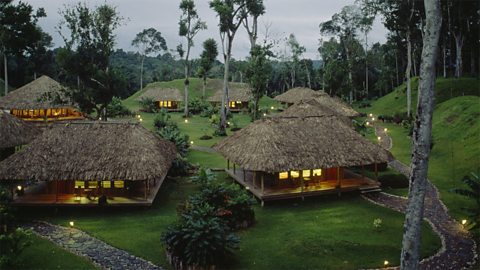
Tourist facilities are made to blend-in with the natural environment, food is sourced locally and waste is usually managed on-site. The numbers of tourists allowed are low to ensure minimal disturbance to the environment, but this increases the cost of trips for visitors.
The main concept of ecotourism is The ability to keep something going over time without harming people or the environment. to enable future generations to experience places which have been relatively untouched by humans.
Ecotourism is quickly becoming an important industry for many A country that has little industry and lacks access to healthcare or education. to bring in Money earned from visitors. while at the same time, preserving some of their most fragile environments.
This can be achieved by some countries preserving their rainforests, as People who travel to remote places to see unspoilt environments. pay to see a country's natural beauty, not the destruction caused by the When the natural environment is destroyed for its natural resources, eg deforestation as a result of cutting timber. of natural resources.
Ecotourism activities should:
- Cause minimal impact on the environment and local people.
- Build environmental and When people are aware of the ideas, customs and social behaviour of another society. and respect.
- Provide positive experiences for both visitors and hosts.
- Provide direct financial benefits for conservation and sustainability.
- Provide economic benefits and When people have the ability to do something. local people, as ecotourism should be managed by locals.
- Increase visitors' understanding of the country's political, environmental and social circumstances.
- Encourage Taking responsibility for looking after and caring for something on behalf of another person. and conservation of the natural environment.
- Respect local traditions, eg dressing appropriately so as not to cause offence, especially in religious buildings.
Causes of/reasons for ecotourism
- Developing countries now want to conserve their fragile environments and view ecotourism as a significant method of generating income.
- Developed countries want to help developing countries conserve their fragile environments by promoting A type of holiday that doesn't cause harm to people or the environment..
- Tourists want to experience a visit to unspoilt environments.
- Many travellers are bored with run-of-the-mill package holidays and want to try something different.
- Tourists are now more environmentally conscious and want to help conserve fragile environments for future generations.
Positive impact of ecotourism on people
- Ecotourism can provide local people with employment opportunities, eg A person who works to protect the natural environment., cooks and cleaners in lodges. This employment provides an income which is often higher than they would receive from selling their crops.
- Education is improved as locals are trained as People who know the local area and offer guided tours., improving their family's standard of living and lifestyle.
- Local communities can earn extra income from the creation of Locally made products that are sold to tourists to generate income. which they can sell to tourists.
- Ecotourism fosters respect for local cultures and the environment and increases the awareness of conservation.
- Teachers who have taken part in ecotourism trips can teach young people to realise the importance of the principles and practices of ecotourism, promoting cultural understanding and environmental awareness.
Negative impact of ecotourism on people
- Locals can be exploited in various ways, such as using them for cheap labour.
- Local people lose their The behaviour, habits, ideas and customs that are typical of a particular society. as they become accustomed to 'Western' cultures.
- Some locals are used as attractions to enable tourists to get traditional photos of Local people who live in a place..
- Many companies who run ecotourism trips profit most, while local people earn very little money.
- Infrastructure is often only beneficial to tourists, eg airports as local people cannot afford to use it.
Positive impact of ecotourism on the environment
- Money spent directly in the local economy helps give financial value to rainforest When an area is conserved to ensure it remains unchanged..
- The government and local communities can see the importance of ensuring the rainforest is unspoiled.
- Most tourists are willing to pay for conservation through donations, park entrance fees and tips for People who know the local area and offer guided tours of areas..
- Ecotourism can reduce the need to hunt animals for income.
- With ecotourism, income is earned from preserving the rainforest - The cutting down of trees and forests to allow a different land use. is discouraged, as it is detrimental to income from tourists.
- Money from tourists goes back into the conservation of the area.
Negative impact of ecotourism on the environment
- Ecotourism is now a large industry and there are not enough regulations to control how it is operated.
- The destruction of local resources to make room for ecotourism is a problem, eg trees felled to make Houses that are built out of natural resources for tourists to stay in. for tourists.
- Natural resources are destroyed to make Objects that tourists buy to remind them of a holiday..
- Plants and animals that are very precious as there as so few of them. are hunted down to use as Natural environments or man-made structures that attract visitors..
- Destruction of natural features, eg overused tracks lead to When earth is washed or blown away. and damage to vegetation.
- There is a real danger of some areas becoming overused.
- Tourist hotels sometimes dump waste into rivers causing water pollution.
