Friction
Friction is a force which always acts to oppose the motion of an object.
Friction always acts to stop an object from starting to move, or to slow down a moving object.
It can be a help or a hinderance.
Helpful frictional forces
Friction can be useful. For example:
- friction between our shoes and the floor stop us from slipping;
- friction between tyres and the road stop cars from skidding;
- friction between the brakes and wheel help bikes and cars to slow down.
Frictional forces are much smaller on smooth surfaces than on rough surfaces, which is why we slide on ice but not on concrete.
Unhelpful frictional forces
Friction can also be unhelpful.
If you do not lubricate your bike regularly with oil, the friction in the chain and axles increases.
Your bike will be noisy and difficult to pedal.
When there is a lot of friction between moving parts, energy is transferred to the surroundings, causing heating.
Think of what happens when you rub your hands together quickly.
The friction warms them up.
Air resistance
Friction caused by air is called air resistance or drag.
Bikes, cars and other moving objects experience air resistance as they move.
Air resistance is caused by the frictional forces of the air against the vehicle.
The faster the vehicle moves, the bigger the air resistance becomes.
The top speed of a vehicle is reached when the force from the cyclist or engine is balanced (equal in size, opposite in direction) by air resistance.
Streamlining
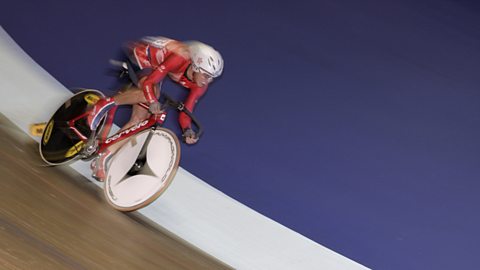
Racing cyclists crouch down low on their bikes to reduce the air resistance on them.
This helps them to cycle faster.
They also wear streamlined helmets.
These have special, smooth shapes that allow the air to flow over the cyclist more easily.
Modern vehicles are also streamlined. Their smooth shapes make the air resistance smaller, which allows them to travel further on the same amount of fuel.
Ways of increasing friction
- Grit on icy roads.
- Tread on car tyres.
- Anti-skid high friction road surfacing increases skid resistance and reduces braking distance. Typical locations for high friction surfacing include road junctions, approaches to traffic lights, pedestrian crossings and roundabouts.
- Grooves on the soles of shoes.
- Gymnasts apply powdered chalk to their hands or grips so that they do not slip.
- Studs on football boots.
Ways of reducing friction
| Method | How it helps | Example |
| Lubricate with oil or grease | Makes the surfaces smoother | Bicycle chain, frying pan, baking tray |
| Polishing | Makes the surfaces smoother | Bowling alley, ice in front of a curling stone |
| Reduce surface area | Reducing the area of contact between the surfaces | Rolling instead of sliding using ball bearings or wheels, ice skates |
| Streamlining | Smooth shape allows air to flow around an object more easily | Crouched racing cyclist, smooth, tapered helmet, high speed racing cars, jet aircraft |
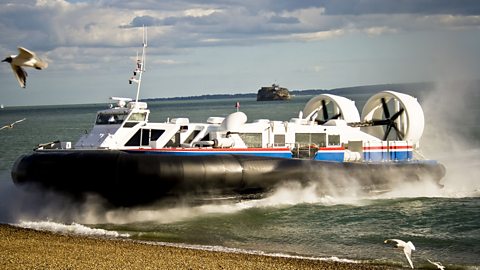
| Cushion of air between surfaces | Separates the surfaces | Hovercraft, air track, air hockey |
| Method | Lubricate with oil or grease |
|---|---|
| How it helps | Makes the surfaces smoother |
| Example | Bicycle chain, frying pan, baking tray |
| Method | Polishing |
|---|---|
| How it helps | Makes the surfaces smoother |
| Example | Bowling alley, ice in front of a curling stone |
| Method | Reduce surface area |
|---|---|
| How it helps | Reducing the area of contact between the surfaces |
| Example | Rolling instead of sliding using ball bearings or wheels, ice skates |
| Method | Streamlining |
|---|---|
| How it helps | Smooth shape allows air to flow around an object more easily |
| Example | Crouched racing cyclist, smooth, tapered helmet, high speed racing cars, jet aircraft |
| Method | Cushion of air between surfaces |
|---|---|
| How it helps | Separates the surfaces |
| Example | Hovercraft, air track, air hockey |
Balanced and unbalanced forces
Balanced and unbalanced forces are explained
