Higher tier: Reducing reliance on fossil fuels in transport
Regenerative braking and hybrid systems
Regenerative braking is a way of taking the wasted energy from the process of slowing down a car and using it to recharge the car’s batteries.
When a car’s brakes are applied on a normal car, the kinetic energy of the car is mainly converted to heat energy, which is then lost to the surroundings.
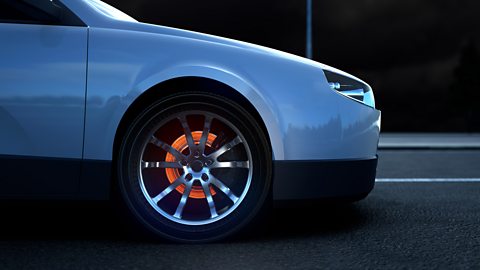
With regenerative braking, some of the kinetic energy is converted to useful electric energy and reused.
For a car without regenerative braking:
Kinetic energy \(\rightarrow\) heat energy + sound energy.
On petrol and diesel cars with regenerative braking, kinetic energy is converted to electrical energy to charge the battery that runs things like the lights, heating, instruments and the radio, meaning less work for the engine and less petrol or diesel burned.
For a car with regenerative braking:
Kinetic energy \(\rightarrow\) electrical energy + heat energy + sound energy.
In hybrid cars (a car with an electric motor and a diesel or petrol engine) and pure electric cars, regenerative braking has a more important role.
In these models, when the brakes are applied, the car’s kinetic energy is converted to electric energy to help charge the larger batteries that directly drive the car.
A hybrid electric vehicle cannot be plugged in to charge the battery.
Instead, the battery is charged through regenerative braking and by cars petrol or diesel engine.
Advantages of hybrid cars
- They reduce the petrol or diesel used which means fewer greenhouse gases emitted and less pollution.
- Reduced dependency on fossil fuels.
- They make good use of the car’s kinetic energy, converting it into electrical energy through regenerative braking.
- Lighter materials are used when building hybrid vehicles, which means they require less energy to run.
Disadvantages of hybrid cars
- Expensive to buy.
- Less powerful because the engine size is small.
- Repair and maintenance of hybrid cars is expensive.
- The batteries used have a limited lifetime and need to be replaced.
- In the event of an accident, the high voltage contained within the batteries could cause death.
Hydrogen fuel cells
Hydrogen is one of the earth’s most abundant elements.
Hydrogen fuel cells can be used in vehicles in a similar way to batteries, but unlike batteries they do not run down or need recharging.
Hydrogen fuel cells join hydrogen and oxygen together, creating nothing but pure water as exhaust.
Chemical energy stored in the gasses is converted to electrical energy that can drive electric motors or charge batteries.
Chemical energy \(\rightarrow\)electrical energy.
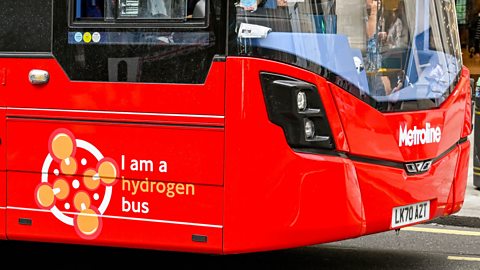
In Northern Ireland, the Ballymena firm Wrightbus designed and produced the world's first hydrogen double-decker bus.
In 2018, hydrogen fuel cell trains began service in Germany, operating between towns in the north and capable of speeds up to 140 km/h (87 MPH).
Hydrogen powered vehicles are expensive to produce because the technology is new.
However, as developments are made costs are expected to fall, meaning they will become more economically viable.
