Female forms
To say the feminine words for jobs in German you usually add -in to the end of the masculine word, eg
- die Dozentin – female lecturer
- die Krankenpflegerin – female nurse, carer
- die Lehrerin – female teacher
- die Moderatorin – female TV presenter
- die Schauspielerin – female actor
- die Schülerin – female pupil
- die Sportlerin – sportswoman
Question
Listen to the following jobs. What are the female forms?
Klempner– plumber
Mechaniker– mechanic
Manager– manager
Konditormeister– master cake-maker
Briefträger– postman
Jurist– lawyer
Landwirt– farmer
Female forms
Klempnerin– plumber
Mechanikerin– mechanic
Managerin– manager
Konditormeisterin– master cake-maker
Briefträgerin– postwoman
Juristin– lawyer
Landwirtin– farmer
Other feminine forms
Some jobs denoting the female form do not follow the pattern of simply adding -in to the ending of the masculine form.
For example, der Arzt (male doctor) is masculine but becomes die Ärztin to describe a female doctor. An umlaut needs to be added to the vowel. Another example is der Bauer (male farmer), but a female farmer is die Bäuerin.
As Zahn means tooth, a dentist in German is described as a 'tooth doctor' – Zahnarzt. So a female dentist is Zahnärztin.
Here are some other jobs which have different feminine forms from those that add -in at the end.
Krankenpfleger– male nurse
Krankenschwester – female nurse
Kaufmann– businessman
Kauffrau– businesswoman
Friseur– male hairdresser
Friseuse– female hairdresser
Feuerwehrmann– fireman
Feuerwehrfrau– firewoman
Question
Sometimes you can guess what words mean even when they are new to you by using your knowledge of other words and clues to help.
Listen and match the jobs with the images. Then check your answers.
Ich bin Kellner.
Ich bin Zahnarzt.
Ich bin Verkäufer.
Ich bin Kassiererin.
Ich bin Programmierer.
Ich bin Elektriker.
Ich bin Gärtnerin.
Ich bin Polizistin.
- Ich bin Kellner. – E. I’m a waiter.
- Ich bin Zahnarzt. – C. I’m a dentist.
- Ich bin Verkäufer. – F. I’m a shop assistant.
- Ich bin Kassiererin. – A. I’m a (female) cashier/I work at the checkout.
- Ich bin Programmierer. – B. I'm a computer programmer.
- Ich bin Elektriker. – G. I’m an electrician.
- Ich bin Gärtnerin. – D. I’m a (female) gardener.
- Ich bin Polizistin. – H. I'm a policewoman.
Did you know?
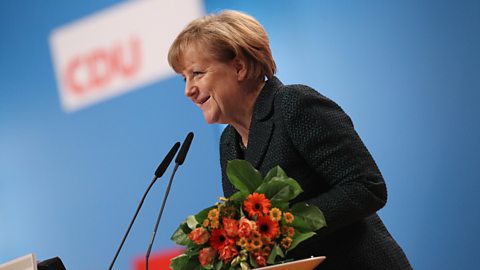
Women in Germany have succeeded in making a name for themselves in politics.
The two main parties are the left wing SPD – Sozialdemokratische Partei Deutschlands and the right wing CDU – Christlich Demokratische Union Deutschlands. Both have a high percentage of female members.
In 2000, Angela Merkel became the first woman leader of the CDU party. In 2005, she became the first female Chancellor of Germany – die Bundeskanzlerin. The job is similar to that of a prime minister or first minister in the UK.
From 2016 onwards, some of Europe's largest businesses are required by law to appoint 30 per cent of women to supervisory posts in Germany.