DJs
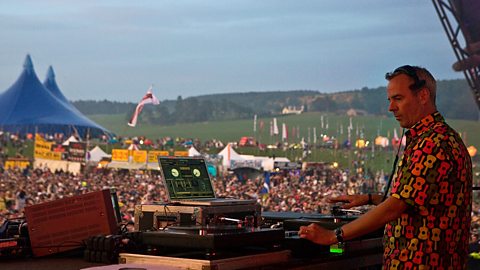
Fatboy Slim headlining at the RockNess festival
Dance music DJs use different ways to manipulate the sound of recordings, adding their own creative element to the music they play. Originally DJs used vinyl records, but today many use CD decks, laptops and software packages to mix tracks, loop sections and create new compositions live.
DJ techniques include:
- Mixing - when records are mixed together.
- Beatmatching - changing the speed at which a record is played so that its tempo matches that of the song currently playing.
- Breakbeatism - two decks are required to spin the same record, which has some sort of percussion interlude or break. Once the break is played on deck 1, the DJ switches quickly to deck 2, where the break has already been set up. The process can be repeated, switching between decks, so that the original break can be extended indefinitely. You can hear an example here:
Afrika Bambaataa - 'Planet Rock'
- Cueing - finding a suitable point on a record to mix in.
- Blending - when a DJ uses the equaliser to create a more seamless-sounding mix.
- Pitch shifting - changing the speed of the record.
- Scratching - moving a vinyl record back and forth, using different cross A slider control on an electronic device for raising or lowering volume levels. techniques to cut sound in and out. You can hear an example here:
Grand Wizzard Theodore - 'Fantastic Freaks at the Dixie'
- Beat juggling - the act of manipulating two or more Short digital recording used in the context of a piece of music. in order to create a unique composition.
- Looping - when a digital sampler is used to repeat a sample over and over again. Listen to the second verse of Bring the Noise by Public Enemy. Notice the use of rapping and the James Brown Funky Drummer sample with added programmed double-bass drums.
Public Enemy - 'Bring the Noise'
