Punishments - fines, physical punishments and humiliation
The main view in the early modern period was that punishment should be as public as possible in order to act as a A thing that discourages or is intended to discourage someone from doing something. Many of the punishments used had existed during the medieval period. However, their use became much more common after 1500, particularly as crimes such as Wandering from place to place with no job or fixed home. increased.
Fines
Fines were the most common form of punishment. The A medieval manor was the land owned by a local lord courts, petty sessions and quarter sessions all frequently issued fines to those found guilty of a crime.
Shaming in church
For offences like having sex outside marriage, the guilty person was made to stand up in front of the church congregation and publicly confess their sins.
The pillory and stocks
The pillory
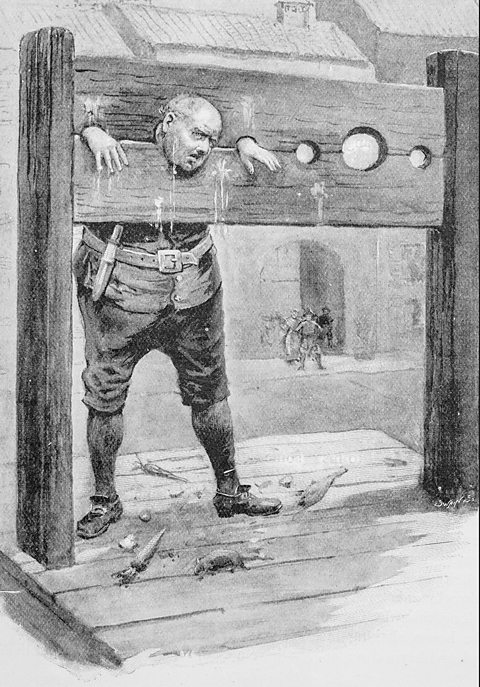
The pillory had more widespread use in this period as a punishment for:
- unfair traders
- cheating at card games
- sexual offences
The guilty person was often attacked while they stood in the pillory. People might throw rotten vegetables or excrement, or even stones. Some offenders were forced to endure further physical punishment while in the pillory, such as having their ears sliced or being branded with a hot iron.
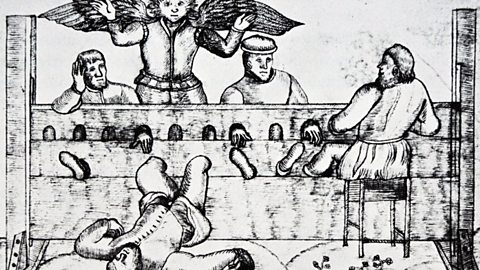
The stocks
The stocks were mainly used for people who could not afford to pay fines. Though this was a less harsh punishment than the pillory, people might be left in the stocks for days, completely exposed to the weather. The stocks were deliberately placed in public places where the offenders could be kicked, insulted or spat at.
Cucking and ducking stools
Cucking and ducking stools were mainly used against women who were accused of scolding - using abusive speech in public - or disobeying their husbands. However, the cucking stool was sometimes used to punish dishonest tradesmen as well.
Cucking stools
As in the medieval period, the cucking stool was a kind of wooden chair or toilet. The offender was strapped in and then dragged around the village.
Ducking stools
This was a much harsher punishment. The guilty person was strapped to a wooden chair that was fixed to the end of an iron beam. The chair was then repeatedly lowered into a local river or pond. Some people who underwent this punishment drowned.
The scold’s bridle
The scold’s bridle was another punishment for scolds - people, often women, accused of quarrelling, gossiping, nagging or causing a nuisance. A heavy iron frame or muzzle was placed over the offender’s head. The frame contained a spike, which was designed to press down on the tongue to prevent her from speaking. It was very painful as well as humiliating, as the wearer was led through the town or village.
Whipping and branding
Homeless, unemployed person who wandered the streets. (also known as vagabonds), people who were drunk and people who misbehaved in church could be whipped or Marking a person’s skin with a hot iron. Vagrants were branded with a letter V for example. This was usually done on market day in the most public place possible.
The use of whipping and branding as punishments increased with the number of vagrants. A law was passed in 1572 which said that all vagrants over 14 years of age should be whipped and burned through the ear with a hot iron.
Carting
Carting was also used to punish vagrancy as well as Sexual intercourse between a married person and another person who is not their spouse. or running a A place where men visit prostitutes. The offender was paraded around the streets in a cart for everyone to look at.
