Ecological and social footprint
When considering the ecological and social implications of using timber, the term The cutting down of trees and forests to allow a different land use. is often used. Deforestation is when a Removing or cutting down. is made by chopping down trees. If more trees are planted than are cut, it is possible to minimise the impact. It is possible to manage deforestation through responsible management of the forests.
Supply and demand can cause issues for forest management. If the customer demands more timber because of an increase in purchasing, a forest management organisation could struggle as trees will take time to mature.
Alternative boards made from recycled timber are available.
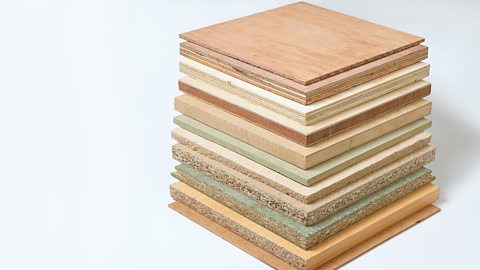
Plywood, MDF, chipboard and blockboard can all be made from timber that has once been used. These Used materials that have been reprocessed to make new materials. materials are made by gluing pieces of timber or fibres of timber together - the gluing process makes it very difficult to recycle the timber a second time around. MDF cannot be recycled and often ends up in a landfill site when it has reached the end of its life.
Whenever environmental impact is to be reduced, the term ‘the 6 Rs’ can always be called upon to ensure an in-depth analysis has been done. The 6 Rs can be considered by the designer, the A person or company that makes something from raw materials or from an assembly of component parts. and the In business, a consumer is a person who uses a product and may also buy it. to reduce that negative impact on the environment.
Considering the 6 Rs when designing food packaging
The 6 Rs
The 6 Rs are a set of principles to promote sustainable waste management or consumption. The term ‘the 6 Rs’ can be applied to the design of new products or when a product is finished with, used up or no longer wanted.
Here are some questions to prompt 6 Rs thinking:
- To make decisions that decrease the amount of waste produced - one of the 6 Rs. - Can the amount of timber used be reduced? Can the timber be bought locally to reduce product miles?
- To use a product again rather than replacing with a new one - one of the 6 Rs. - Can the timber be reused for another purpose once a product is finished with?
- To break down and process so a new material is produced - one of the 6 Rs. - Can the timber be disposed of correctly so that it can be recycled to produce another material like chipboard or MDF?
- To change the design of a product to be more environmentally friendly - one of the 6 Rs. - Can the way a product is made be redesigned so that less timber is used?
- To avoid using a product to save on waste - one of the 6 Rs. - Refusing to use hardwood can be a consideration; could a wood stain be used on softwood instead?
- To fix a broken product - one of the 6 Rs. - When a product is broken, can it be repaired rather than discarded?
