The instruments and rhythms of Africa
The instruments of Africa
African drums are usually made from wood, metal or clay and come in different sizes. If the drum has a large body, it will produce a lower pitch and if the The skin placed on top of the wooden body of a drum and pulled taut. has a tight tension, a high The frequency of a sound. Sounds with a high pitch have a high frequency. will be produced. The player will strike the drum with their hands, sticks or both. Drums are highly decorated with carvings or beadwork because they are treasured assets within African communities. Added beads or rattles can change the The tonal quality or sound of an instrument that distinguishes it from others. of the drum.
A percussionist explains the playing techniques of some of the traditional instruments of Africa
Djembe

One of the best-known African drums is the West African djembe. It is shaped like a large goblet and played with bare hands. The body is carved from a hollowed trunk and is covered in goat skin.
An audio clip of the djembe
Talking drum

The talking drum is a West African instrument that has drum skins on both the top and bottom of its body. It is played with a beater and the performer is able to squeeze the drum’s tension chords, which changes the pitch of the drum, imitating a human voice.
Talking drums
Dundun
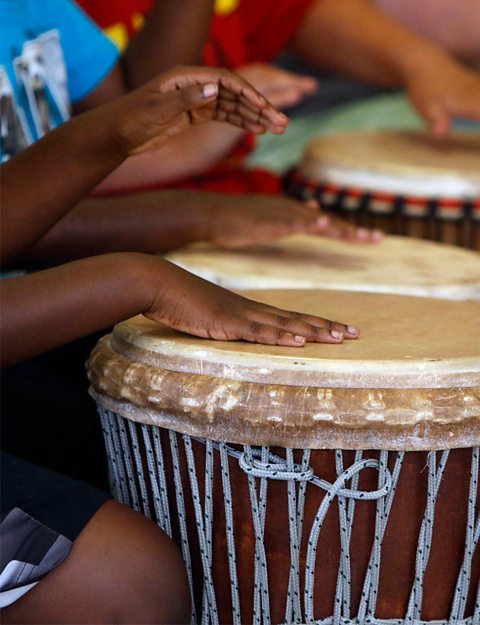
Often played in groups, a dundun is made of cow skin and is played on the floor and with a beater-stick. It is often played as the bass drum in the ensemble. Dunduns are double-headed and belong to the family of hourglass-shaped pressure drums. The pitch of the note is changed by squeezing or releasing the drum's strings with the arm.
Timelines
In this extract, a The repeating ostinato heard in African music, which acts as a pulse to hold the piece together. is being played on a single bell. This short repeating rhythm - or A repeated melodic or rhythmic pattern. In film music an ostinato can create energy, excitement or tension. - acts as the pulse and holds the piece together. The talking drum heard in the extract is playing the other rhythm. During the extract, the placing of this rhythm changes to conflict with the timeline rhythm, creating a An effect created when two or more conflicting rhythms are heard at the same time. Eg one may be in simple time and another in triple time..
An example of a timeline
