The folk dances of the Middle East
The music of the Middle East has been influenced by many different religions and cultures. As well as the religious influences of Judaism, Christianity, Islam and Druze, there are traces of Russian and Egyptian musical influence too.
Maqam modes
Both the Traditional music from a particular country. of Israel and Palestine in the Middle East have strong The voice as a musical instrument. melodies passed down through Music that is taught by aurally communicating the techniques rather than written formally in a score.. The melodies found in Interval which is smaller than a semi-tone. vocal music are based on a Arabic modal scale. system of A sequence of notes that have varying intervals between each degree of the sequence. , or scales. Many of modes and scales contain Interval which is smaller than a semi-tone. , which differ from the The gap between two adjacent or simultaneously sounded notes. found in Western music. The music often has an An uneven number of beats appear in the time signature resulting in unequal groupings of beats, eg 7/8 would have groups of 3-2-2..
Traditional instruments
The most common traditional instruments are:
- doumbek
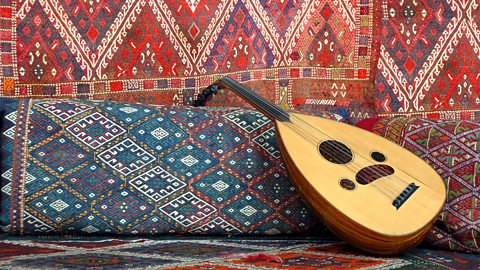
- oud
- harp-lyre
- clarinet
- accordion
- flute
The doumbek is a goblet shaped drum similar to the African djembe. It has three different tones and is played with the fingertips. The rhythmic pattern in Arabic music is called the Repeated rhythm found in Middle Eastern music., and there are hundreds of them in different time signatures. The The basic 4/4 rhythm in Middle Eastern music. is a basic Arabic rhythm seen below.
