Commercial processes
When a product is going to be When the same product is manufactured many times., it can cost a A person or company that makes something from raw materials or from an assembly of component parts. less money in the long term to invest in specialist equipment and processes, as these will ensure a higher quality product and a quicker production process.
Pick and place assembly
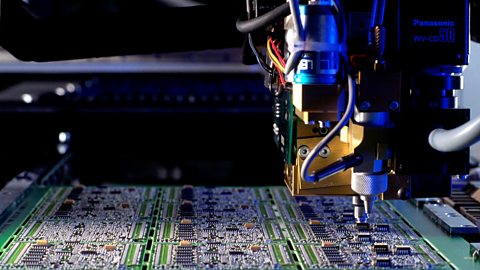
A robotic machine that is programmed to pick and place electrical components so they can be placed in the correct place on a circuit board. is when A part that when put together makes a product. are picked up and placed on a circuit board automatically by robots, with suction cups used to pick up and arrange components in the right place on a A copper sheet used to attach electrical components. . It is used in the production of printed circuit boards (PCBs) in electrical systems. Although buying the machines and programming them is expensive and time-consuming, their performance is quick and accurate, and it is also cost-effective when mass producing a circuit.
Manual assembly
Manual assembly of components can be fiddly and time-consuming, as components are small and take longer to fit into place when done by hand. This assembly method is used mainly for circuits made up of components that are fitted with The pins on an integrated circuit appear in two rows and are manufactured as dual in line (DIL) packages. through a circuit board. This is a costly and slow method of production, more suitable for specialist production of small numbers of electronics such as for TVs, radios and alarms.
Flow soldering
A solder paste is used to fix components in place until heated. The solder will only attach to an electrical pad because the rest of the board will be covered in lacquer. is a technique used to attach components to a circuit board quickly, without the need for human input. This improves accuracy and speed and reduces the amount of solder used. To allow components to be added to several circuit boards in a row, Components that can be soldered directly to a board rather than having to be pushed through a hole. is used. This allows connections to be made easily while taking up as little room as possible. Once the SMT components are placed on the PCB with pre-soldered pasted pads, they are put into a precisely controlled oven where the solder melts into the correct positions and creates an accurate connection.
Wave soldering
A molten flow of solder is used to fix components in place. The solder will only attach to an electrical pad because the rest of the board will be covered in lacquer. is used in the mass production of PCBs as it is a fast, efficient and accurate way of soldering PCBs. Components are placed into a PCB by their pins through pre-drilled holes and put on a Used on a production line to move items along. - this takes the boards through a series of stages:
- Chemical used to improve the flow of solder. is added to the underside board to help the flow of solder
- it is then heated up and passed over a wave of solder
- the solder covers the pins under the PCB and creates a bond once cooled
