Attempts to improve welfare under President Johnson
Lyndon B Johnson had been a One of two officials elected every six years to represent an American state in the Senate. for Texas before he became John F Kennedy’s vice president in 1961. He was more experienced than Kennedy in getting laws passed through The legislative body of the US government, made up of the Senate and the House of Representatives. Additionally, as a Political party in the United States. Democrats tend to hold a more liberal viewpoint on politics and society. from the South, he had a better idea of how to deal with opposition to Rights everyone is entitled to regardless of the colour of their skin, their beliefs, sexuality, gender or other personal characteristics. These rights could include the right to vote, or the right to a good education etc. legislation. When Kennedy was Murder for religious or political reasons. in 1963, Johnson took over as president, and he was re-elected in 1964. He is most well known for increasing America’s involvement in the A war between communist North Vietnam and non-communist South Vietnam for control of the whole of Vietnam; the USA sent American troops to protect South Vietnam. His efforts to continue Kennedy’s reforms are less well remembered.
The Great Society programme
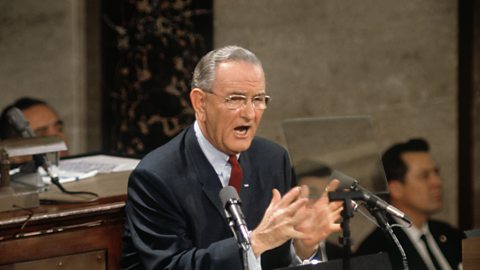
Johnson continued Kennedy’s programme to end A state in which someone is poor, either relatively or absolutely. He used the term Social reforms promoted by President Lyndon B Johnson to create a country in which living standards were high and the feeling of living in a community. to describe what he wanted to achieve through his reforms: a free, equal and Being successful or thriving, particularly with regard to finance. society. This meant trying to help the poor, the elderly, the sick and black Americans - anyone who was struggling or being To treat someone differently or unfairly because they belong to a particular group. against.
There is ongoing debate about how successful Johnson’s ‘war on poverty’ was. The proportion of people living in poverty in America was reduced from roughly 19 per cent in 1964 to around 11 per cent in 1973. However, the largest drop in the number of people living in poverty had actually happened in the five years before this.
The Great Society rests on abundance and liberty for all. It demands an end to poverty and racial injustice, to which we are totally committed in our time.
Medicare and Medicaid
In 1965, President Johnson signed the A programme, created in 1965, which uses federal government funds to provide basic healthcare to people aged 65 or older. Since 1973, some disabled people have also been entitled to Medicare. Law, as part of the Social Security Act Amendments. This introduced Medicare which provided basic hospital and medical Bought protection against unfortunate events that may cost money, eg car insurance is paid so that damage is paid for in the event of an accident. for people aged 65 and older. More than half of elderly people could not afford to buy their own health care insurance, and they were more likely to need expensive medical treatment than younger people.
Medicare helped to Removal of laws that separate people from different races in public places and day-to-day life. medical treatment as the Part of the government of the USA as a whole rather than relating to an individual state. government would not pay claims made by This meant that white people and black people had to live separately. The areas of society affected by segregation included churches, hospitals, theatres and schools. health care providers. The programme cost $10 billion to set up and around 19 million people signed up for it in its first year. In 1972, the scheme was expanded to include disabled people who were younger than 65.
The 1965 Social Security Amendments also introduced A joint federal and state program that helps cover medical costs for people who are unable to afford health insurance. to help provide health care for people who were unable to pay for healthcare insurance themselves. The federal government would provide half of the money required and the rest would come from individual states. However, how the scheme was run would vary from state to state.
Some elderly people and disabled people were able to claim support from both Medicare and Medicaid.
More guides on this topic
- Anti-Communism c.1945-1954 - Cambridge OCR A
- African Americans c.1945-1954 - Cambridge OCR A
- Civil rights in the USA 1954-1964 - Cambridge OCR A
- Broadening of the campaigns for civil rights - Race - Cambridge OCR A
- Broadening of the campaigns for civil rights - Women's rights - OCR A
- Broadening of the campaigns for civil rights - Gay rights - OCR A
- Politics and protest - Cambridge OCR A
