Ethical and ritual mitzvot
The Commandments or laws in Judaism. can be divided up according to their purpose:
- Ritual mitzvot explain what Jews should or should not do to avoid offending God. They cover areas such as worship and festivals. These mitzvot form a personal An agreement or promise. between a Jewish person and God. The first four of the The list of rules, revealed by God to Moses, found in the Old Testament books of Exodus and Deuteronomy. Also known as the Decalogue. (the Decalogue) are the most important of the ritual mitzvot.
- Ethical mitzvot explain how Jews should act when dealing with other people. They help Jews to live as a community in a way that God finds acceptable. The Ten Commandments are important mitzvot as they are the basis for moral behaviour. Some laws are judgements from God, for example
you shall not steal.
Fix these words of mine in your hearts and minds; tie them as symbols on your hands and bind them on your foreheads. Teach them to your children, talking about them when you sit at home and when you walk along the road, when you lie down and when you get up. Write them on the door-frames of your houses and on your gates, so that your days and the days of your children may be many in the land that the Lord swore to give your ancestors, as many as the days that the heavens are above the earth.
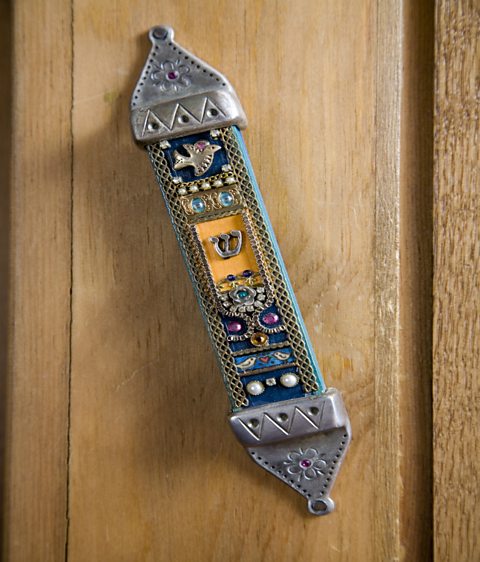
Some Jews fix a mezuzah to the door frame of their houses to fulfil this mitzvah
The Lord said to Moses, ‘Speak to the Israelites and say to them: “Throughout the generations to come you are to make tassels on the corners of your garments, with a blue cord on each tassel. You will have these tassels to look at and so you will remember all the commands of the Lord, that you may obey them and not prostitute yourselves by chasing after the lusts of your own hearts and eyes. Then you will remember to obey all my commands and will be consecrated to your God. I am the Lord your God, who brought you out of Egypt to be your God. I am the Lord your God.”’
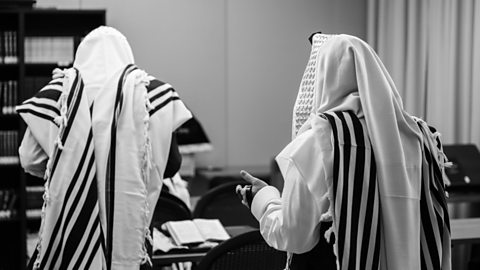
When they are praying, Jewish men (and sometimes women) wear a shawl with tassels called a tallit to fulfil this mitzvah
Question
Which mitzvot concern humans’ relationships with other people?
Ethical mitzvot.
