Compositional movement
Compositional movement refers to how the eye moves around a piece.
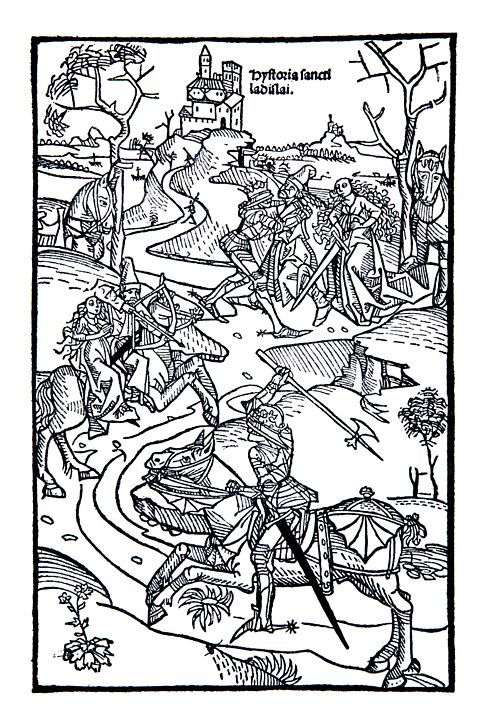
This woodblock is an illustration from Chronica Hungarae, a fifteenth century German chronicle of the Kingdom of Hungary.
The viewer's eye is drawn along the path that winds through the illustration. Following the path leads the viewer through a story of a chase on horseback that results in a fight.
Our eyes continue to follow the path to the castle at the top of the frame and the title 'Hystoria Sancti Ladislai' (History of Saint Ladislas).
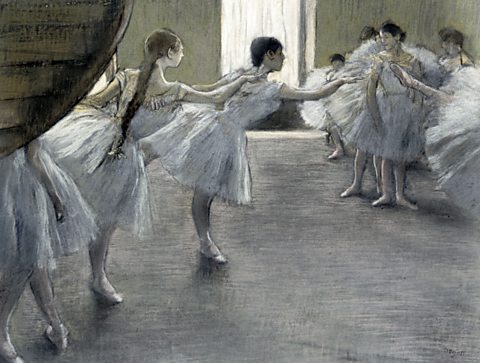
In Dancers at Rehearsal (1875-77), Edgar Degas has arranged a line of ballerinas to create compositional movement.
Their posture leads our eyes to the top right of the frame. Here an upright dancer is standing motionless, framed by the circle of her tutu and a small group of dancers around her.
Our eyes tend to stop at this area of stillness in the composition.
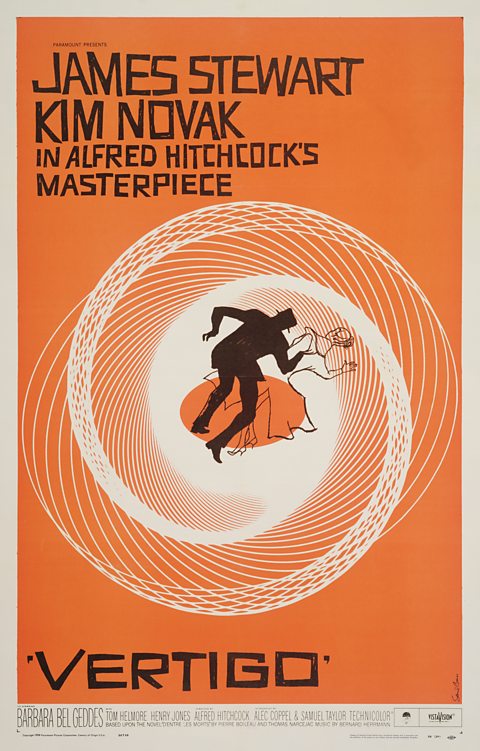
Movement can also be shown very clearly in a graphic style. In this poster for the movie Vertigo, Saul Bass has used white spiral geometric patterns. These confuse the eye, partly leading it into the centre of the spiral, partly taking the viewer out to the edges.
The spiral suggests that the two central figures on the poster are falling from a great height or spiralling round as though they are dizzy or disorientated.
Bass uses a simple, but striking colour scheme. The red background stands out and draws the viewer’s eye, whilst the simple silhouettes of the two figures allow you to focus on the detail of the intricate spiral.
