Representing physical movement
When a piece does not actually move, physical movement can be represented through a range of techniques
Frozen moments
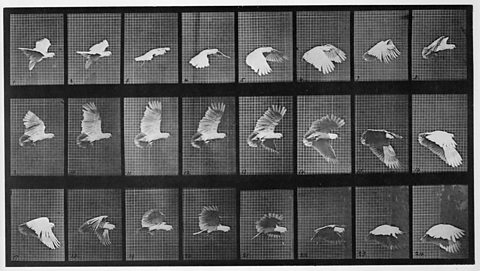
Eadweard Muybridge used a series of cameras to take multiple exposures of animals and people in motion. The resulting photographs capture his subjects’ changing positions in sharp focus and clear detail. Together they create an effective sense of movement, like a series of images from a stop-frame animation.
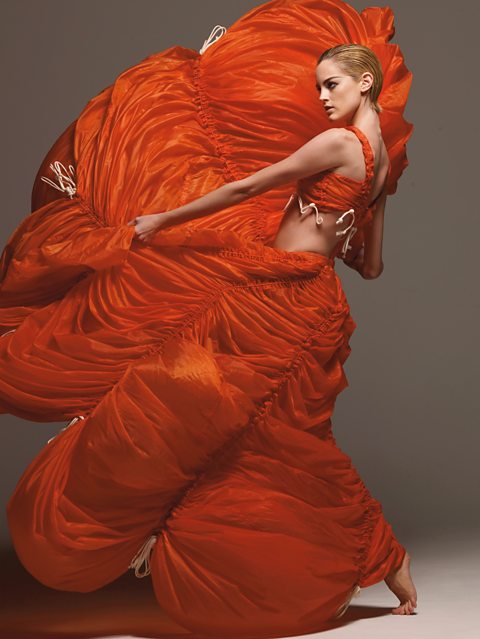
This fashion photograph of a skirt and bustier by Norma Kamali (c.1974) has been taken using a fast The length of time a camera's shutter is open, and therefore the time the photographic film or sensor is exposed to light. . This freezes the shot perfectly without any blurring.
The model is shown swirling the dress and the photographer has captured the movement of the material billowing around her.
This creates a dynamic photograph. It allows the dress to fill the frame and shows it off more fully than if the model were standing still with the dress at her feet.
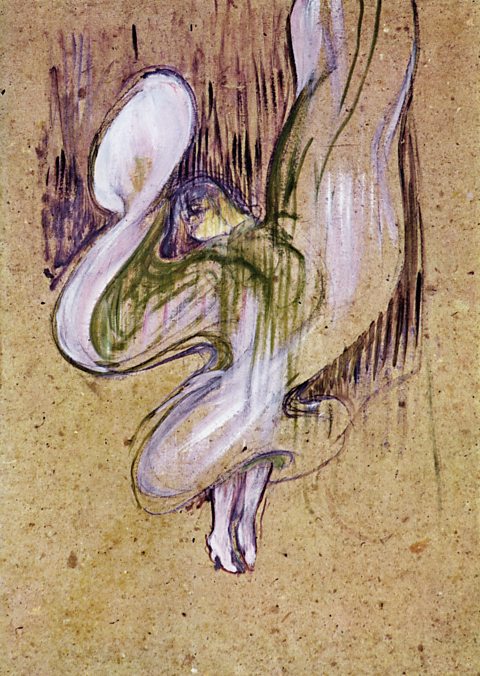
With La Loïe Fuller aux Folies Bergère (1893), Henri De Toulouse-Lautrec has captured a vibrant, dancing scene as if it were a photograph taken with a fast shutter speed.
He has painted the dancer in an active pose, with her arms causing movement in the flowing dress. The position of her skirt suggests that the arm movement has caused it to fan out.
Although she is painted clearly, without expressive lines, Toulouse-Lautrec successfully shows that she was moving before and after this ‘snapshot’ was painted.
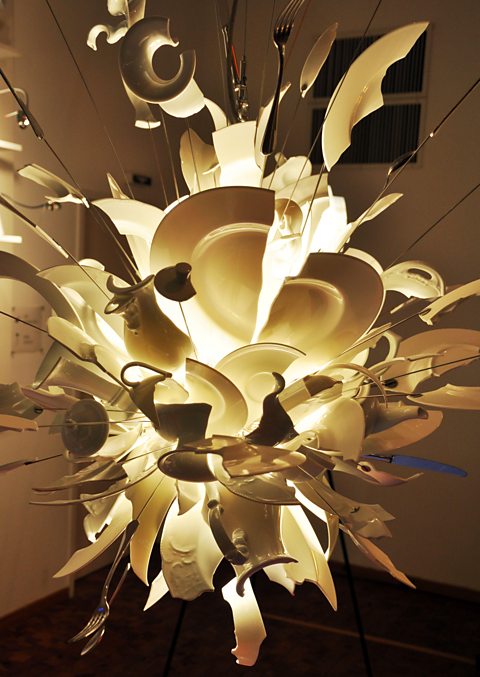
Porca Miseria! (Ingo Maurer, 1994) is a lamp designed to hang above the dining table in a minimalist kitchen.
It is made from broken pieces of crockery and cutlery that are fixed to a metal frame arranged around a central point.
The effect is of a frozen moment in which plates and cups break and fly apart as the result of an explosion.
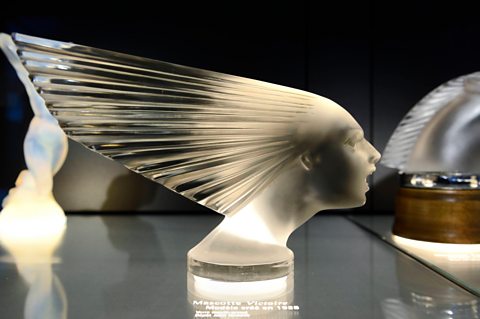
The Victoire ornament for the bonnet of a car by René Lalique is made from glass - a solid, static material. In spite of this, the design and shape of the ornament shows movement.
It has been made in the A design movement from the 1920s and 30s that was inspired by modernism and machinery and which featured simple, stylised, geometric shapes and forms. style, characterised by the simplified, Relating to geometry and featuring straight lines and regular mathematical shapes and forms such as squares, circles, triangles, cubes and spheres. shapes.
The design of the piece looks like the shape of a bird's wing in flight as well as echoing the movement that would be present as the hair blows back as the car moves at speed. The hood ornament would be seen as a status symbol for anyone who bought it, as speed when related to cars usually implies luxury and wealth.
