Festivals
There are many holy days in Judaism, with the most important being The Jewish New Year festival., which is the Jewish New Year, and The Day of Atonement in the Jewish calendar. This is the most sacred and solemn day of the year for Jews., the Day of Atonement.
Rosh Hashanah
The Jewish festival of Rosh Hashanah occurs in September or October, depending on the lunar calendar that is followed by Jews. It is a time for Jews to reflect on their year, including their good deeds and their bad deeds.
The A ram's horn that is blown like a trumpet, especially during Rosh Hashanah and Yom Kippur. is blown to symbolise a call for Remorse for your past actions..
Jews spend time in the Building for Jewish public prayer, study and assembly. with prayers being said and parts of the Law; teaching. The word Torah can be used in a narrow sense to mean the first five books of the Hebrew Bible (The Five Books of Moses) and also in a wider sense to include the whole of the Hebrew Bible and the Talmud. read.
They also eat apples dipped in honey to represent the hope of a sweet new year. Historically, Jews believed that apples have healing powers, and this belief is mentioned in the The ancient language of the Jewish people. The language of the Torah, the Temple and the modern state of Israel. Bible.
It is believed that on Rosh Hashanah God writes names into one of his three books. These are:
- the Book of Life, for those who are wholly good
- the Book of Death, for the truly evil
- an intermediate book, which is where most people’s names are written
Jews believe that they can influence which book God writes their name in if they take action during the festival. People can do charity work or anything they feel will make up for the harm they have caused over the past year.
The Tashlich ceremony takes place during Rosh Hashanah. At this ceremony, sins are cast out (or ‘thrown away’) and people ask for God’s forgiveness.
Yom Kippur
The Day of Atonement in the Jewish calendar. This is the most sacred and solemn day of the year for Jews. is the holiest day of the Jewish calendar. It is also called the Day of Atonement. Jews focus on asking God for forgiveness as it is believed that he will make his final judgement on the day of Yom Kippur sometime in the future.
Atonement shall be made for you to cleanse you of all your sins.
Jews spend a lot of time at the synagogue and undertake a 25-hour fast. They wear white as a symbol of purity and do not bathe, wear leather shoes or have sex.
Pesach
The Jewish festival (Passover) which remembers the redemption of the Israelites from slavery in Egypt. is a festival held in March or April that celebrates the Jews’ escape from slavery in Egypt. It lasts for seven to eight days and begins with the A Jewish ritual meal, held outside Israel on the first and second day of the Passover festival. In Israel it is held on the first day only., which consists of a service and a meal.
Wine is served, as it is at all Jewish festivals, but on Pesach it takes on another meaning as a symbol of the lambs’ blood painted onto the doorposts to save Jewish children from the final of the The ten plagues that God sent to Egypt until the Pharaoh released the Israelites as Moses requested.. Unleavened bread eaten by Jews at Pesach. is eaten to represent the fact that the Jews did not have time to let the bread rise before their escape.
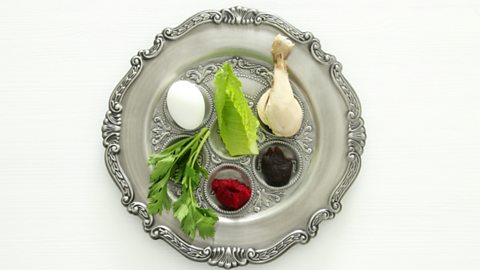
The foods on the Seder plate each symbolise a part of the Exodus story, which is retold during the meal using a book of ritual called the Haggadah. These foods are:
- karpas - a green vegetable dipped in salt water and symbolising both new life and the tears shed by the Jews in slavery
- maror - bitter herbs, symbolising the bitterness of slavery
- baytsah - an egg (not to be eaten) to represent sacrifices in the The central place of Jewish worship in Jerusalem from biblical times until AD70.
- z’roah - a lamb bone (also not eaten) representing the lamb sacrificed before the Exodus
- charoset - a sweet paste to remind Jews that life is sweeter now