Using the prefixes 'da-' and 'dar-'
da-
When you want to use the pronoun ‘it’ with prepositions that begin with a Any letter that is not a vowel. The vowels in German are: a, e, i, o, u, ä, ö, ü
| für - for | dafür - for it |
| hinter - behind | dahinter - behind it |
| von - from | davon - from it |
| durch - through | dadurch - through it |
| mit - with | damit - with it |
| vor - in front of, before | davor - in front of it, before |
| gegen - against | dagegen - against it |
| nach - after | danach - after it |
| zu - at | dazu - at it |
| bei - at, in, at the home of | dabei - at it, in it, at the home of it |
| neben - near to, next to | daneben - near to it, next to it |
| zwischen - between | dazwischen - between it |
| für - for |
| dafür - for it |
| hinter - behind |
| dahinter - behind it |
| von - from |
| davon - from it |
| durch - through |
| dadurch - through it |
| mit - with |
| damit - with it |
| vor - in front of, before |
| davor - in front of it, before |
| gegen - against |
| dagegen - against it |
| nach - after |
| danach - after it |
| zu - at |
| dazu - at it |
| bei - at, in, at the home of |
| dabei - at it, in it, at the home of it |
| neben - near to, next to |
| daneben - near to it, next to it |
| zwischen - between |
| dazwischen - between it |
dar-
When you want to say ‘it’ with prepositions which begin with a vowel, you put the prefix dar- in front of the preposition to make it easier to pronounce:
| an - to, on | daran - to it, on it |
| in - in, into | darin - in it, into it |
| um - round | darum - round it |
| auf - on top of | darauf - on top of it |
| über - over, above | darüber - over it, above it |
| unter - under | darunter - under it |
| an - to, on |
| daran - to it, on it |
| in - in, into |
| darin - in it, into it |
| um - round |
| darum - round it |
| auf - on top of |
| darauf - on top of it |
| über - over, above |
| darüber - over it, above it |
| unter - under |
| darunter - under it |
You do not use da- when talking about a person. You use a personal pronoun.
| für ihn - for him | mit ihm - with him |
| für sie - for her | mit ihr - with her |
| für ihn - for him |
| mit ihm - with him |
| für sie - for her |
| mit ihr - with her |
Question
How would you say these in German?
- in it
- for us
- under it
- against it
- behind him
- on top of it
- in it - darin
- for us - für uns
- under it - darunter
- against it - dagegen
- behind him - hinter ihm
- on top of it - darauf
Did you know?
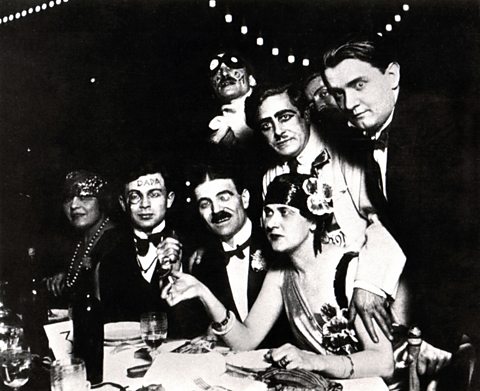
Dada or Dadaism – Dadaismus – was an artistic and literary movement that was founded in Zürich, Switzerland in 1916 as a reaction to the atrocities of World War I. The movement lasted until 1924.
Dada paintings, poetry and performances were often satirical and absurd, often using boring everyday items like maps, water fountains, wrappers and train tickets and calling them art.
One of the founders once described how to make a Dadaist poem – cut out the individual words from a newspaper article, place the words in a bag, then shake it. Once the words are jumbled up, take out each word and copy them out in the order they left the bag.
The influence of Dadaism soon spread to a number of other European countries and also to New York, and became a precursor to the surrealist movement. Unsurprisingly, the name Dadaism is not thought to have any meaning.