The time, manner, place rule - TMP
When several A word that describes a verb (an action or a doing word). are used in the same sentence in German, the sentence becomes more complex and they must appear in this strict order:
German sentences will often seem a bit different from how we would say things in English. In English, for example, we tend to put the place before the time, but in German the time always goes before the place.
Look at the following English sentences:
- I go to school by bus at 08:00.
- I play with my dog in the park every day.
Now look at the difference in word order when the sentences are translated to German. You can see how they follow the time, manner, place (TMP) rule.
If there are two adverbial phrases from the same group in a sentence, they follow the same order as in English, eg:
zweimal – twice
die Woche – week
so:
zweimal die Woche - twice a week
jeden Tag um acht Uhr – every day at 08:00
The verb (main or auxiliary) is still the second idea.
Past participles and infinitives go to the end.
- Wir werden am Dienstag (1) schnell (2) in die Stadt (3) gehen. - We'll quickly go into town on Tuesday.
- Sie kann immer (1) sehr gut (2) singen. - She can always sing well. (No adverb of place in this sentence).
- Ich lese jeden Tag (1) eine halbe Stunde (2) im Bett. (3) - I read in bed for half an hour every day. (No adverb of manner).
Question
Can you identify the time, manner and place phrases in these sentences?
- Wir sehen abends nicht gern Horrorfilme.
- Ich war meistens samstags mit Freunden im Einkaufszentrum.
- Du kannst morgen hoffentlich bei mir übernachten.
- Sie sind letztes Jahr mit uns nach Irland gefahren.
- Wir sehen abends nicht gern Horrorfilme. - We don't like watching horror films in the evening. (Literally: We don't watch horror films gladly).
| Time | Manner | Place |
| abends | nicht gern | no place |
| Time | abends |
|---|---|
| Manner | nicht gern |
| Place | no place |
- Ich war meistens samstags mit Freunden im Einkaufszentrum. - I was usually in the shopping centre with my friends on Saturdays.
| Time | Manner | Place |
| meistens/samstags | mit Freunden | im Einkaufszentrum |
| Time | meistens/samstags |
|---|---|
| Manner | mit Freunden |
| Place | im Einkaufszentrum |
- Du kannst morgen hoffentlich bei mir übernachten. - You can sleep round at my house tomorrow, hopefully.
| Time | Manner | Place |
| morgen | hoffentlich | bei mir |
| Time | morgen |
|---|---|
| Manner | hoffentlich |
| Place | bei mir |
- Sie sind letztes Jahr mit uns nach Irland gefahren. - They went to Ireland with us last year.
| Time | Manner | Place |
| letztes Jahr | mit uns | nach Irland |
| Time | letztes Jahr |
|---|---|
| Manner | mit uns |
| Place | nach Irland |
Question
Place the TMP adverbs in the right place in the sentence.
- Ich frühstücke draußen. (mit meiner Familie; manchmal)
- Sie wird als Sprachassistentin arbeiten. (in Graz; nächstes Jahr)
- Wir spielen Doppelkopf. (einmal im Monat; mit Freunden; normalerweise)
- Er kann nicht kommen. (zur Arbeit; heute; leider)
- Ich frühstücke manchmal mit meiner Familie draußen. - I sometimes have breakfast outside with my family.
| Time | Manner | Place |
| manchmal | mit meiner Familie | draußen |
| Time | manchmal |
|---|---|
| Manner | mit meiner Familie |
| Place | draußen |
- Sie wird nächstes Jahr als Sprachassistentin in Graz arbeiten. - She will work as a foreign language assistant in Graz next year.
| Time | Manner | Place |
| nächstes Jahr | als Sprachassistentin | in Graz |
| Time | nächstes Jahr |
|---|---|
| Manner | als Sprachassistentin |
| Place | in Graz |
- Wir spielen normalerweise einmal im Monat mit Freunden Doppelkopf. - We usually play Doppelkopf once a month with friends.
| Time | Manner | Place |
| normalerweise | mit Freunden | none |
| Time | normalerweise |
|---|---|
| Manner | mit Freunden |
| Place | none |
- Er kann heute leider nicht zur Arbeit kommen. - Unfortunately, he can't come to work today.
| Time | Manner | Place |
| heute | leider | zur Arbeit |
| Time | heute |
|---|---|
| Manner | leider |
| Place | zur Arbeit |
Did you know?
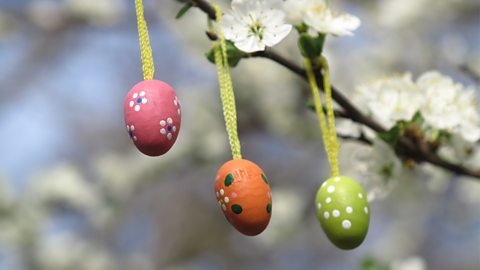
At Easter time, especially in Germany and Austria, people decorate trees in the garden by hanging painted or plastic eggs on them. Eggs, the ancient symbol of life, are also hung on branches indoors.
On Easter Sunday – Ostersonntag – children will go into the garden to hunt eggs left by the Easter bunny – der Osterhase. Shops also sell Easter wreaths, similar to Christmas wreaths, to hang on doors. The German word for an Easter wreath is ein Osterkranz.