Impact of enslavement of Africans and the growing empire in Asia
The Africans and Indians who worked as servants in the houses of the wealthy were part of the system that brought great economic wealth to Britain.
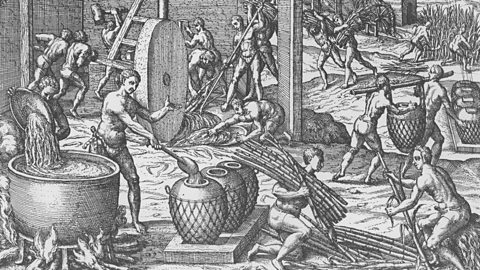
Financed by the banks and insurance companies, businesses shipped goods, such as guns and metalware, to West Africa. There the goods were exchanged for enslaved people who were transported to the Americas to be sold and work on plantations. As ‘Someone who is treated as someone else's property, to be bought and sold as an enslaved person, and whose children are also enslaved.’, they and their descendants became the ‘property’ of their owners. The commodities they produced - sugar and tobacco above all - were shipped to Britain and sold to generate great profits for the trading companies. Africans who came to Britain were caught in this system and part of what built Britain’s wealth.
Employees of the East India Company started to bring domestic servants back to England to work for them. These women who worked as nannies were known as ayahs. The pay and conditions offered in England were superior to what they could get in India but life was not always good for these people. Sometimes they were promised a return to their home country which never materialised. Children were also brought from India to England to work as servants.
In Britain where enslavement was not lawful, black people worked alongside poorer white workers and bonds often grew up between them. This kind of social mixing among the working classes provided a support structure for black immigrants. And African servants who ran away would often be sheltered by both black and white working people.
More guides on this topic
- Migration to Britain c1000 to c2010 overview - OCR A
- Medieval 1000-1500 overview - OCR A
- Reasons for immigration in the Medieval era - OCR A
- Experiences of immigrants in the Medieval era - OCR A
- Impact of immigration in the Medieval era - OCR A
- Immigration in the Early Modern era, 1500-1750 overview - OCR A
- Reasons for immigration in the Early Modern era, 1500-1750 - OCR A
- Experiences of immigrants in the Early Modern era, 1500-1750 - OCR A
- Immigration in the Industrial era, 1750-1900 overview - OCR A
- Reasons for immigration in the Industrial era, 1750-1900 - OCR A
- Experiences of immigrants in the Industrial era 1750-1900 - OCR A
- Impact of immigration in the Industrial era 1750-1900 - OCR A
- Immigration in the Modern era 1900 - present overview - OCR A
- Reasons for immigration in the Modern Era 1900 - present - OCR A
- Experiences of immigrants in the Modern era, 1900 - present - OCR A
- Impact of immigration in the Modern Era 1900 - present - OCR A
- Migration to Britain c1000 to c2010 - exam preparation - OCR A
