Smoking and cardiovascular disease
Smoking increases the risk of Relating to the heart and the blood vessels. in several ways:
- Smoking damages the lining of the Blood vessels that carry blood away from the heart., including the Referring to the heart and the blood vessels which serve the heart tissues. arteries. The damage encourages the build-up of fatty material in the arteries. This can lead to a When the supply of blood to the heart is suddenly blocked. or a Damage to the brain caused by bleeding or blood clots in the brain's blood vessels..
- Inhalation of Poisonous gas produced during incomplete combustion. in cigarette smoke reduces the amount of oxygen that can be carried by the blood.
- The The addictive substance found in tobacco and tobacco smoke. in cigarette smoke increases heart rate, putting strain on the heart.
- Chemicals in cigarette smoke increase the likelihood of the A clump of platelets and blood cells that forms when a blood vessel is damaged., resulting in a heart attack or Damage to the brain caused by bleeding or blood clots in the brain's blood vessels..
Lung disease
Smoking may result in lung diseases.
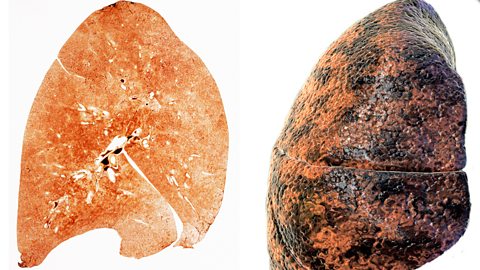
A person may develop COPD or chronic obstructive pulmonary disease is the name to several lung diseases that restrict air flow in the lungs and cause breathing difficulties for a patient. - chronic obstructive pulmonary disease. This condition includes the diseases chronic Inflammation of the bronchi and bronchioles. and Disease in which the walls of the alveoli break down, reducing the surface area for gas exchange in the lungs.. In COPD:
- smoking damages the The many small, branching tubules into which the bronchi subdivide. and can eventually destroy many of the Tiny air sacs in the lungs, where gas is exchanged during breathing. in the lungs
- the airways become inflamed and Slimy white protein, which lines the respiratory tract and alimentary canal., which normally traps particles in the lungs, builds up
- the patient becomes breathless, and finds it more and more difficult to obtain the oxygen required for The chemical change that takes place inside living cells, which uses glucose and oxygen to release the energy that organisms need to live. Carbon dioxide is a by-product of respiration.
The damage caused by COPD is permanent. The disease cannot be cured, and can result in death. It is essential that the person seeks medical help to try to prevent progression of the disease.
Lung cancer
The carcinogens in cigarette smoke also cause lung cancer. Almost all cases of lung cancer are caused by smoking - smaller numbers of cases are linked with air pollution and Radiation that is able to remove electrons from atoms or molecules to produce positively charged particles called ions. from radon gas, a When unstable atoms give off particles that can be harmful to humans.A substance made of one type of atom only. found in the environment in some parts of the country.
Many cases of lung cancer lead to death, although there have been improvements in diagnosis and treatment.
Note that the trend in the rate of developing lung cancer for women has been increasing, while that in men is decreasing. The main reason is because numbers of female smokers - unlike men - continued to increase in the 1950s and 1960s before starting to fall. Cancer may take some years to develop, so a fall in female rates of lung cancer is likely to occur later. Evidence also suggests that women are more susceptible to developing the condition.
Effects of smoking on babies
For mothers who smoke during pregnancy:
- smoking increases the risk of miscarriage
- the babies and children are more likely to suffer from respiratory infections and an increased risk of A disease that affects the respiratory system.
- the long-term physical growth and intellectual development of the baby/child is affected
- there is an increased risk of birth defects
- the birthweight of the baby is reduced
When parents smoke, there is a greater risk of cot death – sudden infant death syndrome.
Question
The bar chart shows that when mothers under the age of 20 smoke whilst pregnant, the birthweight of their babies is reduced.
Suggest two pieces of additional information that would need to be collected before drawing firm conclusions about the effect of mothers smoking on the birthweight of babies.
- Carry out a similar study of mothers of different age groups to see if similar results could be obtained.
- Check to ensure that other factors – for instance, related to lifestyle factors of the experimental group – could not have affected birthweight.
