Caring for the wounded on the Western Front
High numbers of Someone who is injured or dies in a war or other destructive event. led to fast-paced developments in the care of the wounded on the Western Front.
The chain of evacuation
An evacuation route was used to treat injured soldiers quickly because this increased their chances of survival. A system of assessing the injured and treating the most urgent and severe cases first. was used at the dressing stations to organise the wounded and treat the more serious injuries most quickly.
| Stage of treatment | Description of treatment |
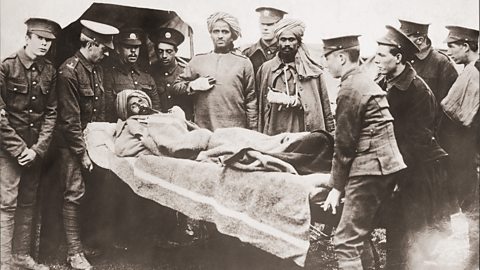
| 1. Stretcher bearers | Stretcher bearers recovered the dead and wounded from No Man’s Land. They would go out at night and during breaks in the fighting. This led to them having to overcome mud, shell craters and crowded trenches, sometimes in darkness. It took four men to carry a stretcher, sometimes more in deep mud. They would carry basic medical supplies, such as bandages. |
| 2. Regimental aid post (RAP) | A RAP was close to the front line, such as in a dugout (a hole dug in the side of a trench). Here light wounds would be treated so that soldiers could return to the front line. Those who needed more treatment were moved on to a dressing station. |
| 3. Dressing station | A dressing station was often set up in a tent behind the trenches. Seriously injured soldiers were moved to a casualty clearing station by a motor or horse-drawn ambulance. |
| 4. Casualty clearing station (CCS) | A CCS was the first medical facility in which the moderately seriously wounded would receive treatment. Here, soldiers were treated by doctors, nurses and surgeons. A CCS contained operating theatres, mobile X-ray machines and hospital ward beds. |
| 5. Base hospitals | A base hospital was where civilians and serious injuries were treated. They were usually in large converted buildings. A base hospital had operating theatres, X-ray departments and specialist centres for treatment of specific problems, such as gas poisoning. The wounded would arrive here by train or motor ambulance. |
| Stage of treatment | 1. Stretcher bearers |
|---|---|
| Description of treatment | Stretcher bearers recovered the dead and wounded from No Man’s Land. They would go out at night and during breaks in the fighting. This led to them having to overcome mud, shell craters and crowded trenches, sometimes in darkness. It took four men to carry a stretcher, sometimes more in deep mud. They would carry basic medical supplies, such as bandages. |
| Stage of treatment | 2. Regimental aid post (RAP) |
|---|---|
| Description of treatment | A RAP was close to the front line, such as in a dugout (a hole dug in the side of a trench). Here light wounds would be treated so that soldiers could return to the front line. Those who needed more treatment were moved on to a dressing station. |
| Stage of treatment | 3. Dressing station |
|---|---|
| Description of treatment | A dressing station was often set up in a tent behind the trenches. Seriously injured soldiers were moved to a casualty clearing station by a motor or horse-drawn ambulance. |
| Stage of treatment | 4. Casualty clearing station (CCS) |
|---|---|
| Description of treatment | A CCS was the first medical facility in which the moderately seriously wounded would receive treatment. Here, soldiers were treated by doctors, nurses and surgeons. A CCS contained operating theatres, mobile X-ray machines and hospital ward beds. |
| Stage of treatment | 5. Base hospitals |
|---|---|
| Description of treatment | A base hospital was where civilians and serious injuries were treated. They were usually in large converted buildings. A base hospital had operating theatres, X-ray departments and specialist centres for treatment of specific problems, such as gas poisoning. The wounded would arrive here by train or motor ambulance. |
The Royal Army Medical Corps and the First Aid Nursing Yeomanry
All medical officers and men who cared for the wounded on the Western Front belonged to the Royal Army Medical Corps (RAMC). They included doctors, stretcher bearers and ambulance drivers.
Women who travelled to the Western Front to care for the wounded joined the First Aid Nursing Yeomanry (FANY). Initially, the army only accepted well-trained nurses from the Queen Alexandra's Imperial Military Nursing Service. However, as the need for nurses increased, volunteers were also accepted. Nurses on the Western Front would carry out the following work:
- providing professional nursing care
- driving motor ambulances
- cleaning hospitals
- washing clothes
- bathing the wounded
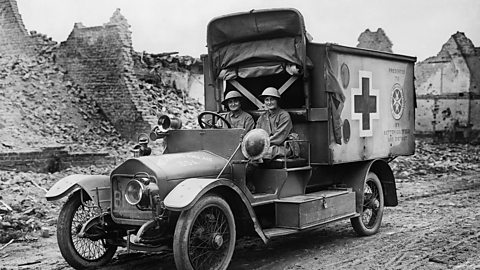
By 1915, there were 250 motor ambulances in France with more arriving. However, horse-drawn ambulances continued to be used as they were more effective when travelling over mud and shell holes.
The underground hospital at Arras
During the Battle of Arras in 1917, the wounded were treated in an underground hospital. This had been built in the tunnels that existed in the chalky ground. The hospital had 700 beds and several operating theatres. This was effective as it enabled the wounded to be treated quickly because it was close to the battle site.
