Illnesses and injuries on the Western Front
The trench environment and the nature of the fighting led to a range of illnesses and conditions that required medical treatment.
Illnesses
Soldiers on the Western Front suffered from illnesses because of the conditions, but many carried on fighting while they were physically able to.
Trench fever
Trench fever was spread by lice. Lice lived in the seams of clothing and in the soldiers’ blankets. The symptoms of trench fever included severe headaches, shivering and pain in the joints. The following measures were used to prevent trench fever:
- clothing and bedding were disinfected
- bathhouses were built
- louse-repellent gel was given to some soldiers to put on their clothes and bodies
- soldiers picked lice out of their clothing by hand or ran a lit match down their seams
Unfortunately, these methods were not entirely successful. This was because overcrowding remained in addition to damp and flooded trenches. Trench fever continued to be a problem until the end of the war. Soldiers who suffered with this illness were not fit to fight.
Trench foot
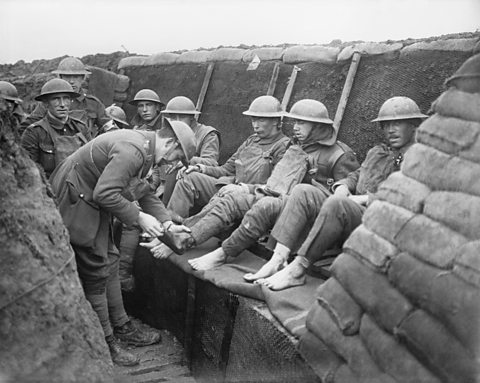
The waterlogged trenches led to soldiers suffering from a condition called trench foot. The symptoms of trench foot were that their feet became swollen, blistered, and turned blue. This was worsened if soldiers’ boots were tight and they were unable to change wet socks. Trench foot could lead to Dead and rotting body tissue, caused by a lack of blood flow to an area or by an infection caused by bacteria. and feet needing to be The removal of a limb, for example an arm or leg. .
By 1915, large numbers of soldiers needed treatment for trench foot and so were unable to fight. The following measures were used to prevent trench foot:
- Soldiers were ordered to change their socks twice a day but this was not always possible.
- Soldiers were encouraged to rub whale oil into their feet as it would keep their feet cool, and it remained a liquid in freezing temperatures.
- Mechanical pumps were sent to the front to reduce the flooding.
These methods did reduce the number of cases. However, the terrain continued to be waterlogged, which meant that soldiers spent days walking and standing in water in the trenches.
Dysentery
Overcrowding and poor hygiene in the trenches led to soldiers suffering from an infection that affected their bowels. This led to some soldiers suffering from stomach pains and A disorder of the large intestine causing too much water to be lost in faeces. to the point of When the body does not have as much fluids and water as it should. Severe dehydration can be life-threatening..
Shell shock
Until shell shock was To decide which disease, illness or condition is present by looking carefully for its signs and symptoms., it was recorded as ‘Not yet diagnosed. Nervous.’ Shell shock was a psychological reaction to the trauma of war. Because it was little understood, soldiers were often accused of cowardice and being too scared to fight.
The number of soldiers who suffered from shell shock increased as the war progressed. This led to the soldiers receiving treatment close to the front line so that they could return to the fighting more quickly. Soldiers suffering with shell shock were given rest and food. Those who suffered following an explosion were treated in specialist centres. Altogether, there were 80,000 recorded cases of shell shock within the British army.
As shell shock was not properly understood until long after the war, there were cases where soldiers were disgraced and court martialled for refusing to fight. Today, doctors would recognise the symptoms as post-traumatic stress disorder (PTSD).
Wounds
The British army suffered high numbers of Someone who is injured or dies in a war or other destructive event. during the battles on the Western Front. Soldiers’ wounds were severe because of the developments in weapons. These had become more mechanised and automatic, so they were more violent and deadly.
| Weapons used on the Western Front | Injuries caused by the weapons and terrain |
|
|
| Weapons used on the Western Front |
|
|---|---|
| Injuries caused by the weapons and terrain |
|
As a way to reduce casualties, steel helmets were introduced in 1915 to attempt to protect soldiers from head injuries.
Rapid-fire and more powerful weapons led to bullets and shrapnel going deeper into the body. They introduced pieces of material and soil into the body, which could lead to infection. Many soldiers died from the infection rather than the bullet wound. The Single-celled microorganisms, some of which are pathogenic in humans, animals and plants. Singular is bacterium. from fertiliser in the soil led to soldiers dying from An infection that causes gas in gangrene wounds.. Military surgeons had little experience of this infection and so it caused many deaths and amputations.
Gas attacks
Gas was used for the first time by the Germans, in 1915. Soldiers were at first given basic gas masks to protect them from the effects of gas. However, the quality of the gas masks improved as the war went on.
In most cases, gas caused a loss of taste and smell, coughing and blindness. Sometimes the gas led to suffocation and death. The large numbers of casualties led to slower treatment of the victims.
| Type of gas | Key information |
| Chlorine gas |
|
| Phosgene gas |
|
| Mustard gas |
|
| Type of gas | Chlorine gas |
|---|---|
| Key information |
|
| Type of gas | Phosgene gas |
|---|---|
| Key information |
|
| Type of gas | Mustard gas |
|---|---|
| Key information |
|
