Natural and manufactured timbers
Types of timbers and their uses
Timber comes from trees, which have to grow to full maturity (between 25 and 100 years) before they can be cut down for wood. Careful consideration should be given to how the wood is cut from the tree. Natural timbers are available in A piece of timber that is longer and wider than it is thick., A piece of material that is much wider than is thick., Wood that can be purchased pre-cut into a length., Wood can be bought pre-cut in a piece that has equally measured sides and angles. and A solid, cylindrical rod of wood, often cut into short lengths to join two pieces of wood together via pre-drilled holes forms.
Timber is categorised into two groups:
- Timber that has come from a tree that drops leaves in the autumn to prepare for winter.
- Timber that has come from a coniferous tree that does not drop leaves in the autumn to prepare for winter.
Hardwood
Hardwoods come from Trees that lose their leaves during autumn to prepare for winter. trees, which have large flat leaves that fall in the autumn. Holly is one exception to this rule. Hardwoods take longer to grow, are not easily sourced and are expensive to buy.
| Hardwood | Properties | Uses |
| Balsa | Soft and easy to form, lightweight, pale in colour, not durable but cheap | To make models |
| Beech | Close-grained, hard, strong and tough, can be challenging to work with and is prone to warping and splitting | Furniture, toys and tool handles, a veneer for worktops |
| Jelutong | A pale, close-grained timber, with medium toughness, easy to work with | Sculpture and pattern making |
| Mahogany | Deep reddish colour that is strong and durable, fairly strong and of medium weight, relatively easy to work with but prone to warping | Indoor furniture, panelling and veneers |
| Oak | Moderate-brown colour with unique and attractive grain markings, tough and durable, polishes well | High-quality furniture, kitchens units, flooring and for veneers as an expensive material |
| Hardwood | Balsa |
|---|---|
| Properties | Soft and easy to form, lightweight, pale in colour, not durable but cheap |
| Uses | To make models |
| Hardwood | Beech |
|---|---|
| Properties | Close-grained, hard, strong and tough, can be challenging to work with and is prone to warping and splitting |
| Uses | Furniture, toys and tool handles, a veneer for worktops |
| Hardwood | Jelutong |
|---|---|
| Properties | A pale, close-grained timber, with medium toughness, easy to work with |
| Uses | Sculpture and pattern making |
| Hardwood | Mahogany |
|---|---|
| Properties | Deep reddish colour that is strong and durable, fairly strong and of medium weight, relatively easy to work with but prone to warping |
| Uses | Indoor furniture, panelling and veneers |
| Hardwood | Oak |
|---|---|
| Properties | Moderate-brown colour with unique and attractive grain markings, tough and durable, polishes well |
| Uses | High-quality furniture, kitchens units, flooring and for veneers as an expensive material |
Softwood
Softwoods come from Trees that do not lose their leaves during autumn to prepare for winter. trees. These often have pines or needles, and they stay evergreen all year round - they do not lose leaves in the autumn. They are faster growing than hardwoods, making them cheaper to buy, and are considered a A sustainable resource can be replaced once used. As a tree is chopped down, many more can be planted to ensure the use of trees can be sustained. material.
| Softwood | Properties | Uses |
| Paraná pine | Hard, straight-grained, strong and durable with a smooth finish, almost knot free, expensive and tends to warp | Quality, indoor joinery, eg staircases and built-in furniture |
| Scots pine | Straight-grained but knotty, fairly strong and easy to work with and paint, cheap | Indoor joinery, eg staircases and furniture - if used outdoors it needs regular protection |
| Western red cedar | Lightweight and knot free, has natural oils that protect it, easy to work but weak and expensive | Outdoors including building cladding |
| Softwood | Paraná pine |
|---|---|
| Properties | Hard, straight-grained, strong and durable with a smooth finish, almost knot free, expensive and tends to warp |
| Uses | Quality, indoor joinery, eg staircases and built-in furniture |
| Softwood | Scots pine |
|---|---|
| Properties | Straight-grained but knotty, fairly strong and easy to work with and paint, cheap |
| Uses | Indoor joinery, eg staircases and furniture - if used outdoors it needs regular protection |
| Softwood | Western red cedar |
|---|---|
| Properties | Lightweight and knot free, has natural oils that protect it, easy to work but weak and expensive |
| Uses | Outdoors including building cladding |
Manufactured board
Manufactured boards are usually made from timber waste and A substance which bonds the surfaces of materials together.. To make them more aesthetically pleasing they are often A thin decorative covering of fine wood applied to a coarser wood or other material.. They are cheap to buy but will need protective coatings for longevity.
| Manufactured board | Properties | Uses |
| Chipboard (particle board) | Large chips or flakes of wood glued together under pressure, brittle, difficult to shape and finishes poorly, absorbent to water and low in cost | Used for veneered worktops and flooring |
| Medium-density fibreboard (MDF) | A compressed board made from wood fibres glued together, smooth, light brown, can be veneered and painted, hard, keeps edges well on cutting, goes soggy when exposed to water if not protected | Used for kitchens and flat pack furniture |
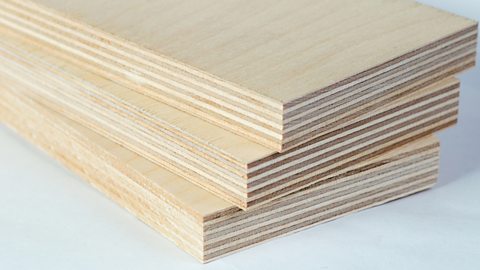
| Plywood | Odd number of layers of veneer glued at 90 degree angles for strength, aesthetically pleasing outer layer, it is stiff and hard to bend unless glued into set shapes | Used for shelving work surfaces, floors and furniture |
| Manufactured board | Chipboard (particle board) |
|---|---|
| Properties | Large chips or flakes of wood glued together under pressure, brittle, difficult to shape and finishes poorly, absorbent to water and low in cost |
| Uses | Used for veneered worktops and flooring |
| Manufactured board | Medium-density fibreboard (MDF) |
|---|---|
| Properties | A compressed board made from wood fibres glued together, smooth, light brown, can be veneered and painted, hard, keeps edges well on cutting, goes soggy when exposed to water if not protected |
| Uses | Used for kitchens and flat pack furniture |
| Manufactured board | Plywood |
|---|---|
| Properties | Odd number of layers of veneer glued at 90 degree angles for strength, aesthetically pleasing outer layer, it is stiff and hard to bend unless glued into set shapes |
| Uses | Used for shelving work surfaces, floors and furniture |