Challenges to US influence: China
How has China challenged US influence?
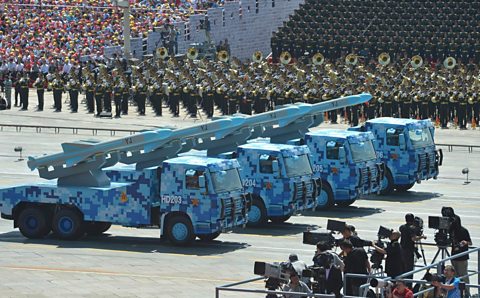
The emergence of China as an economic and military power represents a challenge to US power and influence. The US has also been challenged by the increasing importance of China in recent years.
China's military capabilities
Although China is not yet a match militarily to the US, it has been investing heavily in defence and building up its military capabilities. In 2022, China spent the second highest amount on defence ($292 billion) of all countries in the world, investing in additional nuclear weapons and state-of-the-art hypersonic missile systems. For the last few years China has also been rapidly expanding its space program, which has also raised concerns in the US.
For the US, China’s growing military power represents a real challenge to US global militarily dominance. By way of response, the US under President Biden, has increased military spending in the Indo-Pacific through the Pacific Deterrence Initiative which aims to boost the US military presence in the area.
A diplomatic row broke out between the US and China in 2023 when a Chinese spy balloon was spotted over mainland USA. The Chinese claimed the balloon was for weather research and was blown off course. To the US, which shot down the balloon, this was unacceptable and resulted the US Secretary of State Anthony Blinken calling off a visit to China in protest.
China's economic influence
China is an economic superpower. After the US, China has the second highest GDP ($17.7 trillion to US $26.9 trillion, 2023). For the US, this represents a challenge to its global power although President Biden stated in 2021, that he would not see China become more economically powerful than the US during his presidency.
Some economists had predicted China’s economic output would pass the US, but China’s economy was hard hit by the economic slowdown brought on by the covid pandemic (and its economy has other problems such as lack of new investment and national debt), so China overtaking the US as the world’s largest economy is seen as less likely in the near future.
Belt and Road Initiative (BRI)
China is also using its new found wealth to increase its influence in Asia and Africa. One way China has done this is through its huge Belt and Road Initiative (BRI) which allows developing countries to access loans from China to develop infrastructure projects such as airports, bridges and sea ports. However, US economists believe that BRI projects tie developing countries to China, giving China increasing influence in the world. To counter the BRI, the US and other G7 countries have developed the $600 billion Partnership for Global Infrastructure and Investment (PGII) which aims to support development in a positive and non-binding way.
Trade rivalry between the USA and China
Although the USA and China both benefit hugely from extended bilateral trade (USA: cheap goods; China: markets for its manufactured goods), the US has become increasingly frustrated with the way China, in the view of the US, has broken world trade rules.
The US claims the Chinese government has:
- systematically under-valued its currency to make Chinese goods cheaper to buy
- not done enough to prevent Chinese companies stealing ‘intellectual property’ (i.e. stealing US ideas which Chinese companies copy)
- given huge subsidies to Chinese-based companies to attract global companies to China or to ensure Chinese companies can under-cut companies in other parts of the world.
By way of response, the US has imposed a range of tariffs (taxes) on Chinese made goods (extended under President Biden), imposed bans on certain US exports to China (particularly in technology) and banned some types of US investment in China.
The US is also concerned about some parts of China’s telecommunications industry (companies such as Huawei and ZTE) and the way in which these companies could be a risk to US national security. The US has placed a ban on the use of certain Chinese technologies in some US government areas such military.
Taiwan and the South China Sea
There has been tension between the US and China in respect of Taiwan and the South China Sea.
Although most countries in the world do not recognise Taiwan as an independent country, it has acted separately from Communist China since 1949. Today, Taiwan is a modern democracy with its own constitution. Crucially, it is also heavily supported by the US with the US pledging to support Taiwan if it were attacked.
Although Taiwan and China have strong trading links and cultural ties, a militarily stronger and more assertive China has increasingly called for Taiwan to return to mainland Chinese control. China sees Taiwan as a breakaway province which has no legitimacy. In recent years, China has undertaken repeated military exercises around Taiwan which aim to put pressure on the Taiwanese government. China claims it wishes reunification peacefully but it has not ruled out reunification by military force.
Beyond Taiwan and to the south, lies the huge expanse of the South China Sea. Bordered by countries such as the Philippines, Vietnam and Malayasia, the South China is rich in fish in its waters and mineral deposits under it.
Conflict between China and its neighbours over the fishing and mineral resources of the South China Seas goes back many years. Again, as China has become militarily stronger and more assertive, it has increased its claims to many of the uninhabited islands in the seas. This has brought China into conflict with its neighbours and the US which does not want to see China increasing its influence in this part of the world.
One source of tension between the US and China is over a series of man-made islands China has constructed in the South China Sea. These islands, as far as the US is concerned, are in international waters and US air force planes have regularly overflown the islands to make this point. The Chinese, on the other hand, have repeatedly warned US aircraft off. With so many ships and planes in the disputed area, there are real fears of an international incident arising that could quickly escalate.
