Challenges to US influence: Russia
Russian aggression has challenged the position of the United States as a global power.
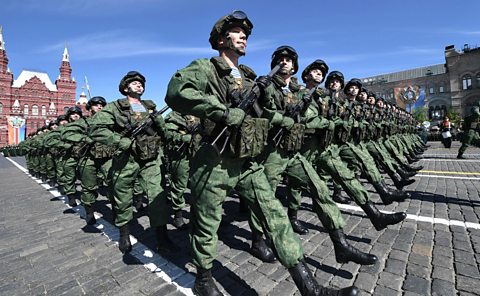
The re-emergence of Russia as a military power and its annexation of Crimea has radically changed the US-Russian relationship.
After years of increased co-operation, e.g. through the NATO-Russia Council and with Russian membership of the G8 Group (now G7), the view in the US was that Russia no longer threatened the peace in Europe. Since the Russian invasion of Ukraine in 2022 – Putin’s so-called “special military operation” – a major war is once more being fought on European soil.
Ukraine
When Russia invaded Ukraine in February 2022, Russia believed it would secure a quick victory that would see the Ukrainian government removed with Ukraine brought back under Russian influence. However, the Ukrainians put up a stubborn defence and with US (and others) support were able to prevent Russia from taking control of the country.
The impact of the Russian-Ukraine war has been devastating. US intelligence suggests that Russian casualties (killed or injured) could be as high as 300,000, with Ukraine suffering nearly 200,000 casualties. As many as 10 million Ukrainians have been displaced by the conflict (6.3 million of these outside Ukraine). In terms of infrastructure damage to Ukraine, once the war is over it has been estimated that Ukraine will need around $1 trillion to repair the damage to the country.
In the US, President Biden sees the Russia-Ukraine war as a conflict between a sovereign and democratic Ukraine and a brutal, autocratic aggressor in Putin’s Russia. From the beginning of the conflict, Biden has pledged his country's full support. According to the Council on Foreign Relations, the US has given about $75 billion in aid (this includes humanitarian, financial and military aid).
In 2024, a bill in Congress to send additional aid to the Ukraine has currently stalled, the US has pledged to send $300 million in military weapons to Ukraine. (Source: BBC News).
Republicans in Congress have so far blocked this aid seeking concessions from Biden in other policy areas. Also, Donald Trump – almost certainly the Republican nomination for president in 2024 – has repeatedly spoken against any further aid to Ukraine.
Along with its allies worldwide, the US has imposed a wide range of economic sanctions on Russia to try and cripple Russia’s ability to fight its war in Ukraine, as well as to restrict the wealth and movement of many powerful Russian individuals. However, these sanctions have only had a limited impact on undermining the Russian economy, as the Russians have managed to get around many of the sanctions by increasing trade with India and China.
Russia and Syria
Another source of disagreement between the USA and Russia has been in respect of Syria.
After a period of political upheaval involving several rival groups (for example Islamic State or IS), war broke out is Syria in 2011/12, between forces loyal to the Syrian government, which is backed by Russia, and pro-democracy rebels (the Free Syrian Army) who are supported by the US.
In what has been a devastating, protracted and complex conflict, over 300,000 people have been killed and as many as 13 million people have been displaced from their homes.
For the US, this conflict has been hugely frustrating as:
- despite US backing, the Free Syrian Army (FSA) has been slowly ground down by the Syrian government army with Russian military support
- Russia's steadfast support for the Syrian government by means of its UN Security Council veto has meant the US has been unable to gain UN approval for action
In 2024, the Syrian war continues in the north of the country. The United States continues to support the FSA (as well as counter Islamic State (IS) militants) and has around 800 troops deployed in Syria (Operation Inherent Resolve).
Russian election interference
The 2016 Presidential election was dogged by claims that the Russian state had covertly manipulated the campaign to achieve a win for Donald Trump – a candidate who was seen to be more favourable to Russia.
In 2017, the Department of Homeland Security and the Office of the Director of National Intelligence published a report stating that they believed that Russian secret services hacked the emails of the Democratic National Committee and Hilary Clinton’s campaign manager to destabilise their campaign and provide an advantage to their adversaries.
The FBI conducted an investigation into alleged links and financial ties between the Russian state and Donald Trump's associates. On 13 February 2018, the heads of the US intelligence agencies restated their belief in Russian interference.
Alongside, these suspicions of hacking, there were claims that thousands of fake social media accounts on Facebook and Twitter attempted to sway public opinion against Clinton and for Trump. In October 2017, Facebook admitted that as many as 126 million Americans may have been exposed to social media influence from Russian-based operatives.
In early 2024, in an interview for the BBC, President Putin claimed to now prefer Democratic President Biden over Republican Donald Trump in the race for the US presidency. However, some US commentators believe Putin’s statement in stating a preference for Biden may be to help Trump as Republican’s could use this information to attack Biden.
