Refugees seeking safety in Britain
Although the 1905 ‘A foreigner, someone who has come from another country. Act’ restricted The action of coming to live permanently in another country., it still allowed entry to A person living outside their own homeland as a result of war, famine or persecution..
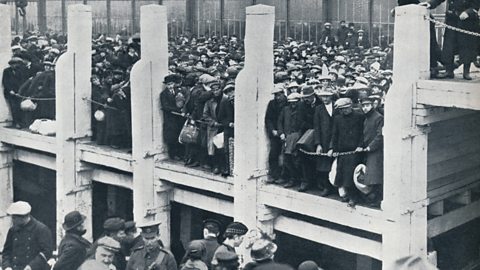
During World War One, about 250,000 Belgian refugees came to Britain to escape German invasion. In general they were warmly received, although there were some tensions because some British people suffering hardship felt the refugees were living in better conditions than them. When people are moved from where they live and settled somewhere else. centres were set up in places such as Earl’s Court Exhibition Centre and Alexandra Palace in London. Some went to live with families, while others went to live in specially built camps. There was even a purpose-built Belgian village in Tyne and Wear with its own school, shops and churches. Most returned to Belgium after the war.
During the Spanish Civil War in 1937, about 4,000 children came as refugees. The Salvation Army and the Catholic Church were amongst others who volunteered to look after the children.
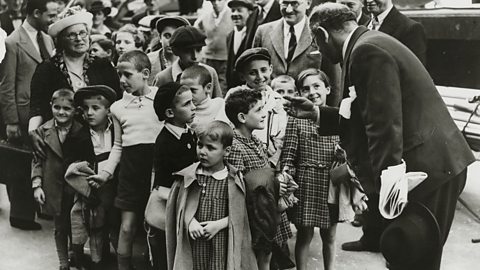
When Jews were being persecuted in Nazi Germany and Austria following the rise of Hitler in 1933, human rights groups argued that the UK should take refugees and about 40,000 were accepted, although many more were refused. In 1938 and 1939, thanks to the work of campaigners, around 10,000 Jewish children came to safety in Britain from Germany, Austria and Czechoslovakia in what is known as the The programme that brought 10,000 Jewish children to safety in 1938 and 1939, escaping Nazi-controlled Germany, Austria and Czechoslovakia.. Their parents, however, were not allowed to come with them and many died in the The killing of 6 million Jews and other minorities by the Nazis during World War Two. .
Jack Adler's Kindertransport story
After the Nazi invasion of Poland and during World War Two, some 160,000 Polish refugees arrived in Britain and many Poles served in the Allied armed forces. After the war, the 1947 Polish Resettlement Act allowed them to stay and be joined by their families.
Since World War Two, refugees from many conflicts have come looking for safety in the UK.
Key facts: below are examples of refugees that came to Britain after World War Two.
More guides on this topic
- Migration to Britain c1000 to c2010 overview - OCR A
- Medieval 1000-1500 overview - OCR A
- Reasons for immigration in the Medieval era - OCR A
- Experiences of immigrants in the Medieval era - OCR A
- Impact of immigration in the Medieval era - OCR A
- Immigration in the Early Modern era, 1500-1750 overview - OCR A
- Reasons for immigration in the Early Modern era, 1500-1750 - OCR A
- Experiences of immigrants in the Early Modern era, 1500-1750 - OCR A
- Impact of immigration in the Early Modern era, 1500-1750 - OCR A
- Immigration in the Industrial era, 1750-1900 overview - OCR A
- Reasons for immigration in the Industrial era, 1750-1900 - OCR A
- Experiences of immigrants in the Industrial era 1750-1900 - OCR A
- Impact of immigration in the Industrial era 1750-1900 - OCR A
- Immigration in the Modern era 1900 - present overview - OCR A
- Experiences of immigrants in the Modern era, 1900 - present - OCR A
- Impact of immigration in the Modern Era 1900 - present - OCR A
- Migration to Britain c1000 to c2010 - exam preparation - OCR A
