Blood
The composition of blood
Blood transports materials and distributes heat around the body. It also helps to protect against disease. Blood contains The liquid part of the blood containing useful things like glucose, amino acids, minerals, vitamins (nutrients) and hormones, as well as waste materials such as urea., which is a liquid that cells and cell fragments are suspended in:
Plasma is a straw-coloured liquid that makes up just over half the volume of blood.
Types of blood cell and cell fragments:
- red blood cells
- white blood cells
- platelets
This table explains the functions of various blood components.
| Component | Function(s) |
| Plasma | Transporting carbon dioxide, digested food molecules, urea and hormones; distributing heat |
| Red blood cells | Transporting oxygen |
| White blood cells | Ingesting pathogens and producing antibodies |
| Platelets | Involved in blood clotting |
| Component | Plasma |
|---|---|
| Function(s) | Transporting carbon dioxide, digested food molecules, urea and hormones; distributing heat |
| Component | Red blood cells |
|---|---|
| Function(s) | Transporting oxygen |
| Component | White blood cells |
|---|---|
| Function(s) | Ingesting pathogens and producing antibodies |
| Component | Platelets |
|---|---|
| Function(s) | Involved in blood clotting |
Red blood cells
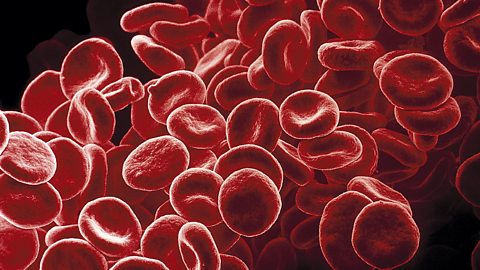
Red blood cells transport the oxygen required for Respiration that requires oxygen. in body cells.
They must be able to absorb Gaseous element making up about 20% of the air, which is needed by living organisms for respiration. in the lungs, pass through narrow blood Tiny blood vessels with walls one-cell thick where exchange of materials occurs., and release this oxygen to To engage in respiration, the energy-producing process inside living cells. cells.
Red blood cells have adaptations that enable them to carry a maximum amount of oxygen:
- They contain the Organic compound made up of amino acid molecules. One of the three main food groups, proteins are needed by the body for cell growth and repair.The red protein found in red blood cells that transports oxygen round the body., which gives them their red colour, at the lungs
- \( \text{haemoglobin} + {oxygen} \xrightarrow {at~the~lungs} \text{oxyhaemoglobin}\)
- \( \text{haemoglobin} + {oxygen} \xleftarrow {at~the~cells} \text{oxyhaemoglobin}\)
- Haemoglobin can combine reversibly with oxygen. This is important - it means that it can combine with oxygen as blood passes through the lungs, and release the oxygen when it reaches the cells.
- They have no The nucleus controls what happens inside the cell. Chromosomes are structures found in the nucleus of most cells. The plural of nucleus is nuclei. - they lose it during their development - so they can pack in more haemoglobin.
- They are small and flexible so that they can fit through narrow blood capillaries.
- They have a biconcave shape - they are the shape of a disc that is curved inwards on both sides - to maximise their surface area for oxygen absorption.
- They are thin, so there is only a short distance for the oxygen to diffuse to reach the centre of the cell.
White blood cells
There are several main types of white blood cell.
Phagocytes
About 70% of white blood cells are Cells, such as white blood cells, that engulf and absorb waste material, harmful microorganisms, or other foreign bodies in the bloodstream and tissues.. Phagocytes engulf and destroy unwanted microorganisms that enter the blood, by the process of The process of the ingestion of bacteria or other material by phagocytes.. They are part of the body's The body's defence system against entry of any foreign body, including pathogens and agents such as pollen grains. The role of the immune system is to prevent disease..
Lymphocytes
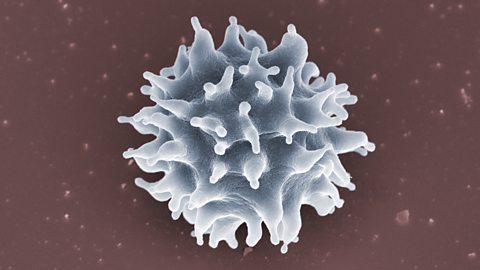
Lymphocytes make up about 25% of white blood cells. They are also part of the body's immune system. Lymphocytes produce soluble proteins called A protein produced by the immune system in humans (and other animals) that attacks foreign organisms (antigens) that get into the body. when a foreign body such as a microorganism enters the body.
Platelets
Platelets are cell fragments produced by giant cells in the Soft tissue found inside bones that produces new blood cells..
Platelets stop bleeding in two main ways:
- they have Organic compound made up of amino acid molecules. One of the three main food groups, proteins are needed by the body for cell growth and repair. on their surface that enable them to stick to breaks in a blood vessel and clump together
- they secrete proteins that result in a series of chemical reactions that make blood clot, which plugs a wound.
Blood products
Blood products are components of blood that are given to a patient by When people are given blood via a drip.. They include:
- red blood cells
- platelets
- plasma
- A protein produced by the immune system in humans (and other animals) that attacks foreign organisms (antigens) that get into the body.
Blood products are produced from blood from blood A person or organism providing an organ or tissue for transplant..
Blood products can then be given to patients depending on their needs. Patients rarely receive transfusions of whole blood in modern medicine.
Blood products are screened for:
- infectious agents such as HIV
- their blood group
- the presence of certain antibodies
Blood for transfusion must be compatible with that of the patient's blood, for instance, their blood group. Before a transfusion, white blood cells are often removed to reduce the risk of infections or immune reactions.
