Convection
Convection is the flow of heat energy from a region of high temperature to a region of low temperature by movement of a fluid.
Convection only occurs in fluids (liquids and gases).
Convection in a liquid
Convection in a liquid can be seen by putting a crystal of potassium permanganate in a beaker of water and gently heating it with a Bunsen flame.
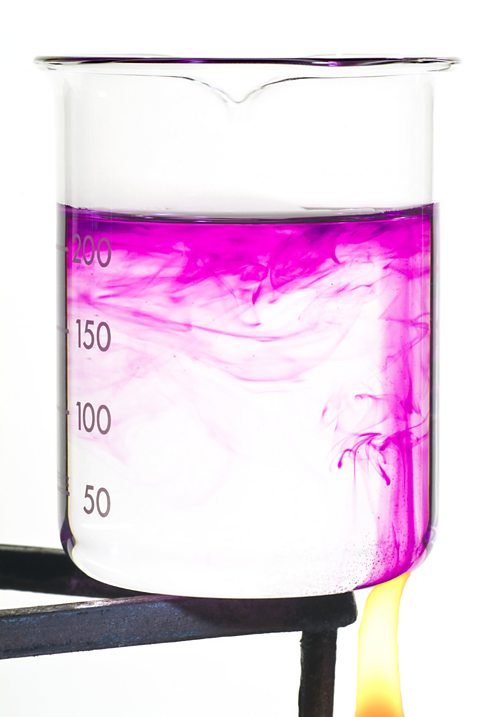
A beaker is heated and the coloured fluid inside shows convection currents
- Heat is initially transferred through the glass wall of the beaker by The transfer of heat through a material by transferring kinetic energy from one particle to another..
- The water in the region of the Bunsen flame is heated.
- It expands, becomes less dense and rises.
- It is replaced by the cooler, denser water which surrounds it.
- This water is in turn heated, expands becomes less dense and rises.
- The process continues, a convection current is set up and heat is transferred through the liquid.
Convection currents can be seen in lava lamps.
The wax inside the lamp warms up, becomes less dense than the liquid and so rises.
