1919 to 1948
The period between World War One and Word War Two was one of low The action of coming to live permanently in another country. and high unemployment as immigration laws and restrictions on merchant seamen were tightened.
The rise of the Hostility or prejudice against Jews.Someone with extreme right-wing, nationalist views who believes in the idea that there should be a strong, all powerful leader and a one party state. Blackshirts in Britain culminated in their attempted march through East London’s Jewish area. This was prevented by anti-fascist protesters at the Battle of Cable Street in 1936. The fact that Jews and non-Jews came together to defend their streets from an attack showed that a united community response to racism was possible and could succeed.
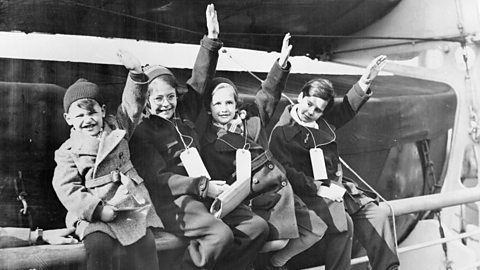
Some Jewish A person living outside their own homeland as a result of war, famine or persecution. from Nazi Germany were accepted in Britain, but many were refused at a time when immigration was highly restricted and anti-Semitism was on the rise. In 1938 and 1939, however, about 10,000 Jewish children came to safety in the UK on what became known as the The programme that brought 10,000 Jewish children to safety in 1938 and 1939, escaping Nazi-controlled Germany, Austria and Czechoslovakia..
Jack Adler's Kindertransport story
During World War Two, ‘enemy A foreigner, someone who has come from another country.' including many members of the large Italian community, were again Detained in a camp or prison, usually in the case of 'enemy aliens' in time of war..
As was the case in World War One, during World War Two large numbers of colonial troops fought for Britain. The merchant convoys had a large proportion of African, Arab and Indian seamen, many of them from port cities such as Cardiff and Liverpool.
After the war, Polish servicemen living in the UK were allowed to stay and be joined by their families.
More guides on this topic
- Migration to Britain c1000 to c2010 overview - OCR A
- Medieval 1000-1500 overview - OCR A
- Reasons for immigration in the Medieval era - OCR A
- Experiences of immigrants in the Medieval era - OCR A
- Impact of immigration in the Medieval era - OCR A
- Immigration in the Early Modern era, 1500-1750 overview - OCR A
- Reasons for immigration in the Early Modern era, 1500-1750 - OCR A
- Experiences of immigrants in the Early Modern era, 1500-1750 - OCR A
- Impact of immigration in the Early Modern era, 1500-1750 - OCR A
- Immigration in the Industrial era, 1750-1900 overview - OCR A
- Reasons for immigration in the Industrial era, 1750-1900 - OCR A
- Experiences of immigrants in the Industrial era 1750-1900 - OCR A
- Impact of immigration in the Industrial era 1750-1900 - OCR A
- Reasons for immigration in the Modern Era 1900 - present - OCR A
- Experiences of immigrants in the Modern era, 1900 - present - OCR A
- Impact of immigration in the Modern Era 1900 - present - OCR A
- Migration to Britain c1000 to c2010 - exam preparation - OCR A
