Split staging
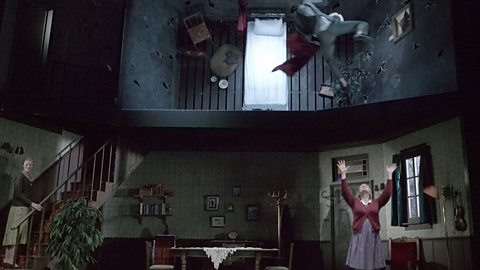
Some plays demand that you divide the acting area into more than one space, eg the office and the factory floor. This may or may not be created realistically. If you’re performing with the minimum of staging, it’s important that you maintain the illusion of the two areas by very precise positioning of imagined doors. You must make sure any mimed routines such as using door keys are repeated in exactly the same way by each performer. Even with realistic staging you’ll probably need to be careful about things like entrances to each area in order to sustain the illusion.
Offstage
Clearly characters can wait offstage in the wings (sides of the stage usually marked by staging panels (flats) or curtains) but offstage can also play a part in the action. A character can speak from offstage or someone’s entrance can be made more significant by gestures and lines anticipating their entrance.
Rehearsing in a space or for a space
We’d all prefer to rehearse and perform in the same space but for all sorts of reasons, apart from the dress rehearsal, this rarely happens. If you’re using a substitute space, make sure you measure it out carefully so you know how much room you’ll have for your action. Most people would think of this when rehearsing stage fighting or an energetic piece of physical theatre. Remember that it’s also important that an actor playing an emotional scene should know how many paces will let him cross the stage. Actors watching the action in a crowd scene need to know how much onstage space they have to fill.
You could experiment with a scene in rehearsal by using a variety of different stage settings in order to measure the impact of each one from the audience’s perspective.
