Sign up to the BBC Bitesize newsletter! External Link
For home education news and stories plus updates on the latest Bitesize content, register for our newsletter today.

If you’re home educating your child you may not be basing their learning around specific subjects, and instead be led by your child’s interests. However, numeracy – the ability to use and understand maths in everyday life – is a skill we all need.
There are lots of fun ways to incorporate maths and numeracy into what currently excites your child, whether they love playing ‘shops’ or actually going to the shops! Read our tips for fun maths activities to try at home.
Maths activity ideas for younger children
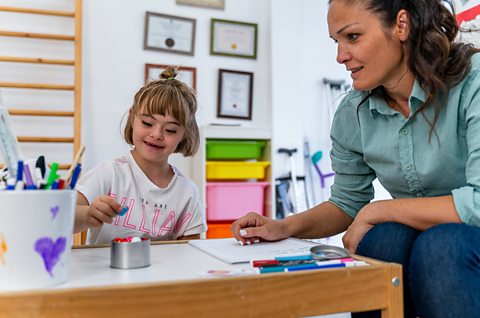
Mathematician Hannah Fry believes the best way to ‘teach’ maths is to be playful. You could ask younger children to match cups and saucers for a teddy bears’ picnic, or get them to arrange your containers in size order in the cupboard. Ordering, matching or counting items (yes, even pairs of socks!) is a great foundational skill in the early years.
Other similar activities include:
putting coloured sweets or pom poms into cups of a matching colour
organising toys in size or weight order
baking and measuring ingredients
having a height or wall measurement chart
playing pairs or similar card games
playing the memory game (sometimes called ‘Kim’s game’) where your child memorises objects and recites them after you cover them up.
EYFS maths activities
If your child is very young, read some of our Bitesize early years articles like Helping your child learn how to count or CBeebies Parenting articles like Learning numbers and counting through play.
Your child could play online maths games like Numberblocks: See the Amount and Bud's Number Garden.
Even just talking about numbers and mathematical concepts such as big and small, half or whole, all contribute to your child’s early numeracy.
Fun maths activities for ages 5 to 7
The National Curriculum in England, Wales and Northern Ireland for maths at Key Stage 1 (ages five to seven) covers concepts like counting, multiplying and dividing, fractions,time, shapes and measurement.
There are lots of online maths games for children aged five to seven, including Karate Kats Maths, The Canine Crew: Measuring Mass and Space Shoppers: Money Funfair.
See the full range of Bitesize maths games here!
"One of the most beautiful things about home education is you can absolutely learn together and there are so many resources out there on the internet to help you.” - Emma Beal, mum of three from the New Forest
Fun ways to learn maths for ages 7 to 11
The English, Welsh and Northern Irish National Curriculum at Key Stage 2 (ages seven to 11) covers concepts like place value, algebra, percentages, rounding and estimating, coordinates and tables, graphs and charts.
The popular Bitesize game Guardians: Defenders of Mathematica lets children practise their maths skills with quick-fire questions and customisable characters.
Children also practise solving maths problems in their heads. There are loads of ‘mental maths’ challenges to do while going about your daily lives, for example adding up door numbers on the way to the park, managing a budget on a shopping trip, or working out travel times on the train or bus.
You can tailor it to your child’s favourite hobbies. If your child loves sewing or crafting, practise measurements by getting them to use a tape measure to measure out material or thread. Incorporate learning about shapes by getting them to mark out and safely cut fabric shapes and patterns, for example when making a cushion, pencil case or bunting.
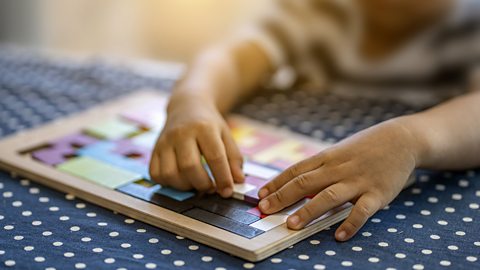
Board games, card games and activity books all help build maths and problem-solving skills too. For example, play top trumps and your child will learn numbers and concepts like greater than or less than. Dominoes is good for early maths addition, place value, and even practising times tables.
Maths activities for children aged 11 to 16
Helen is head of maths at a secondary school in Manchester. She says the biggest worry for most parents or carers is the level of challenge once their child reaches secondary school.
“Many people have a fear of mathematics from either poor experiences back when they were at school or the misconception that people fall into two categories: mathsy or wordy. The best thing you can do to help your children is to not let that fear show. Remember, maths, like anything else, is just about practice!”
"We encourage all our parents to refrain from phrases like ‘I was never very good at maths at school’ or ‘I can’t help you with this, it’s too hard.’" - Helen, head of maths
How to use maths in the real world
According to charity National Numeracy, there are many ways you can help your child explore (and practise!) maths in the real world.
Consider using some of these techniques:
When you’re going places, talk about how long the journey will take, how far away the destination is, what transport you need to take, including bus or train timetables, and even get your child to try out giving directions to where you need to go.
Explore the local area and work out distances to the park, the motorway, the nearest beach, etc. You can also guess the population of your town or city together, find out why they’ve guessed what they have and then check it on the internet.
Chat about building and landscapes around you when you’re out. You could ask your child to estimate how many panes of glass there are in a building or how many trees are in the park.
Talk about broader geography like longest rivers, tallest mountains, most populated city, etc, which cover things like shape, size and quantity.
If you’re playing sport together, think about things like keeping score, or counting down in darts, and discussing shot or goal angles. If you’re watching sport, you can talk about your team’s points, match statistics and how many goals/wickets/tries your child’s team needs to succeed.
Keep an eye out for things like percentages, graphs and statistics on the news or in the newspaper, or length of TV programmes in a TV guide, and reference those. You could ask questions like ‘If you watch such-and-such a programme, how long will you have left to play before tea time at 6pm?’
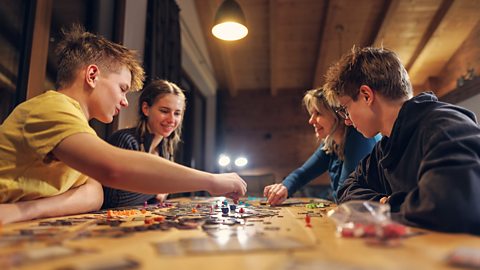
You can also use board games like Monopoly, draughts, chess, Connect 4, PLYT, and card games to build maths skills.
There are many free-to-access maths games or tutorials online, including Divided Islands on BBC Bitesize for Key Stage 3 (ages 11-14) and GCSE (ages 14+), and secondary maths content on BBC Teach.
You may also be interested in our article on the ten common fears around home education and tips for overcoming them.
Learn maths based on your child’s interests
One of the things many home educating parents mention is the ability to learn based on your child’s interests. For example:
If your child enjoys model-making, get them to draw and work out the correct measurements for their design to succeed.
If your child enjoys computers, learn coding and programming together, or play games like Minecraft, The Talos Principle, Zachtronics and SimCity.
If your child enjoys creative writing, get them to plot out a book using mathematical principles. They can use percentages and proportions for how long the beginning and end of a book should be, and a spreadsheet to keep track of word count and countdowns to deadlines.
If your child enjoys sport, encourage them to keep score, test probability with a coin toss and predict a game’s outcome. Or they could create their own scoring system for a new game or obstacle course in the park, or use a stopwatch or activity tracker and get creative.
If your child already enjoys maths, get them to try out a competition. Visit the UK Maths Trust website for details about their competitions. MathsWorldUK has videos for maths challenges you can do at home. Number Champions has downloadable maths games and activities.
As teacher Helen says, when it comes to maths: “The most important advice I can give anyone is to not close it down in your mind and to keep practising!”
Where can I find more support for home education and parenting?
The BBC Bitesize home education collection is designed to support you and your child’s learning at home with free downloadable resources, advice articles and videos for children aged two-to-five years old, five-to-11 years old and 11-to-16+ years old.
Bitesize Parenting is the go-to place for the whole parenting community to find stories, expert advice and fun activities.
If your child has special educational needs or disabilities, be sure to check out the Parenting SEND collection. Bitesize has a collection of Sensory Stories, an immersive video series of unique sensory adventures for children with additional needs.
For more information about home education, this BBC News article covers the rise in families deciding to educate their children at home.
