Stars
The Sun as a star
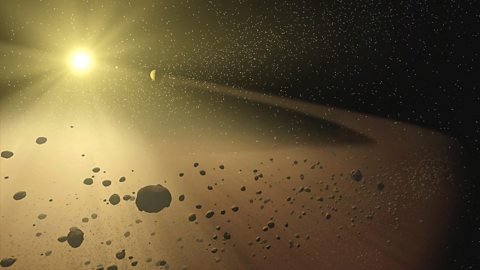
The Sun is a star of medium size. It gives out heat and light and makes life possible on Earth.
The Sun consists mostly of hydrogen and helium, and it radiates most of its energy in the infrared, visible light and ultraviolet regions of the The different types of electromagnetic radiation, arranged in order of frequency or wavelength..
Galaxies and the Milky Way
Galaxies are huge collections of billions of stars like our Sun.
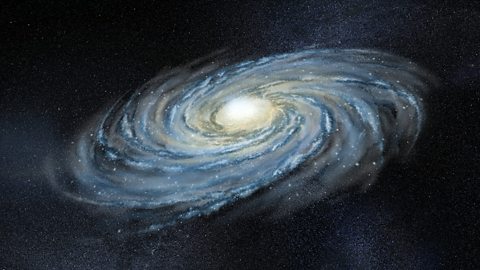
Our Sun belongs to a spiral galaxy called the Milky Way.
Astronomers estimate that the Milky Way is a collection of about 100 thousand million stars with a diameter of approximately 100,000 light years.
Our solar system lies in one of the Milky Way’s four spiral arms, nearly two thirds of the way from the centre.
Part of the Milky Way is visible on a clear night from Earth, as a thick band of stars stretching across the sky.
The light year
The distances between objects in space are huge:
- the distance from one star to another in a galaxy is millions of times more than the distance between the planets in the solar system;
- the distance from one galaxy to another is millions of times more than the distance between the stars in a galaxy.
This means that the numbers used to describe distances in space become very difficult to understand and to write down.
For example, the distance between the Earth and the Sun is about 150,000,000,000 m but the distance to the next nearest star (Proxima Centauri) is 39,900,000,000,000,000 m.
To get around this problem, scientists use the light year as the unit of astronomical distance.
A light year is the distance travelled by light in one year in the vacuum of space.
So, for example:
It takes light from our Sun about 8 minutes to reach the Earth.
Sun to Proxima Centauri distance is about 4.24 light years.
Sun to the centre of the Milky Way is about 27,000 light years.
The Milky Way is about 100,000 light years across.
Milky Way to Andromeda (the next nearest spiral galaxy) distance is about 2.5 million light years.
Extended syllabus content
If you are studying the Extended syllabus, you will also need to know the calculation for a light year. Click 'show more' for this content:
Remember that one light year is the distance light travels in one year.
Distance = speed × time
Speed of light = 300,000,000 m/s
Speed of light = 3.0 × 10⁸ m/s
Time = 1 year
Time = 365 × 24 × 60 × 60
Time = 31,536,000 s
Distance = 3.0 × 108 x 31,536,000
Distance = 9.46 × 10¹⁵ m
1 light year = 9.46 × 10¹⁵ m
One light year is a distance of 9.46 × 10¹⁵ m.
The formation and life cycle of stars
Extended syllabus content: The life cycle of stars
If you are studying the Extended syllabus, you will also need to know about the formation and life cycle of stars in the section below. If you're studying the core content, please move onto the section titled 'Red shift'.
The life cycle for a particular star depends on its size. The diagram shows the life cycles of stars that are:
- about the same size as the Sun
- far greater than the Sun in size
All stars begin life in the same way. A cloud of dust and gas, also known as a nebula, becomes a protostar, which goes on to become a A stable stage in the life cycle of a star. Nuclear fusion occurs, fusing hydrogen nuclei into helium nuclei. There is a balance between the outwards radiation and the force of gravity pulling inwards. star. Following this, stars develop in different ways depending on their size.
Stars that are a similar size to the Sun follow the left-hand path:
red giant star \(→\) white dwarf \(→\) black dwarf
Stars that are far greater in mass than the Sun follow the right-hand path:
red super giant star \(→\) The large explosion at the end of a large star’s life, which distributes much of the elements formed in the star across space. \(→\) neutron star, or a black hole (depending on size)
Life cycle of a star
Image caption, A nebula
A star forms from massive clouds of dust and gas in space, also known as a nebula. Nebulae are mostly composed of hydrogen.







1 of 9
Extended syllabus content
If you are studying the Extended syllabus, you will also need to know more about main sequence stars and Supernovae. Click 'show more' for this content:
For most of its lifetime, a star is a main sequence star. Here nuclear reactions power the star by releasing energy. Helium is formed from hydrogen in nuclear fusion reactions. It is stable, with balanced forces keeping it the same size all the time. During this period:
- gravitational attraction tends to collapse the star
- radiation pressure from the fusion reactions tends to expand the star
- forces caused by gravitational attraction and fusion energy are balanced
The Sun is expected to be a main sequence star for billions of years.
Supernovae
All the naturally occurring elements in the Universe are produced by nuclear fusion reactions in stars. For example, beryllium and carbon nuclei can be produced from helium nuclei:
During the majority of a star’s lifetime, hydrogen nuclei fuse together to form helium nuclei. As the star runs out of hydrogen, other fusion reactions take place forming the nuclei of other elements.
Elements that are heavier than hydrogen and helium are formed. Elements heavier than iron are formed in the supernova explosions of high mass stars. When the supernova explodes, all the elements produced are thrown out into the Universe. The heavy elements found on Earth, such as gold, came from material thrown out in previous supernova explosions.
Red shift
Shifts in frequency and wavelength are observed for light coming from stars in distant galaxies.
By comparing the light from distant stars with the spectrum of light from our Sun it was noticed that the spectra from distant stars had a slightly decreased frequency and slightly increased wavelength. This indicated the stars were moving away from Earth (just as the sound of a siren moving away from you has a decreased frequency and increased wavelength).
As the light was shifted towards the red end of the spectrum (lower frequency/longer wavelength) this phenomenon was termed 'redshift'.
Redshift is therefore an increase in the observed wavelength of electromagnetic radiation emitted from receding starts and galaxies.
Redshift in the light from distant galaxies is evidence that the Universe is expanding and supports the Big Bang theory.
Extended syllabus content
If you are studying the Extended syllabus, you will also need to know more about redshift and the Universe. Click 'show more' for this content:
The speed at which a galaxy is moving away from the Earth can be found from the change in wavelength of the galaxy’s starlight due to redshift.
Cosmic microwave background radiation, supernova and Hubble's constant
Extended syllabus content: Cosmic microwave background radiation
If you are studying the Extended syllabus, you will also need to know about cosmic microwave background radiation. Click 'show more' for this content:
In addition to the electromagnetic radiation that reaches us from stars we can also detect some very long wavelength microwave radiation which is all around us in space.
This Cosmic Microwave Background Radiation (CMBR) is evidence for the Big Bang theory.
The 'temperature' of deep space has been measured as around 3K, not absolute zero, due to the afterglow of the Big Bang.
This radiation is now used to 'map' the early Universe.
The diagram below is a heat map showing that temperature was not evenly distributed.
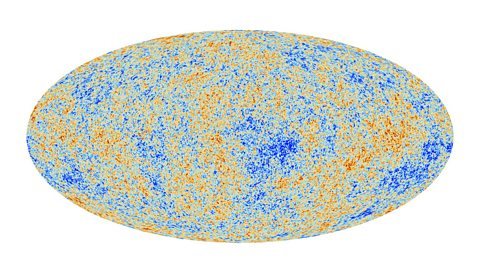
This is a whole sky Planck space telescope image of the cosmic microwave background (CMB), the relic radiation from the Big Bang.
This Cosmic Microwave Background Radiation (CMBR) was produced shortly after the Universe was formed. It has expanded into the microwave regions of the electromagnetic spectrum as the Universe expanded. It is evidence for the Big Bang theory.
Extended syllabus content: Supernova
If you are studying the Extended syllabus, you will also need to know more about finding distances using supernovae. Click 'show more' for this content:
The distances between A cluster of billions of stars, held together by gravity. are extremely large. It is two million The distance light travels in a year. to our nearest galaxy, Andromeda. If we could travel at the 300,000,000 m/s it would take this many years to reach it. Different types of supernovae have a known brightness. How bright an object seems is When one value increases and the other decreases. to its distance. So we can measure the brightness of a distant supernova and compare it with its known brightness to determine how far away the galaxy it is in is.
Extended syllabus content: Hubble's Law
If you are studying the Extended syllabus, you will also need to know more about Hubble's Law. Click 'show more' for this content:
American astronomer American astronomer for whom the space telescope was named. measured the speed of galaxies and their distance from Earth and obtained the following graph.
As the graph is a straight line through the origin it represents a direct proportionality. This is knows as 'Hubble's Law' and is described in the equation:
\(H_o = \frac{v}{d}\)
In the equation, \(v\) is the velocity of a receding galaxy, \(d\) is the distance to the galaxy, and \(H_{o}\) is the Hubble's constant.
Hubble's constant is approximately 2.2 x 10⁻¹⁸ if the distance is in metres and the speed in metres per second.
This relationship means that the further a galaxy is from Earth, the faster it is moving.
The real significance of Hubble's Law is that the Universe is expanding in all directions, not just from Earth.
This means all matter in the Universe started at one point in space at the time of 'the Big Bang'. A small number of galaxies exhibit blueshift as they are moving towards Earth, but the vast majority of galaxies are redshifted, giving strong evidence for an expanding universe.
In 2012, NASA's Wilkinson Microwave Anisotropy Probe (WMAP) spacecraft estimated the age of the universe to be 13.772 ± 0.059 billion years.
The next year, the European Space Agency's Planck spacecraft confirmed this with an age of 13.82 billion years. This was only possible using Hubble's Law and a precise knowledge of the Hubble constant.
This was calculated using the equation:
\(\frac{d}{v} = \frac{1}{H_o}\)
Quiz
Test your knowledge with this quiz on the life cycle of a star.
Teaching resources
Are you a physics teacher looking for more resources? Share these short videos with your students:
More on Space physics
Find out more by working through a topic
- count3 of 3

- count1 of 3