Key points
Short division is also known as the bus stop method and is often used to divide large numbers.
Division is sharing things out or working out how many times one number goes into another. Division is the When an operation is combined with its inverse, the number is unchanged. Multiplication and division are inverse operations. Eg, 3 × 10 ÷ 10 = 3 of multiplication.
When doing short division, it can be useful to know your times tables. It is also important to be able to work out The amount remaining after division. Eg, 30 divided by 7 is 4 remainder 2 if values do not divide exactly.
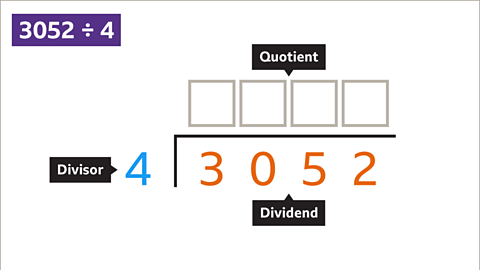
In the calculation 36 ÷ 3 = 12, 36 is the In division, the number that is divided. Eg, in the calculation 30 ÷ 6, 30 is the dividend., 3 is the The number by which another is divided. Eg, in the calculation 30 ÷ 6 , the divisor is 6 and the The result of a division. Eg, in the calculation 30 ÷ 6 = 5, the quotient is 5 is 12
If a digit in the answer is A repeating digit or group of digits. A repeating digit can be shown with a dot over the repeating digit. Eg, 0.3333 may be written as 0.3 with a dot over the 3 it can be shown in the answer with a dot above the repeating digit.
How to complete a short division calculation
- Set out the division. Write the question in bus stop form.
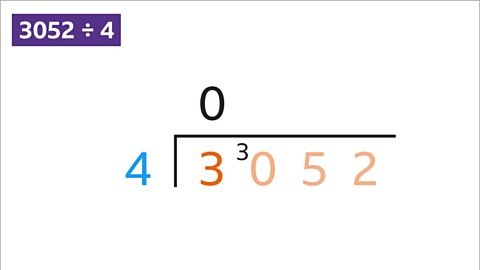
- Starting with the first digit, divide each digit of the In division, the number that is divided. Eg, in the calculation 30 ÷ 6, 30 is the dividend. by the The number by which another is divided. Eg, in the calculation 30 ÷ 6 , the divisor is 6. Write the answers above the line.
- A zero at the start is used as a place holder in the working out to keep it lined up - it is not written in the answer.
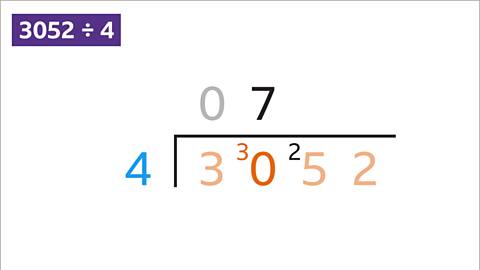
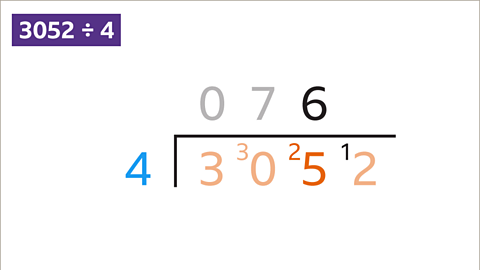
- If there is a remainder when dividing a digit, carry the remainder to the next digit.
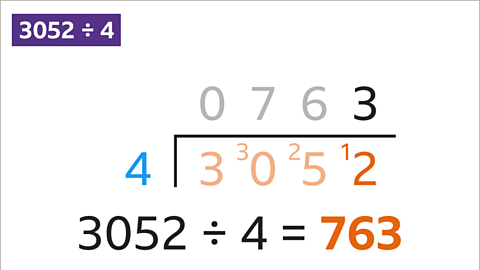
Example: calculate 3052 ÷ 4
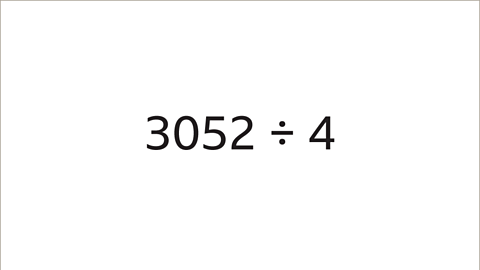
Image caption, How to use short division to work out 3052 ÷ 4
1 of 6
Question
Use short division to work out 8785 ÷ 7. You might need a pen and paper to solve this problem.
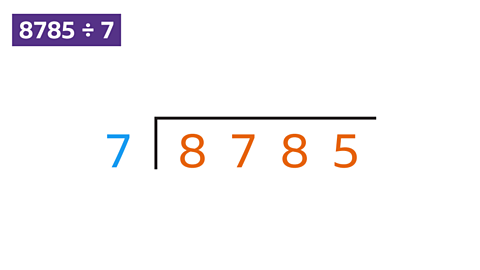
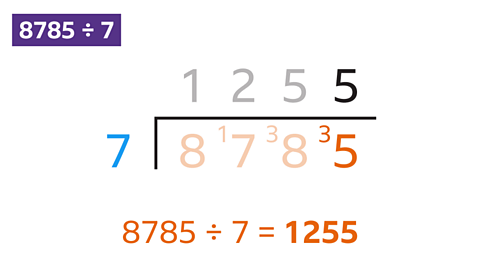
Use short division to work out 8785 ÷ 7
Start with 8 ÷ 7. 8 ÷ 7 = 1 remainder 1. Write 1 above 8 and carry the 1 to the next digit to give 17
17 ÷ 7 = 2 remainder 3. Write 2 above the 7 and carry the 3 to the next digit to give 38
38 ÷ 7 = 5 remainder 3. Write 5 above the 8 and carry the 3 to the next digit to give 35
35 ÷ 7 = 5. Write 5 above the 5
8785 ÷ 7 = 1255
How to complete a short division calculation with remainders
- When one number cannot divide completely into another number, there is a The amount remaining after division. Eg, 30 divided by 7 is 4 remainder 2.
- If there is a remainder when you calculate the last digit, add a decimal point to the number to be divided and a decimal point above that in the answer space.
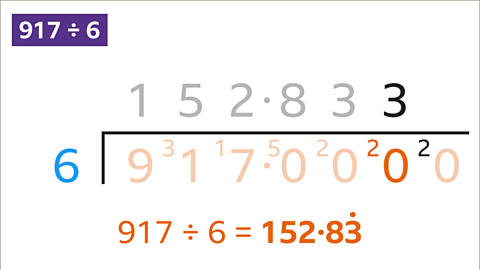
- If a decimal place answer digit is A repeating digit or group of digits. A repeating digit can be shown with a dot over the repeating digit. Eg, 0.3333 may be written as 0.3 with a dot over the 3 , it can be shown in the answer with a dot above the repeating digit. If a decimal number has digits that ends, it is a A decimal number that has digits that end. Eg, 0.25 is a terminating decimal with two decimal digits..
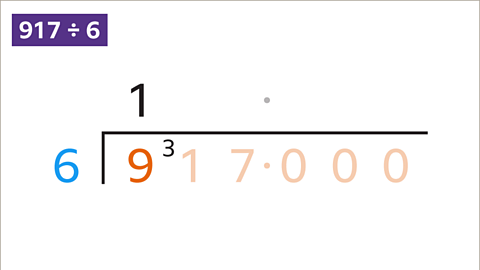
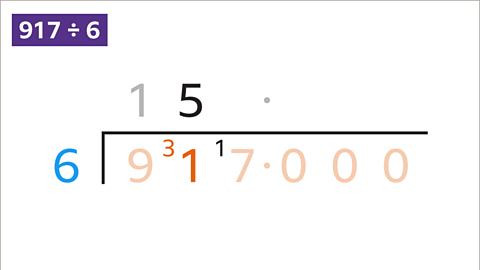
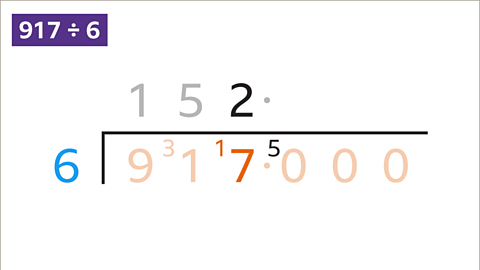
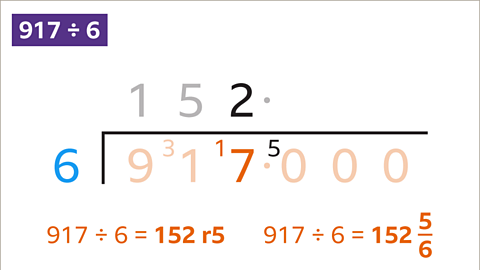
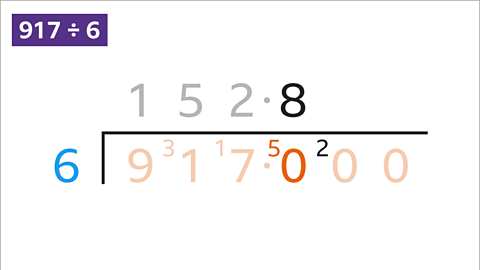
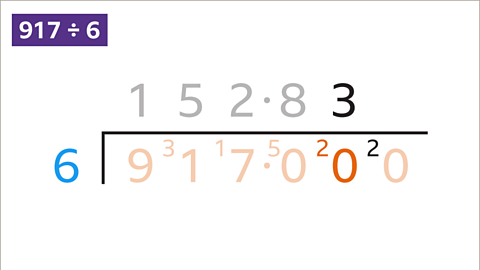
Example: calculate 917 ÷ 6
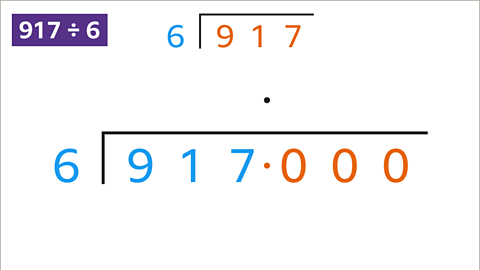
Image caption, Use short division to work out 917 ÷ 6. There will be a remainder because 917 is odd and all numbers in the 6 times table are even. Extend to include a decimal point and decimal places.
1 of 8
Question
Use short division to work out 73 ÷ 5. You might need a pen and paper to solve this problem.
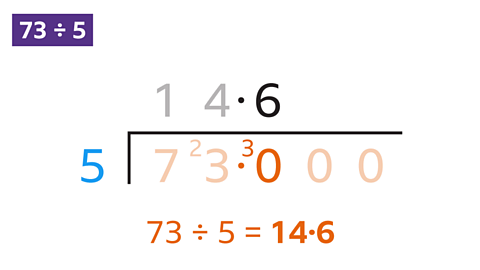
Use short division to work out 73 ÷ 5.
There will be a remainder because 73 is not a multiple of 5. Add a decimal point after the 3
Start with 7 ÷ 5. 7 ÷ 5 = 1 remainder 2. Write 1 above 7 and carry the remainder 2 to the next digit to give 23
23 ÷ 5 = 4 remainder 3. Write 4 above the 3 and carry the remainder 3 to the next digit to give 30. 30 ÷ 5 = 6
There are no more numbers after the 6. This answer is a terminating decimal.
73 ÷ 5 = 14.6
Practise short division
Try this quiz to practise short division. You might need a pen and paper to solve the problems in this quiz.
Quiz
Real-world maths

- A waiter may need to divide a bill for a group of friends who are eating out at a restaurant so that the cost is split equally between the group.
- A gardener may need to calculate how many grams of organic fertilizer they can allocate to each of their 6 raised vegetable beds.
Revise for your exams with BBC Bitesize
Get ready for the GCSEs with quizzes, past papers, flashcards, podcasts and more resources!

More on Operations - Calculations
Find out more by working through a topic
- count7 of 10
- count10 of 10