What is Bonfire Night?

Bonfire Night is celebrated every year on 5 November.
In the UK, people light bonfires, fireworks and sparklers in parks and gardens all over the country.
Sometimes a dummy called a guy is burned on the bonfire.
The guy represents Guy Fawkes, who was part of the Gunpowder Plot.
Guy Fawkes tried to blow up the Houses of Parliament in 1605, but he was stopped.
History

On 5 November 1605, 36 barrels of gunpowder were discovered hidden under the Houses of Parliament.
A man called Guy Fawkes and other men had made a plan to blow up the building.
Here is some more information, along with some videos and activities you could try to learn more.
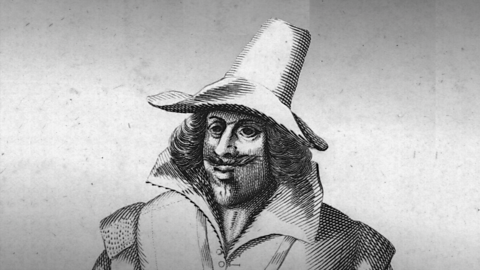
Who was Guy Fawkes?
Guy Fawkes was born in April 1570 in York, England. His parents were Protestants, but during his childhood, Guy became a Catholic. At that time, it was dangerous to be Catholic.
At the age of 21, Guy left England to join the Catholic Spanish army and fought in the Eighty Years' War.
During his time in the army, he was known by the name ‘Guido’, the Italian version of Guy.
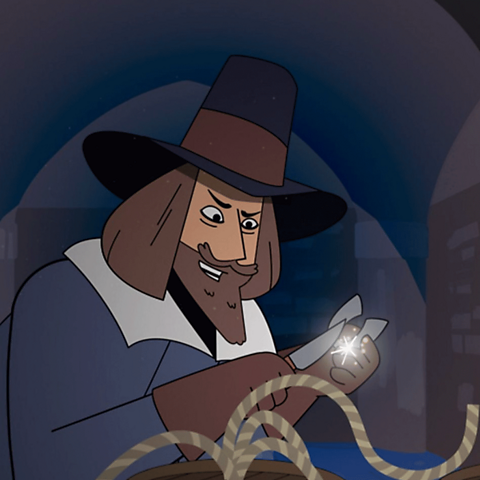
What was the Gunpowder Plot?
In 1605, Guy Fawkes joined a group of English Catholics in a plot to blow up the Houses of Parliament on 5 November in order to kill King James I and his government.
Fawkes was responsible for lighting the fuse to the barrels of gunpowder, which they had hidden under the Houses of Parliament.
However, the gunpowder and Guy Fawkes were found in the cellars of the Houses of Parliament and Guy Fawkes was arrested.
On 31 January 1606, Guy Fawkes was taken to the Old Palace Yard in Westminster, where he was hanged for his part in the plot.
Watch: Horrible Histories - The Gunpowder Plot song
Learn more fascinating facts about Guy Fawkes in this video.
Sing along as we hear about the birth of fireworks and Guy Fawkes' failed gunpowder plot that led to his capture, with this BANGing tune from Horrible Histories!
The birth of fireworks, an ancient Chinese tale.
Wei Boyang tried to live forever,
but was doomed to fail.
He mixed three powders up,
thought they would be a hit.
He didn’t live so long
but now the spark was lit.
Cos when you add some
heat and then retreat,
It starts to smoke and spark,
and lights the dark.
Oh, this really seems to help my psoriasis.
Yes, he has made an eczema cure.
Apply the mixture to the sore.
Not what he was looking for.
Must be more to this for sure.
Little fireworks go zoom, zoom, zoom.
But fill a barrel and it’s boom, boom, boom.
We’ll blow the king across the room, room, room.
Then Catholic England can resume, ‘sume, ’sume.
Cos they were using gunpowder
that started as an eczema cure.
But Guy Fawkes’ plan did not go bang.
And soon he was a captured man.
Now no matter where you go, fireworks put on a show.
Hear the crowds go “ah, aah, OOOH!” entertainment just for you.
Did you know?
During World War I and World War II, Bonfire Night was celebrated indoors.
This was because it was illegal to light bonfires and fireworks because of the wartime blackouts.
This was part of an 1914 Act of Parliament in called The Defence of the Realm Act, which aimed to protect people during the war by not showing the enemy where they were.
Discover more on KS2 History
You can learn about more important figures in history and what life was like in earlier times in these articles below.
Design and Technology
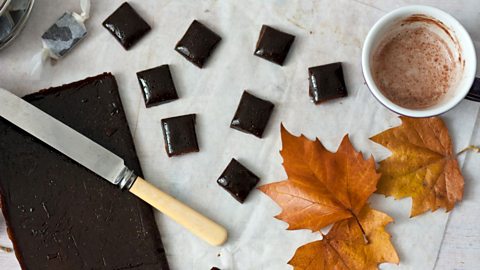
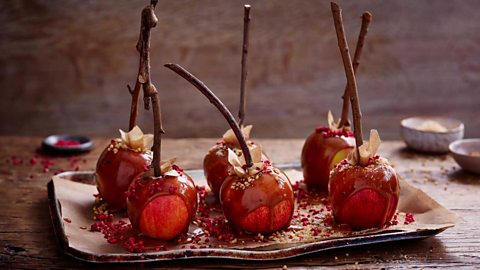
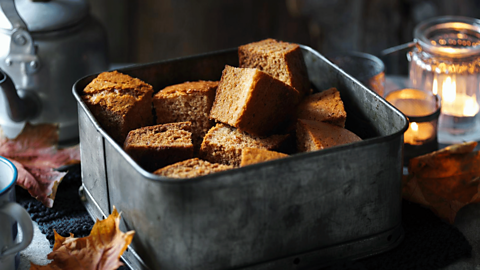
There are lots of sweet treats that we eat around Bonfire Night.
Some recipes have been around for hundreds of years.
Check out the information and links below to find out more about some traditional Bonfire Night treats.
Bonfire Night recipes
There are lots of traditional treats made for Bonfire Night. They are often sticky and slightly spicy to keep us warm in the cold weather.
Follow the links below and have a go at making some of your own treats.
Remember to always have an adult around to help you when making any of the recipes.
This slideshow tells you more about these Bonfire Night treats.
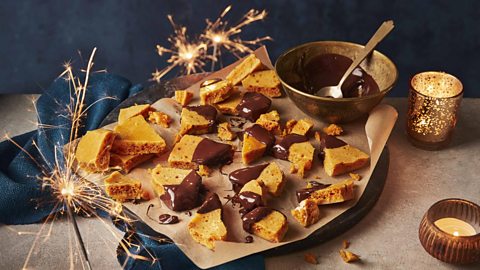
Image caption, Cinder toffee
Cinder toffee, also known as honeycomb, is a traditional UK recipe which has been around for centuries. It has a crunchy, bubbly texture and can be eaten on its own or dipped in chocolate.
1 of 4
Discover more on Design and Technology
Look at these links below to improve your cooking skills and learn more about food.
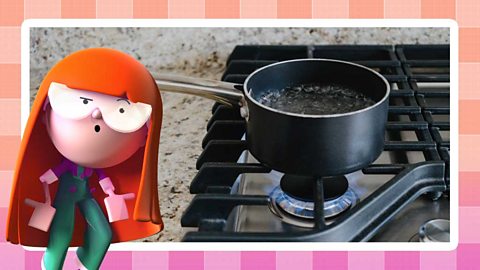
Cooking safely with heat
KS2 Design and Technology
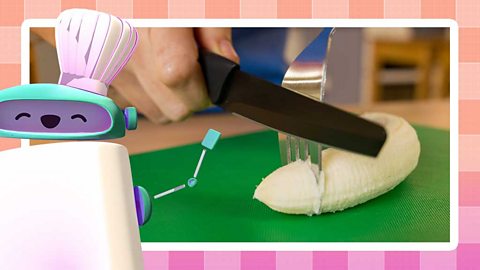
Slicing and cutting safely
KS2 Design and Technology
What is seasonality?
KS2 Design and Technology
Citizenship

It is very important that we stay safe when we are out and about.
Although Bonfire Night is great fun, there are some things that we can do to keep ourselves and others safe.
Here is some more information and activities for you to learn more.
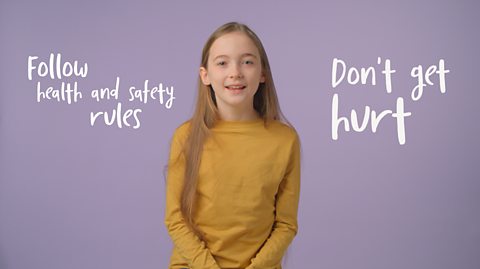
What is health and safety?
Health and safety is important as it helps to keep everyone safe and well in their community.
Rules and guidance are made to prevent accidents or injuries to people.
Following health and safety rules can make the community a safer place for everyone.
Staying safe on Bonfire Night
Have a look at this slideshow for some top tips on keeping yourself and others safe on Bonfire Night.
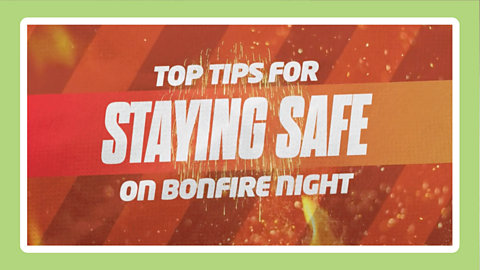
Image caption, Follow these tips to staying safe on Bonfire Night.
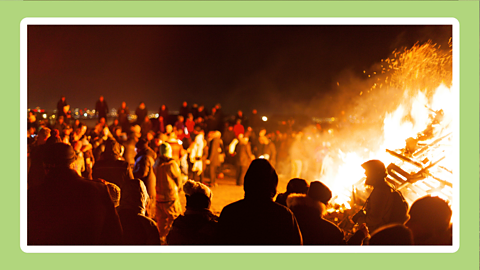

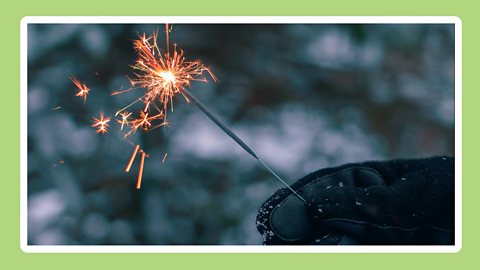
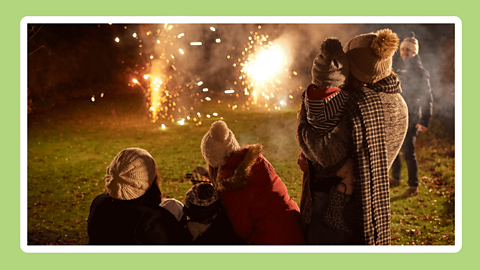


1 of 7
Discover more on KS2 Citizenship
Follow the links below to learn more about how we can look after ourselves and others.
Health and safety in the community
KS2 Citizenship
Helping others
KS2 Citizenship

Differences and diversity
KS2 Citizenship
Quiz - Bonfire Night
Put your Bonfire Night knowledge to the test with this quiz.
More resources from the BBC
You can find many more amazing resources from around the BBC.
Follow the links below for more ideas on Bonfire Night.
Fantastic things about fireworks
BBC Newsround

How to make a bottle rocket
BBC Teach - Terrific Scientific DIY

Fawkes' 13
CBBC - Horrible Histories
Where next?

Play Bitesize Primary games. game
Fun and educational primary games in science, maths, English, history, geography, art and design, computing and modern languages.