Key points about describing tourist attractions

Use opinion phrases followed by an The basic form of the verb. In French, all infinitives end in '-er', '-ir' or '-re'. to describe tourist attractions.
Use A verb that is usually followed by an infinitive, such as pouvoir (to be able to), vouloir (to want to), and devoir (must). to talk about things you can do, have to do or want to do.
Used to communicate that something must be done without specifying who should do it, where there is no natural subject (I, you, he, etc.). can be used to describe what attractions there are in a particular place and to talk about the weather.
This guide contains video as well as listening and reading practice.
Video - Describing tourist attractions
Watch the video of Detchen as she travels to Orléans, discovers street art and visits the local market.
Detchen uses modal verbs to describe her trip to Orléans and what she does there
Bonjour !
Je m’appelle Detchen et je suis prof de français.
Mais j’enseigne en ligne donc je peux voyager très facilement.
J'habite le plus souvent à Paris, dans le nord de la France.
Aujourd’hui, je voyage pour le plaisir !
Je vais aller passer la journée à Orléans.
Orléans est à 1 heure en train de Paris.
J’adore prendre le train, parce que c'est plus écologique que la voiture et plus confortable aussi: j'aime bien lire dans le train !
Allons-y !
J’ai de très bons amis à Orléans.
Ils m’ont donné des conseils pour passer une super journée !
Quand j’arrive dans une nouvelle ville, j’adore marcher.
À Orléans, on peut admirer l’art dans les rues.
J’adore les mosaïques.
D’ailleurs, saviez-vous qu'en français, on utilise en général l’expression anglaise “street art” ?
À Orléans, on peut aussi aller au marché.
J’adore les marchés. Les marchés, c’est typique de la France.
Les fruits et légumes sont frais au marché. J’adore !
J’ai passé une super journée !
Il y a encore plein de choses à faire, mais il est temps de s’arrêter.
Je peux rentrer à Paris ou je peux dormir chez mes amis, qui ont une chambre libre.
Quand je voyage comme ça, j’essaie toujours de dormir chez des amis ou chez ma famille, c’est mieux et moins cher qu'une chambre d'hôtel !
Si vous venez en France, n’hésitez pas à demander autour de vous.
Peut-être que l’ami d’un ami aura une chambre pour vous !
Translation
Hello!
My name is Detchen and I am a French teacher.
But I teach online so I can travel very easily.
I live most often in Paris, in the north of France.
Today, I’m travelling for fun!
I'm going to go and spend the day in Orléans.
Orléans is 1 hour by train from Paris.
I love taking the train, because it’s more ecological than by car and more comfortable too: I like reading on the train!
Let's go!
I have some great friends in Orleans.
They gave me tips so I can have a great day!
When I arrive in a new city, I love walking.
In Orléans, you can admire the art in the streets.
I love mosaics.
By the way, did you know that in French, we generally use the English expression “street art”?
In Orléans, you can also go to the market.
I love markets. Markets are typical of France.
Fruits and vegetables are fresh at markets. I love it!
I've had a great day!
There's still plenty of things to do, but it's time to stop.
I can go back to Paris or sleep at my friends', who’ve got a spare room.
When I travel like this, I always try to stay with friends or family, it's better and cheaper than a hotel room!
If you come to France, don't hesitate to ask around.
Maybe a friend of a friend will have a room for you!
Vocabulary - Visiting and describing tourist attractions
Express opinions about destinations and and tourist attractions with this useful vocabulary
| French | English |
|---|---|
| Check your connection, refresh the page and try again. | I like |
| Check your connection, refresh the page and try again. | I don't like |
| Check your connection, refresh the page and try again. | I love |
| Check your connection, refresh the page and try again. | I prefer |
| Check your connection, refresh the page and try again. | I would like |
| Check your connection, refresh the page and try again. | I'm going to |
| Check your connection, refresh the page and try again. | I intend to |
| Check your connection, refresh the page and try again. | I hope |
| Check your connection, refresh the page and try again. | I've always wanted to |
Opinion and expressions of intention phrases can be followed by an infinitive. Useful infinitive phrases include:
| French | English |
|---|---|
| visiter des sites historiques | to visit historic sites |
| voir l’ancien château | to see the old castle |
| se promener à la campagne | to go for a walk in the countryside |
| aller à la montagne | to go the mountains |
| se relaxer au bord de la mer | to relax by the seaside |
| visiter le vieux quartier | to visit the old quarter |
| manger dans un restaurant vivant | to eat in a lively restaurant |
| visiter des musées et des galeries d’art | to visit museums and art galleries |
| aller au marché pour acheter des souvenirs | to go to the market to buy souvenirs |
| recommander des sites touristiques | to recommend tourist sites |
For example:
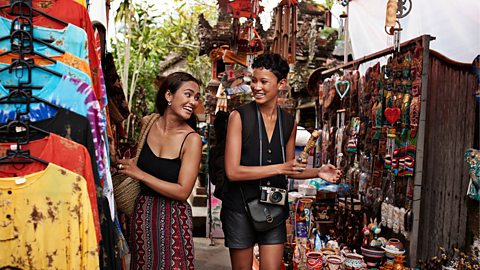
Je vais aller au marché pour acheter des souvenirs. - I am going to go to the market to buy some souvenirs.
J'espère visiter le vieux quartier. - I hope to visit the old quarter.
Je préfère visiter des sites historiques. - I prefer visiting historic sites.
J'ai toujours voulu visiter des musées et des galeries d'art. - I've always wanted to visit museums and art galleries.
Grammar - Modal verbs
Modal verbs verbs indicate modality, ability, necessity, possibility, obligation and permission.
Modal verbs can work on their own, or with another verb that is always in the infinitive.
For example:
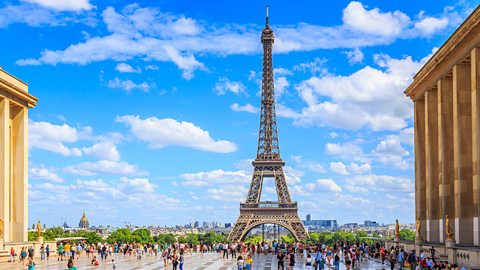
Je peux visiter les sites touristiques. - I can visit the tourist sites.
Je veux visiter la Tour Eiffel. – I want to visit the Eiffel Tower.
Useful modal verbs in French include:
vouloir - to want
devoir - to have to, must
pouvoir - to be able to, can
savoir - to know
Click or tap on the Show more button to find out how to conjugate these key modal verbs.
Vouloir - to want
| French | English |
|---|---|
| Check your connection, refresh the page and try again. | I want |
| Check your connection, refresh the page and try again. | you want (singular, informal) |
| Check your connection, refresh the page and try again. | he/it wants |
| Check your connection, refresh the page and try again. | she/it wants |
| Check your connection, refresh the page and try again. | one wants/we want |
| Check your connection, refresh the page and try again. | we want |
| Check your connection, refresh the page and try again. | you want (singular formal or plural) |
| Check your connection, refresh the page and try again. | they want (masculine or mixed) |
| Check your connection, refresh the page and try again. | they want (feminine) |
Devoir - to have to/must
| French | English |
|---|---|
| Check your connection, refresh the page and try again. | I have to/I must |
| Check your connection, refresh the page and try again. | you have to/you must (singular, informal) |
| Check your connection, refresh the page and try again. | he/it has to/he/it must |
| Check your connection, refresh the page and try again. | she/it has to/she/it must |
| Check your connection, refresh the page and try again. | one has to/we have to/one must/we must |
| Check your connection, refresh the page and try again. | we have to/we must |
| Check your connection, refresh the page and try again. | you have to/you must (singular formal or plural) |
| Check your connection, refresh the page and try again. | they have to/they must (masculine or mixed) |
| Check your connection, refresh the page and try again. | they have to/they must (feminine) |
Pouvoir - to be able to/can
| French | English |
|---|---|
| Check your connection, refresh the page and try again. | I can/I am able to |
| Check your connection, refresh the page and try again. | you can/you are able to (singular, informal) |
| Check your connection, refresh the page and try again. | he/it can/he/it is able to |
| Check your connection, refresh the page and try again. | she/it can/she/it is able to |
| Check your connection, refresh the page and try again. | one can/one is able to |
| Check your connection, refresh the page and try again. | we can/we are able to |
| Check your connection, refresh the page and try again. | you can/you are able to (singular formal or plural) |
| Check your connection, refresh the page and try again. | they can/they are able to (masculine or mixed) |
| Check your connection, refresh the page and try again. | they can/they are able to (feminine) |
Savoir - to know
| French | English |
|---|---|
| Check your connection, refresh the page and try again. | I know |
| Check your connection, refresh the page and try again. | you know (singular, informal) |
| Check your connection, refresh the page and try again. | he/it knows |
| Check your connection, refresh the page and try again. | she/it knows |
| Check your connection, refresh the page and try again. | one knows |
| Check your connection, refresh the page and try again. | we know |
| Check your connection, refresh the page and try again. | you know (singular formal or plural) |
| Check your connection, refresh the page and try again. | they know (masculine or mixed) |
| Check your connection, refresh the page and try again. | they know (feminine) |

Remember
Modal verbs are often used with the on form to mean ‘you’/’we’ do something in a general sense.
For example:
On doit visiter Montmartre. – We must visit Montmartre.
On peut aller au stade. – We can go to the stadium.
Find out more about using modal verbs in the Infinitives in French guide.
Modal verbs - Mini quiz
Complete the following sentences with the correct modal verb:
________ visiter des sites touristiques.
I want to visit tourist sites.
Je veux visiter des sites touristiques.
Je veux means ‘I want’.
______ voir l’ancien château.
One (we) must see the old castle.
On doit voir l’ancien château.
On doit means ‘one (we) must’.
_______ aller au stade.
We can go to the stadium.
Nous pouvons/on peut aller au stade.
Nous pouvons/on peut mean ‘we can’.
_______ comment aller au centre-ville ?
Do you (singular informal) know how to get to the town centre?
Tu sais/Sais-tu comment aller au centre-ville ?
Tu sais means ‘you know’ or ‘do you know’.
To ask a question in French you can either say tu sais or invert the verb and say sais-tu.
Listening practice
Listen to Emma and Jules discussing visiting the Alps in France and decide whether each of the following statements are true or false.
Are the following statements true or false?
- Emma has never been to Nice before.
The statement is true.
The text says: Tu as déjà visité Nice ? Pour moi c’est la première fois.
Have you ever visited Nice? For me it's the first time.
- Jules recommends visiting the castle.
The statement is false.
The text says: Oui, j’adore Nice. On peut aller au vieux Nice et se promener avec tout le monde sur la Promenade des Anglais, près de la plage.
Yes, I love Nice. You can go to Nice old town and walk with everyone on the Promenade des Anglais, next to the beach.
- Emma is visiting Nice just with her mother.
The statement is false.
The text says: Je vais avec mes parents et ma mère aime le shopping et les restaurants.
I’m going with my parents and my mother likes shopping and restaurants.
- Jules recommends the shopping centre for good shopping.
The statement is false.
The text says: Pour le shopping il faut aller au marché au Cours Salaya.
For shopping you have to go to the market at Cours Salaya.
- Jules recommends eating at a restaurant by the sea.
The statement is false.
The text says: Vous devez aller manger dans un restaurant au bord de la mer.
You have to go eat in a restaurant by the sea.
Click or tap on Show more to see the full transcript and translation.
Transcript
Emma:Tu as déjà visité Nice ? Pour moi c’est la première fois.
Jules:Oui, j’adore Nice. On peut aller au vieux Nice et se promener avec tout le monde sur la Promenade des Anglais, près de la plage.
Emma:Ah bon. Je vais avec mes parents et ma mère aime le shopping et les restaurants. Qu’est-ce que tu peux recommander ?
Jules:Pour le shopping il faut aller au marché au Cours Salaya où on peut trouver des jolis souvenirs. En plus, vous devez aller manger dans un restaurant au bord de la mer !
Translation
Emma: Have you ever visited Nice? For me it's the first time.
Jules: Yes, I love Nice. You can go to Nice old town and walk with everyone on the Promenade des Anglais, next to the beach.
Emma: Oh right. I’m going with my parents and my mother likes shopping and restaurants. What can you recommend?
Jules: For shopping you have to go to the market at Cours Salaya where you can find beautiful souvenirs. Plus you have to go eat in a restaurant by the sea.
Vocabulary - Places and sights to visit
Useful adjectives to describe places you might visit include:
| French | English | French | English |
|---|---|---|---|
| beau/bel/beaux/belle/belles | beautiful | froid(e) | cold |
| calme | calm, quiet | historique | historic |
| chaud(e) | hot, warm | idéal(e) | ideal |
| cher/chère | expensive | industriel(le) | industrial |
| étranger/étrangère | foreign | propre | clean |
Useful nouns to use when talking about places to visit include:
| French | English | French | English |
|---|---|---|---|
| Check your connection, refresh the page and try again. | seaside | Check your connection, refresh the page and try again. | sea |
| Check your connection, refresh the page and try again. | countryside | Check your connection, refresh the page and try again. | mountains |
| Check your connection, refresh the page and try again. | castle | Check your connection, refresh the page and try again. | mosque |
| Check your connection, refresh the page and try again. (f) | church | Check your connection, refresh the page and try again. | museum |
| Check your connection, refresh the page and try again. (m) | place | Check your connection, refresh the page and try again. | country |
| Check your connection, refresh the page and try again. (f) | island | Check your connection, refresh the page and try again. | stadium |
| Check your connection, refresh the page and try again. | garden | Check your connection, refresh the page and try again. | synagogue |
| Check your connection, refresh the page and try again. | shop | Check your connection, refresh the page and try again. | temple |
| Check your connection, refresh the page and try again. | market | Check your connection, refresh the page and try again. | view |
Vocabulary - The seasons of the year
| French | English |
|---|---|
| Check your connection, refresh the page and try again. | in spring |
| Check your connection, refresh the page and try again. | in summer |
| Check your connection, refresh the page and try again. | in autumn |
| Check your connection, refresh the page and try again. | in winter |
All Foundation Tier vocabulary listed in this guide can be found on the vocabulary sheet below.
Impersonal verbs
Impersonal means that the verb does not change according to the person doing the action of the verb.
Impersonal verbs, therefore, have only one conjugation: the third person singular indefinite, il, which in this case is equivalent to ‘it’ in English. For example:
Check your connection, refresh the page and try again. – there is/are
Check your connection, refresh the page and try again. – there was/were, there used to be
Check your connection, refresh the page and try again. – there will be, there is going to be
Check your connection, refresh the page and try again. followed by the infinitive - it is/it’s necessary followed by a verb.
Il y a beaucoup de sites touristiques à Montréal. – There are lots of tourist sites in Montreal.
À Paris il y avait moins de touristes dans le passé. – In Paris there used to be fewer tourists in the past.
À l’avenir il y aura un nouveau musée ici. – In the future there will be a new museum here.
Il faut voir l’ancien château. – It’s necessary to see the old castle.
Se trouver (to be situated) can be used as an impersonal verb:
For example:
Le château se trouve dans le centre-ville. – The castle is situated in the town centre.
Using impersonal verbs to talk about the weather
Use impersonal verbs when talking about the weather. For example:
Il fait chaud aujourd'hui. - It is hot today.
Have a look through the slideshow to see how impersonal verbs are used when talking about the weather in French.
Click or tap on Show more to see a list of phrases for describing the weather.
| French | English |
|---|---|
| Il fait froid | It's cold |
| Il fait chaud | It's hot |
| Il fait du soleil | It's sunny |
| Il fait du vent | It's windy |
| Il fait beau | It's good weather |
| Il fait mauvais | It’s bad weather |
| Il pleut | It’s raining/It rains |
| Il neige | It’s snowing/It snows |
Impersonal verbs - Mini quiz
Complete the following sentences with the correct impersonal verbs:
_____ beaucoup de temples dans la ville.
There are lots of temples in the town.
Il y a beaucoup de temples dans la ville.
Il y a is the impersonal verb meaning ‘there is/are’.
______ voir l’Arc de Triomphe.
It’s necessary to see the Arc de Triomphe.
Il faut voir l’Arc de Triomphe.
Il faut followed by the infinitive is an impersonal verb meaning ‘it’s necessary to’.
_____ beaucoup à Montréal.
It snows a lot in Montreal.
Il neige beaucoup à Montréal.
Il neige is the impersonal verb meaning ‘it snows’.
Find out more about using impersonal verb phrases in the Infinitives in French guide.
Reading practice
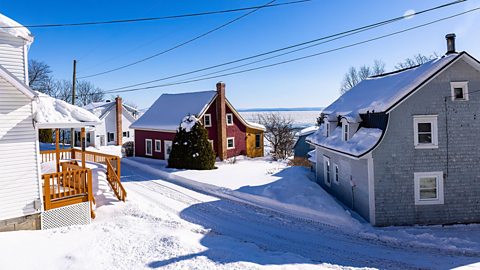
You see an advert about three places to visit in Québec, a French-speaking province in Canada.
Read the advert and answer the questions below.
Montréal
L’ancienne ville historique est très agréable avec ses bars et restaurants vivants et le vieux port. Les gens qui aiment faire du shopping vont adorer les marchés.
Les Éboulements
Les Éboulements est une ville dans l’est de la région. Elle est célèbre pour les belles vues sur la grande rivière qui va vers la mer. Il y a des galeries d’art et des endroits qui servent la cuisine traditionnelle.
La Vile de Québec
La Ville de Québec est une jolie ville pleine d’histoire. Le château se trouve en centre-ville. A une heure de la ville, il y a des forêts et des montagnes. C’est idéal quand il neige en hiver. En été il fait très chaud.
- In Montreal, you can visit…
a) the new town
b) the old town
c) the castle
b) In Montreal you can visit the old town.
L’ancienne ville historique est très agréable. – The old historic town is very nice.
- Montreal will please people who like …
a) delicious food
b) sightseeing
c) shopping
c) Montreal will please who like shopping.
Les gens qui aiment faire du shopping vont adorer les marchés. - People who like shopping will love the markets.
- Les Éboulements is in the … of the region.
a) east
b) west
c) north-west
a) Les Éboulements is in the east of the region.
Les Éboulements est une ville dans l’est de la région. - Les Éboulements is a town in the east of the region.
- Les Éboulements has good views of …
a) the sea
b) traditional houses
c) the river
c) 4. Les Éboulements has good views of the river.
Elle est célèbre pour les belles vues sur la grande rivière qui va vers la mer. - It is famous for the beautiful views of the big river that flows towards the sea.
- In Québec City you can go to the … .
a) castle
b) forest
c) mountains
a) In Québec City you can go to the castle.
Le château se trouve en centre-ville. A une heure de la ville, il y a des forêts et des montagnes. - The castle is located in the city centre. An hour from the city, there are forests and mountains.
- The ideal time to see the city is in the …
a) the summer
b) the spring
c) the winter
c) The ideal time to see the city is in the winter.
C’est idéal quand il neige en hiver. - It’s ideal when it snows in winter.
Click or tap on Show more to read translations of the adverts.
Montréal
L’ancienne ville historique est très agréable avec ses bars et restaurants vivants et le vieux port. Les gens qui aiment faire du shopping vont adorer les marchés.
The old historic town is very nice with its lively bars and restaurants and the old port. People who like shopping will love the markets.
Les Éboulements
Les Éboulements est une ville dans l’est de la région. Elle est célèbre pour les belles vues sur la grande rivière qui va vers la mer. Il y a des galeries d’art et des endroits qui servent la cuisine traditionnelle.
Les Éboulements is a town in the east of the region. It is famous for the beautiful views of the big river that flows towards the sea. There are art galleries and places that serve traditional food.
La Vile de Québec
La Ville de Québec est une jolie ville pleine d’histoire. Le château se trouve en centre-ville. A une heure de la ville, il y a des forêts et des montagnes. C’est idéal quand il neige en hiver. En été il fait très chaud.
The city of Québec is a beautiful city full of history. The castle is located in the city centre. An hour from the the city, there are forests and mountains. It is ideal when it snows in winter. In summer it is very hot.
Vocabulary sheet
Click or tap on the image below for a list of useful vocabulary to use when describing tourist attractions.

Higher Tier - Vocabulary - Talking about tourist attractions
Useful vocabulary for describing tourist attractions include:
| French | English |
|---|---|
| Check your connection, refresh the page and try again./Check your connection, refresh the page and try again. | lively |
| Check your connection, refresh the page and try again. | coast |
| Check your connection, refresh the page and try again. | river |
All Foundation and Higher Tier vocabulary listed in this guide can be found on the vocabulary sheet below.
Higher Tier - Grammar - How to use impersonal verbs
Higher Tier impersonal verbs include:
Il manque… - … is missing
Il vaut la peine de (followed by the infinitive) - It is/it's worth (followed by the verb)
Il vaut mieux (followed by the infinitive) - It is/it's better (followed by the verb)
For example:
Il manque un centre commercial - It needs a shopping centre.
Il vaut la peine de visiter la Tour Eiffel. – It’s worth visiting the Eiffel Tower.
Il vaut mieux prendre un bus pour voir la ville. – It’s better to take a bus to see the town.
Find out more about more about using impersonal verb phrases in the Infinitives in French guide.
Higher Tier - Vocabulary sheet
Click or tap on the image below for a list of useful Higher Tier vocabulary to use when describing tourist attractions.
Now you have revised the important vocabulary and key grammar points for describing tourist attractions, why not try have a look at the Describing the local area guide?
Revise for your exams with BBC Bitesize
Get ready for the GCSEs with quizzes, past papers, flashcards, podcasts and more resources!

More on Travel, tourism and places of interest
Find out more by working through a topic
- count2 of 5
- count4 of 5