On a screen, a teenager is unboxing a package. Scissors cut through the sticky tape with a satisfying “fwhip”. The anticipation builds as they slowly fold one side of the lid over, and then the other. Finally, with thousands of eyes upon them, they reach in and carefully lift out the item inside.
Unboxing content is big – but why are we even watching? Sometimes it’s because we want to actually see what’s in the box - but often we’re there for the thrill of the unboxing itself, and the reason for that dates back millions of years.
Bitesize looks into how the success of unboxing videos online is linked to our ancient survival instincts.

The forager’s dopamine hit
Without a supermarket to pop into whenever they felt a bit peckish, our ancestors needed the drive to find food or water or they would, quite simply, die.
When cave people were out searching for roots, berries or water, dopamine provided the energy and focus to keep them walking over the next hill.
Dopamine is a chemical released by the brain, which is often referred to as the “feel good chemical”. It rewards us for learning, which in the case of our ancestors would be the process of looking for the food, not finding it.
This is why we often get a bigger buzz when watching the unboxing part of a video than we do from the big reveal.
We’re attracted to novelty
Curiosity helps us evolve as individual human beings and as a society. Babies are curious about the world around them - actively seeking and absorbing new information and developing skills as they grow and learn.
As groups of people, we look for ways to innovate and shape society. We invent new vehicles, discover cures for disease and send shuttles into space.
We also watch online videos of people unboxing the latest phone model or stationery haul, another way to satisfy our curiosity.
Back in the 1870s, British naturalist Charles Darwin wrote in his book about evolution, The Descent of Man, that curiosity plays a big role in how species develop, and scientists have since discovered the link between curiosity and dopamine we’ve already described.
This dopamine shot makes us sit up and pay attention - in the case of Paleolithic humans to work out whether the new discovery would be nourishing or poisonous.
Safety in numbers
Have you ever noticed, when you’re watching a content creator tear open a layer of tissue paper, that you can almost feel soft, crinkly wrapping in your own fingers?
And when they peek inside a box and exclaim in delight - do you get a rush of excitement too?
This is due to mirror neurons, brain cells that react the same whether we are experiencing something ourselves or are witnessing someone else do it.
In the early 1990s, Italian scientists discovered these neurons fired in the same way when a monkey grabbed an object as when it watched another monkey grab one.
This not only explains why we feel empathy for other people - like when someone is feeling sad, we feel sad too, but also shows how we learn from watching each other. Understanding how other people feel makes us feel connected to each other and helps build community.

Behold the haul
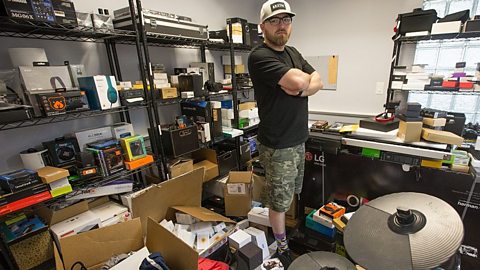
It’s not just the anticipation of unboxing videos that draws us in, it’s also the size of the haul. Just like animals store up food for winter, our ancestors gathered stashes of supplies to keep them going during the colder months when things to eat were much harder to come by.
In fact, it’s only in recent decades that we have no longer had to do this. The invention of freezers and mass production of food, as well as fruit and vegetables being imported from all over the world, means we are no longer restricted to eating with the seasons. Making jam and canning or pickling produce were popular ways to ensure you would have food to eat when there was little growing locally.
Our attraction to videos of content creators revealing a haul of beauty products or toys could actually relate to our innate desire to feel safe and provided for.
This article was published in February 2026
From bedroom to boardroom - three UK businesses that made millions from small beginnings
BBC Bitesize explores the incredible stories of three businesses that went global against the odds

Why do these controversial foods divide opinion?
BBC Bitesize takes a look at the scientific factors behind commonly disliked foods.
Why are iguanas freezing and falling out of trees in Florida?
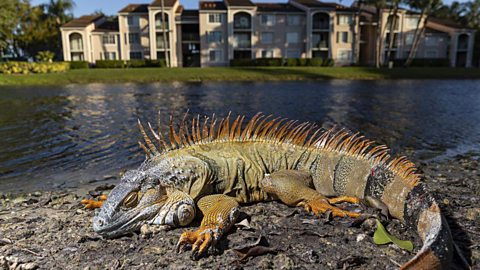
BBC Bitesize looks into the phenomenon of frozen iguanas in the Sunshine State