Ever been for a winter walk in cold weather and felt frozen?
Well, spare a thought for wild iguanas in Florida in the United States.
Overnight temperatures have been dropping below zero in the Sunshine State in recent weeks – and that’s led to a spate of frozen lizards falling out of trees.
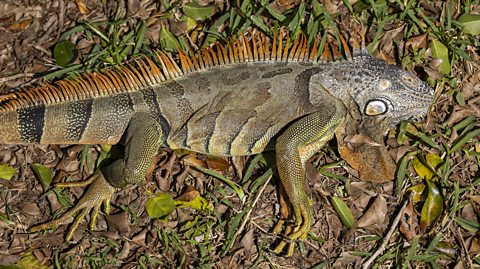
BBC Bitesize wraps up warm and explores why this is happening.
Ice in the Sunshine State
It’s unusual for Florida to experience extreme cold temperatures.
Home to multiple theme parks and a holiday destination for around a million British tourists each year, we’re more likely to associate the Sunshine State with extreme heat than the cold.
But Florida has had some record-breaking cold weather in 2026 – with holidaymakers waking up to freezing temperatures and ice. This has meant some water parks and water-based rides at theme parks being forced to close.
But the most shocking sight across the region is the volume of seemingly frozen iguanas at the foot of trees.
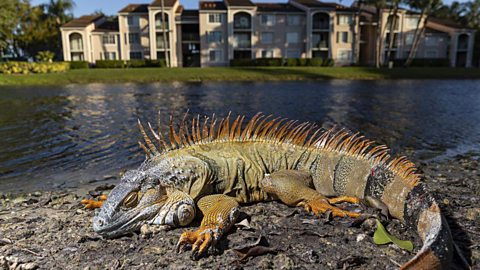
Iguanas are cold-blooded reptiles – meaning they rely on the sun and higher temperatures in order to stay warm.
But once temperatures drop below 4C (39F), the lizards go into a form of survival mode.
Drop it like it’s cold
In these colder conditions, an iguana’s metabolism will slow dramatically and their heart rate and breathing decreases. They enter a state known as torpor – which can look as if they are in a sort of coma.
In this state, their nerve signals slow down to a point where they cannot move, or grip onto branches.
Combine that with the record low temperatures – some parts of Florida reached -5C (23F) in early February – and it appears as if the iguanas have frozen solid.
Typically, iguanas won’t suffer any long-lasting effects from entering torpor – unless they were particularly high up in a tree before falling.
As the temperatures rise, the iguanas start to ‘thaw’ out, coming out of their cold-stunned state and recovering. Despite the freezing overnight temperatures seen across Florida, in some parts of the state temperatures still reached between 7C (45F) and 12C (54F) during the day.
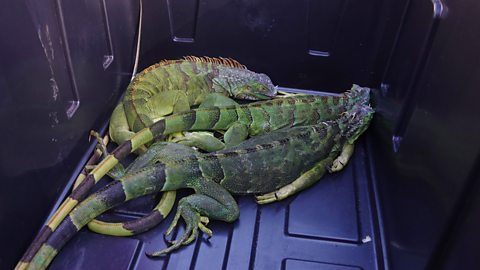
Officials in Florida typically advise people not to take the iguanas into their homes to help them warm up if they come across a frozen one – the reptiles can become aggressive and defensive when they come round.
But due to the unusually low temperatures in some parts of the US state in the big freeze of 2026, the Florida fish and wildlife conservation commission urged the public to bring any frozen iguanas to them, so they could aid their recovery.
Do any other creatures freeze?
It’s fair to say that when it comes to the wood frog, the cold never bothered them anyway.
While most frogs hibernate underwater – in cold, but not freezing conditions – the wood frog takes things a step further.
The only amphibian to live north of the Arctic Circle, the wood frog freezes solid, with up to 70% of the water in its body turning to ice.
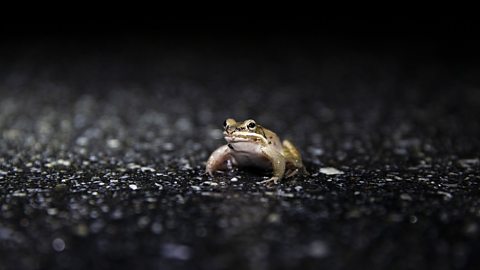
It’s the liquid outside its cells and organs that freezes – meaning it can survive, as any liquid inside would cause catastrophic damage.
Wood frogs can survive in temperatures as low as -16C (3F) – and in their frozen state, they stop breathing, their heart stops beating and their kidneys shut down.
They stay in this state for up to eight months – and once the temperatures rise, they’re typically thawed out and up and jumping again within 10 hours.
A similar thing also happens with painted turtles. Even newborns can survive in a frozen state for around six months, at temperatures as low as -10C (14F).
Despite ice crystals growing around and inside their bodies, the tissues in their bodies can protect them.
When spring comes, the ice around them thaws and they slowly come back to life.
This article was published in February 2026
How to survive and thrive out in the winter weather
We’re all told getting outside is good for us what ever the weather. We've tips from a mountain rescue leader, a sleep expert, a beautician and even a Postie

Meet the animals that live in the most extreme environments
From the mouse at the top of a volcano to the worms at the bottom of the ocean, BBC Bitesize takes a look at the animals that live in the wildest of habitats
Five animals that holiday in colder climates
Which animal has the longest migratory journey on Earth? Here are five animals that prefer to 'chill' in colder climates.