Key points about describing school life
The A verb that describes an action that is happening now or that happens regularly, eg I eat breakfast every day. is used to talk about things that happen regularly and is useful for describing the school day.
Reflexive verbs describe an action that you do to yourself and are useful for describing daily routine and the school day.
A word that usually ends in -self or -selves. They are used when the subject and the object of the verb are the same. For example: I prepare myself. ‘Myself’ is the reflexive pronoun. are used with reflexive verbs.
This guide contains a video as well as reading and listening practice.
Video - Describing daily routine
Watch the video of Detchen describing her daily routine.
Detchen talks about her daily routine using reflexive and other verbs in the present tense
Le matin, je me réveille vers six heure et demi. Je me réveillais à 6h30 quand j’étais à l’école alors c’est une habitude maintenant. Bien sûr, le week-end, on se lève plus tard.
Moi, je m’habille tout de suite. Et après, je me brosse les cheveux.
Aujourd’hui, tu vois, j’ai envie de porter mon pull préféré.
Au petit-déjeuner, je bois un jus d’orange et je mange du pain frais avec du beurre. Parfois, je sors et je vais à la boulangerie.
Je voudrais un jus d’orange et un croissant, s’il vous plaît.
Voici pour vous.
Merci.
Merci, au revoir.
En France, on déjeune entre midi et 14 heures. Quand il fait beau, on peut déjeuner dans un parc ! Je connais un super endroit. On y va ?
Voici le Jardin du Luxembourg. C’est très populaire. Quand on est étudiant dans ce quartier, ou quand on y travaille, c’est parfait !
Le soir, généralement, je me repose chez moi.
Mais parfois, je vais au cinéma avec mes amis ou ma famille. Ici, quand on a moins de 26 ans, la place de cinéma coûte moins cher.
D’habitude, je me couche vers 22 heures. En France, on se couche entre 22 heures et minuit. Maintenant, je vais me coucher !
Translation
In the morning, I wake up around 6:30. I used to wake up at 6:30 when I was in school so it’s a habit now. Of course, on the weekend, we get up later.
I get dressed right away. And after I brush my hair.
Today, you see, I feel like wearing my favourite jumper.
For breakfast, I drink orange juice and eat fresh bread with butter. Sometimes I go out and I go to the bakery.
I’d like an orange juice and a croissant, please.
Here you go.
Thank you.
Thank you, goodbye.
In France, we eat lunch between noon and 14:00. When the weather's nice, you can have lunch in a park! I know a great place. Shall we go?
Here’s le Jardin du Luxembourg. It's very popular. When you're a student in this neighbourhood, or work here, it's perfect!
In the evenings, I generally relax at home.
But sometimes I go to the cinema with my friends or family. Here, if you're under 26, a cinema ticket costs less!
I usually go to bed around 22:00. In France, we go to bed between 22:00 and midnight. Now I'm going to bed!
Useful vocabulary - Describing daily routine and life at school
Useful verbs to use when talking about daily routine include:
| French | English | French | English |
|---|---|---|---|
| Check your connection, refresh the page and try again. | to arrive | Check your connection, refresh the page and try again. | to eat |
| Check your connection, refresh the page and try again. | to have a shower | Check your connection, refresh the page and try again. | to wear/carry |
| Check your connection, refresh the page and try again. | to get dressed | Check your connection, refresh the page and try again. | to go/come back |
| Check your connection, refresh the page and try again. | to get washed | Check your connection, refresh the page and try again. | to finish |
| Check your connection, refresh the page and try again. | to get up | Check your connection, refresh the page and try again. | to travel |
Useful verbs to use when talking about life at school include:
| French | English | French | English |
|---|---|---|---|
| Check your connection, refresh the page and try again., Check your connection, refresh the page and try again. | to learn/teach someone | Check your connection, refresh the page and try again. | to study |
| Check your connection, refresh the page and try again. | to choose | Check your connection, refresh the page and try again. | to win/earn/gain |
| Check your connection, refresh the page and try again. | to understand | Check your connection, refresh the page and try again. | to take exams |
| Check your connection, refresh the page and try again. | to correct/mark | Check your connection, refresh the page and try again. + noun | to make the most of/enjoy + noun |
| Check your connection, refresh the page and try again. | to become | Check your connection, refresh the page and try again. + infinitive/noun | to succeed in + verb/to pass (an exam) |
| Check your connection, refresh the page and try again. | to last | Check your connection, refresh the page and try again. | to work |
Useful nouns to use when talking about daily routine and life at school include:
| French | English | French | English |
|---|---|---|---|
| Check your connection, refresh the page and try again. | library | Check your connection, refresh the page and try again. | lunchtime |
| Check your connection, refresh the page and try again. | secondary school | Check your connection, refresh the page and try again./le prof | teacher |
| Check your connection, refresh the page and try again. (masculine, plural) | course/lessons | Check your connection, refresh the page and try again./Check your connection, refresh the page and try again. | break |
| Check your connection, refresh the page and try again. (masculine, plural) | homework | Check your connection, refresh the page and try again. | result |
| Check your connection, refresh the page and try again. (masculine) | student | Check your connection, refresh the page and try again. | classroom |
| Check your connection, refresh the page and try again. (masculine) | exam | Check your connection, refresh the page and try again. | IT suite |
| Check your connection, refresh the page and try again. | college/sixth form | Check your connection, refresh the page and try again. (masculine) | uniform |
| Check your connection, refresh the page and try again. | subject |
Useful phrases to use when talking about travelling to and from school include:
| French | English |
|---|---|
| Check your connection, refresh the page and try again./Check your connection, refresh the page and try again. | by bus |
| Check your connection, refresh the page and try again. | by coach |
| Check your connection, refresh the page and try again. | on foot |
| Check your connection, refresh the page and try again. | by train |
| Check your connection, refresh the page and try again. | by car |
Grammar - Regular verbs in the present tense in French
In French, the present tense is used to talk about things that happen regularly or are happening now. For example:
Check your connection, refresh the page and try again. - I eat/I am eating
The present tense can also be used with Time adverbs tell us when an action happens, as well as how long for and how often. to refer to something that is happening in the future. For example:
Demain je joue au foot avec mes amis. - Tomorrow I am playing football with my friends.
Les examens commencent la semaine prochaine. - The exams start next week.
French has both regular and irregular verbs. Regular verbs follow a set pattern while irregular verbs do not.
There are many more regular verbs than irregular verbs, but many of the irregular verbs are used often.
The three groups of regular verbs are named after their endings. They are known as er verbs, ir verbs and re verbs. For example:
Check your connection, refresh the page and try again. - to arrive
Check your connection, refresh the page and try again. - to succeed
Check your connection, refresh the page and try again. - to hear
How to conjugate regular verbs
French verbs have different endings depending on who is doing the action. To form the present tense of regular verbs, take the ending off the infinitive and add the necessary endings for each person.
Click or tap on the Show more button to find out how to List the different forms of a verb, according to the person and the tense. regular er, ir and re verbs in the present tense.
Regular er verbs
The table shows the endings for -er verbs, using the example infinitive arriver - to arrive.
| Conjugated verb form | English |
|---|---|
| Check your connection, refresh the page and try again. | I arrive |
| Check your connection, refresh the page and try again. | you arrive (singular, informal) |
| Check your connection, refresh the page and try again. | he/it arrives |
| Check your connection, refresh the page and try again. | she/it arrives |
| Check your connection, refresh the page and try again. | one arrives/we arrive |
| Check your connection, refresh the page and try again. | we arrive |
| Check your connection, refresh the page and try again. | you arrive (singular formal/plural) |
| Check your connection, refresh the page and try again. | they arrive (masculine/mixed) |
| Check your connection, refresh the page and try again. | they arrive (feminine) |
Other useful verbs that follow this pattern are:
Check your connection, refresh the page and try again. - to play
Check your connection, refresh the page and try again. - to eat
Check your connection, refresh the page and try again. - to wear, carry
Check your connection, refresh the page and try again. - to travel
Check your connection, refresh the page and try again. - to watch, look at
For example:
On joue au foot pendant la récré. - We play football during break time.
Regular ir verbs
The majority of -ir verbs follow the same pattern as Check your connection, refresh the page and try again. - to succeed.
| Conjugated verb form | English |
|---|---|
| Check your connection, refresh the page and try again. | I succeed |
| Check your connection, refresh the page and try again. | you succeed (singular, informal) |
| Check your connection, refresh the page and try again. | he/it succeeds |
| Check your connection, refresh the page and try again. | she/it succeeds |
| Check your connection, refresh the page and try again. | one succeeds/we succeed |
| Check your connection, refresh the page and try again. | we succeed |
| Check your connection, refresh the page and try again. | you succeed (singular formal/plural) |
| Check your connection, refresh the page and try again. | they succeed (masculine/mixed) |
| Check your connection, refresh the page and try again. | they succeed (feminine) |
Other useful verbs that follow this pattern are:
Check your connection, refresh the page and try again. - to finish
Check your connection, refresh the page and try again. - to fill
Check your connection, refresh the page and try again. - to choose
For example:
Nous finissons les devoirs demain. - We are finishing the homework tomorrow.
Regular re verbs
The majority of -re verbs follow the same pattern as Check your connection, refresh the page and try again. – to hear.
| Conjugated verb form | English |
|---|---|
| Check your connection, refresh the page and try again. | I hear |
| Check your connection, refresh the page and try again. | you hear (singular, informal) |
| Check your connection, refresh the page and try again. | he/it hears |
| Check your connection, refresh the page and try again. | she/it hears |
| Check your connection, refresh the page and try again. | one hears/we hear |
| Check your connection, refresh the page and try again. | we hear |
| Check your connection, refresh the page and try again. | you hear (singular formal/plural) |
| Check your connection, refresh the page and try again. | they hear (masculine/mixed) |
| Check your connection, refresh the page and try again. | they hear (feminine) |
Other useful verbs that follow the same pattern as Check your connection, refresh the page and try again. are:
Check your connection, refresh the page and try again. - to go down
Check your connection, refresh the page and try again. - to lose
Check your connection, refresh the page and try again. - to wait
For example:
Je descends l’escalier. - I go down the stairs. / I am going down the stairs.
En ce moment j’attends les résultats de mes examens. – At the moment I’m waiting for my exam results.
Have a look at the Regular verbs in the present tense guide to find out more about conjugating verbs in French.
Grammar - Reflexive verbs in the present tense
Reflexive verbs describe an action that you do to yourself or something that reflects back to yourself. They have to include a reflexive pronoun, which changes depending on who is doing the action.
Reflexive infinitives in French are easy to spot as they are preceded by the reflexive pronoun se, or s’ if the next letter is a vowel or silent h.
For example:
Demander means ‘to ask’, while the reflexive verb se demander means ‘to ask oneself’ or ‘to wonder’.
Have a look at the conjugation of the reflexive verb se lever (to get up) with the reflexive pronouns for the I, you (singular) and he/she/it forms in the singular only:
| Subject pronoun | Reflexive pronoun | Conjugated verb form | English |
|---|---|---|---|
| je | me | lève | I get up |
| tu | te | lèves | you get up |
| il | se | lève | he gets up |
| elle | se | lève | she gets up |
| on | se | lève | one gets up/we get up |
For example:
Je me lève à sept heures. – I get up at 7 o’clock.
Reflexive verbs are often used for daily routine activities.
For example, se doucher (to shower oneself/have a shower) and se coucher (to go to bed) are reflexive verbs.
Tu te couches tard ? – Do you go to bed late?
Have a look through the slideshow to see how frequently reflexive verbs can be used to describe daily routine.
Reflexive verbs that begin with a vowel or silent h
Before a reflexive verb that starts with a vowel or a silent h the reflexive pronoun changes. For example:
me becomes m'
te becomes t’
se becomes s’.
The infinitive se becomes s’.
Have a look at how the reflexive pronoun changes in the 1st, 2nd, 3rd person singular with the verb s'amuser (to enjoy oneself):
| Subject pronoun | Reflexive pronoun | Conjugated verb form | English |
|---|---|---|---|
| je | m' | amuse | I enjoy myself |
| tu | t' | amuses | you enjoy yourself |
| il | s' | amuse | he enjoys himself |
| elle | s' | amuse | she enjoys herself |
| on | s' | amuse | one enjoys oneself |
For example:
Elle s’habille très vite. - She gets dressed very quickly.
Reflexive verbs - Mini quiz
Test your knowledge of reflexive verbs in French with this mini quiz.
Press the purple START button when you are ready to start the activity.
Find out more about using reflexive verbs in the Reflexive verbs in French guide.
Reading practice
A French school has updated its details on their website. Read through the text from the website and answer the questions.
Bienvenue sur notre site web. Ici, vous trouverez de l’information utile sur notre établissement. Nous avons 950 étudiants, avec 50 professeurs et neuf personnes qui font l’administration.
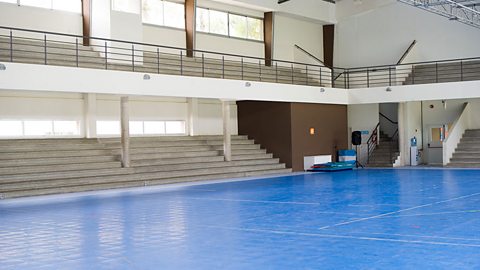
Notre collège a 42 salles de classe qui ont été récemment modernisées. En plus, l’année dernière nous avons construit un grand gymnase. On a quatre excellentes salles d’informatique dont toutes les classes profitent.
Les cours commencent à 8h30. Il y en a sept par jour et ils durent 50 minutes. La plupart de nos étudiants viennent au collège à pied, mais certains prennent l’autobus. À 10h35, il y a une récré de quinze minutes et à 12h30, c’est la pause-déjeuner qui dure quarante-cinq minutes. Les cours se terminent à seize heures. Après les cours, nos étudiants participent à un grand nombre de clubs culturels et sportifs. Il n’y a pas de cours le mercredi après-midi ni le samedi matin.
Tous nos étudiants font un minimum de quarante-cinq minutes de devoirs chaque soir. La discipline est stricte et le comportement de nos étudiants est excellent.
Hélène Benoit, principale du collège.
Question 1
Choose the correct option from the table below.
| A | There are 50 staff at the school |
| B | There are 59 staff at the school |
| C | There are 55 staff at the school |
The answer is B.
The text says: … avec cinquante professeurs et neuf personnes qui font l’administration …with 50 teachers and 9 people doing administration. (Total 59 people.)
Question 2
Choose the correct option from the table below.
| A | The classrooms are all in the course of being modernised. |
| B | The classrooms will all be modernised in the near future. |
| C | The classrooms have all recently been modernised. |
The answer is C.
The text says: Notre collège a 42 salles de classe qui ont été récemment modernisées. - Our school has 42 classrooms which have been recently modernised.
Question 3
Choose the correct option from the table below.
| A | The school has a big new sports hall and some excellent computer rooms. |
| B | The school has a big new sports hall and an excellent canteen. |
| C | The school has a big new sports hall and an excellent library. |
The answer is A.
The text says: En plus, l’année dernière nous avons construit un grand gymnase. On a quatre excellentes salles d’informatique dont toutes les classes profitent. - In addition, last year we built a large sports hall. We have four excellent computer rooms that all classes benefit from.
Question 4
Choose the correct option from the table below.
| A | On Wednesdays there is no school in the afternoon. |
| B | On Wednesdays there is no school in the morning. |
| C | On Wednesdays there is no school. |
The answer is A.
The text says: Il n’y a pas de cours le mercredi après-midi… - There are no lessons on Wednesday afternoons…
Vocabulary - Describing school routine
Useful phrases to describe life at school school include:
| French | English |
|---|---|
| Mon professeur préféré s’appelle… | My favourite teacher is called… |
| Il y a 1 100 élèves dans mon collège. | There are 1,100 students in my school. |
| Le directeur/la directrice est très strict(e). | The headteacher is very strict. |
| Les salles de classe sont modernes/anciennes. | The classrooms are modern/old. |
| Il y a un grand terrain de sport. | There is a big sports field. |
| Cette année, je vais passer mes examens. | This year I am going to take my exams. |
Useful phrases to describe the school day include:
| French | English |
|---|---|
| La journée scolaire commence à huit heures. | The school day begins at eight o’clock. |
| Je vais au collège à pied/à vélo/en voiture. | I go to school on foot/by bike/by car. |
| Je prends le bus/car/train pour aller au collège. | I take the bus/coach/train to go to school. |
| La récréation/récré est à 10h 40. | Break is at 10:40. |
| La pause déjeuner est à 12h30. | The lunch break is at 12:30. |
| Chaque cours dure une heure. | Each lesson lasts an hour. |
| Les cours se terminent à 15h15. | Lessons finish at 3:15. |
| Je rentre à la maison vers 15h45. | I get home around 3:45. |
Useful vocabulary to describe school uniform include:
| French | English |
|---|---|
| Nous devons porter un uniforme. | We must wear a uniform. |
| Mon uniforme est un pantalon noir, une chemise blanche, une cravate noire et rouge et un pull noir. | My uniform is black pants, a white shirt, a black and red tie and a black jumper. |
| Je pense que mon uniforme est moche/pratique/utile. | I think my uniform is ugly/ practical/useful. |
| Il est interdit de porter des bijoux. | It’s forbidden to wear jewellery. |
| Nous pouvons mettre du maquillage. | We can wear make-up. |
Useful phrases to describe school clubs include:
| French | English |
|---|---|
| Je fais partie au club de théâtre. | I’m part of the drama club. |
| Il y a beaucoup de clubs différents au collège. | There are lots of different clubs at school. |
| Il y des clubs culturels, comme les clubs de théâtre, de film, de danse et de musique. | There are cultural clubs, such as theatre, film, dance and music clubs. |
| On peut faire partie des équipes sportives comme le foot, le rugby, le hockey et le netball. | You can be part of sports teams such as football, rugby, hockey and netball. |
| Il y a quelque chose pour tout le monde. | There is something for everyone. |
All Foundation Tier vocabulary listed in this guide can be found on the vocabulary sheet below.
Grammar - Irregular verbs in the present tense
Many of the most common, high frequency verbs are irregular in the present tense including:
- avoir - to have
- être - to be
- aller - to go
- faire - to do / to make
- venir - to come
- écrire - to write
- connaître - to know / to be familiar with
- rire - to laugh
Click or tap on the Show more button to revise how to conjugate the frequently used irregular verbs.
Avoir - to have
| Subject pronoun and verb form | English |
|---|---|
| Check your connection, refresh the page and try again. | I have |
| Check your connection, refresh the page and try again. | you have (singular, informal) |
| Check your connection, refresh the page and try again. | he/it has |
| Check your connection, refresh the page and try again. | she/it has |
| Check your connection, refresh the page and try again. | one has/we have |
| Check your connection, refresh the page and try again. | we have |
| Check your connection, refresh the page and try again. | you have (singular formal or plural) |
| Check your connection, refresh the page and try again. | they have (masculine or mixed) |
| Check your connection, refresh the page and try again. | they have (feminine) |
For example:
J’ai les maths à neuf heures et demie. – I have maths at 9.30.
Nous avons un prof sympa pour l’anglais. – We have a nice teacher for English.
Être - to be
| Subject pronoun and verb form | English |
|---|---|
| Check your connection, refresh the page and try again. | I am |
| Check your connection, refresh the page and try again. | you are (singular, informal) |
| Check your connection, refresh the page and try again. | he/it is |
| Check your connection, refresh the page and try again. | she/it is |
| Check your connection, refresh the page and try again. | one is/we are |
| Check your connection, refresh the page and try again. | we are |
| Check your connection, refresh the page and try again. | you are (singular formal or plural) |
| Check your connection, refresh the page and try again. | they are (masculine or mixed) |
| Check your connection, refresh the page and try again. | they are (feminine) |
For example:
Le collège est situé dans l’est de la ville. – The school is located in the east of the town.
Les profs dans notre collège sont assez strictes. – The teachers at our school are quite strict.
Aller - to go
| Subject pronoun and verb form | English |
|---|---|
| Check your connection, refresh the page and try again. | I go |
| Check your connection, refresh the page and try again. | you go (singular, informal) |
| Check your connection, refresh the page and try again. | he/it goes |
| Check your connection, refresh the page and try again. | she/it goes |
| Check your connection, refresh the page and try again. | one goes/we go |
| Check your connection, refresh the page and try again. | we go |
| Check your connection, refresh the page and try again. | you go (singular formal or plural) |
| Check your connection, refresh the page and try again. | they go (masculine or mixed) |
| Check your connection, refresh the page and try again. | they go (feminine) |
For example:
Je vais au collège à pied normalement. – I usually walk to school.
De temps en temps nous allons en voiture. – From time to time we go by car.
Faire - to do/make
| Subject pronoun and verb form | English |
|---|---|
| Check your connection, refresh the page and try again. | I do/make |
| Check your connection, refresh the page and try again. | you do/make (singular, informal) |
| Check your connection, refresh the page and try again. | he/it does/makes |
| Check your connection, refresh the page and try again. | she/it does/makes |
| Check your connection, refresh the page and try again. | one does/makes, we do/make |
| Check your connection, refresh the page and try again. | we do/make |
| Check your connection, refresh the page and try again. | you do/make (singular formal or plural) |
| Check your connection, refresh the page and try again. | they do/make (masculine or mixed) |
| Check your connection, refresh the page and try again. | they do/make (feminine) |
For example:
Tu fais tes devoirs de français ce soir ? – Are you doing your French homework. tonight?
Je ne fais pas mes devoirs tous les soirs. – I don’t do my homework every evening.
Venir - to come
| Subject pronoun and verb form | English |
|---|---|
| Check your connection, refresh the page and try again. | I come |
| Check your connection, refresh the page and try again. | you come (singular, informal) |
| Check your connection, refresh the page and try again. | he/it comes |
| Check your connection, refresh the page and try again. | she/it comes |
| Check your connection, refresh the page and try again. | one comes, we come |
| Check your connection, refresh the page and try again. | we come |
| Check your connection, refresh the page and try again. | you come (singular formal or plural) |
| Check your connection, refresh the page and try again. | they come (masculine or mixed) |
| Check your connection, refresh the page and try again. | they come (feminine) |
For example:
Tu viens au club de rugby après le collège ? – Are you coming to rugby club after-school?
Nous venons bientôt – We’re coming soon.
Devenir (to become) follows a similar pattern to venir.
Écrire - to write
| Subject pronoun and verb form | English |
|---|---|
| Check your connection, refresh the page and try again. | I write |
| Check your connection, refresh the page and try again. | you write (singular, informal) |
| Check your connection, refresh the page and try again. | he/it writes |
| Check your connection, refresh the page and try again. | she/it writes |
| Check your connection, refresh the page and try again. | one writes/we write |
| Check your connection, refresh the page and try again. | we write |
| Check your connection, refresh the page and try again. | you write (singular formal, plural) |
| Check your connection, refresh the page and try again. | they write (masculine, mixed) |
| Check your connection, refresh the page and try again. | they write (feminine) |
Décrire (to describe) and s’inscrire (to register) follow a similar pattern to écrire.
Demain elle décrit son chien devant la classe. - Tomorrow she is describing her dog in front of the class.
Connaître - to know, be familar with
| Subject pronoun and verb form | English |
|---|---|
| Check your connection, refresh the page and try again. | I know/am familar with |
| Check your connection, refresh the page and try again. | you know/am familar with (singular, informal) |
| Check your connection, refresh the page and try again. | he/it knows/is familar with |
| Check your connection, refresh the page and try again. | she/it knows/is familar with |
| Check your connection, refresh the page and try again. | one/we knows/is familar with |
| Check your connection, refresh the page and try again. | we know/are familar with |
| Check your connection, refresh the page and try again. | you know/are familar with (singular formal, plural) |
| Check your connection, refresh the page and try again. | they know/are familar with (masculine, mixed) |
| Check your connection, refresh the page and try again. | they know/are familar with (feminine) |
Disparaître (to disappear) and reconnaître (to recognise) follow a similar pattern to connaître.
Je reconnais ce professeur de mon école primaire – I recognise this teacher from my primary school
Rire - to laugh
| Subject pronoun and verb form | English |
|---|---|
| Check your connection, refresh the page and try again. | I laugh |
| Check your connection, refresh the page and try again. | you laugh (singular, informal) |
| Check your connection, refresh the page and try again. | he/it laughs |
| Check your connection, refresh the page and try again. | she/it laughs |
| Check your connection, refresh the page and try again. | one laughs/we laugh |
| Check your connection, refresh the page and try again. | we laugh |
| Check your connection, refresh the page and try again. | you laugh (singular formal, plural) |
| Check your connection, refresh the page and try again. | they laugh (masculine, mixed) |
| Check your connection, refresh the page and try again. | they laugh (feminine) |
For example:
On rit beaucoup dans les classes de sciences. – We laugh a lot in science lessons.
Irregular verbs - Mini quiz
Choose the correct form of avoir to complete the following sentence:
Elle ____ beaucoup de devoirs ce soir.
She has a lot of homework tonight.
Elle a beaucoup de devoirs ce soir.
A is the correct part of the verb avoir in the elle (she) form.
Choose the correct form of être to complete the following sentence:
Mes profs ____ très sympas.
My teachers are very nice.
Mes profs sont très sympas.
Sont is the correct part of the verb être in the ‘they’ form.
Choose the correct form of aller to complete the following sentence:
On ___ au collège en autobus normalement.
We normally go to school by bus.
On va au collège en autobus normalement.
Va is the correct part of the verb aller in the ‘we/one’ form.
Choose the correct form of faire to complete the following sentence:
Nous _____ nos devoirs ce weekend.
We’re doing our homework this weekend.
Nous faisons nos devoirs ce weekend.
Faisons is the correct part of the verb faire in the ‘we’ form.
Find out more about using irregular verbs in the Irregular verbs in the present tense in French guide.
Listening practice
Listen to the podcast extracts in which a student is discussing her school life and answer the questions.
Press or click on the purple START button when you are ready to begin the activity.
Vocabulary sheet
Click or tap on the image below for a list of useful vocabulary to use when talking about school and daily routine.

Higher Tier - Vocabulary - Life at school
Useful Higher Tier verbs include:
| French | English |
|---|---|
| Check your connection, refresh the page and try again. + infinitive | to advise/recommend (someone + verb) |
| Check your connection, refresh the page and try again. + infinitive | to teach (someone + verb) |
| Check your connection, refresh the page and try again. | to bully/harrass |
| Check your connection, refresh the page and try again. | to forbid/ban |
| Check your connection, refresh the page and try again. | to participate in |
| Check your connection, refresh the page and try again. | to make a mistake |
Useful Higher Tier nouns include:
| French | English |
|---|---|
| Check your connection, refresh the page and try again. | behaviour |
| Check your connection, refresh the page and try again. | competition |
| Check your connection, refresh the page and try again. (masculine) | establishment/organisation |
Useful Higher Tier phrase:
| French | English |
|---|---|
| On peut participer aux clubs qui soutiennent l’environnement ou l’égalité. | You can participate in clubs that support the environment or equality. |
All vocabulary listed in this guide can be found on the vocabulary sheet below.
Higher Tier - Vocabulary sheet
Click or tap on the image below for a list of useful vocabulary to use when describing life at school and daily routine.
Now you have revised the important vocabulary and key grammar points for life at school why not have a look at the Describing the local area guide?
Revise for your exams with BBC Bitesize
Get ready for the GCSEs with quizzes, past papers, flashcards, podcasts and more resources!

More on Education and work
Find out more by working through a topic
- count3 of 5
- count5 of 5