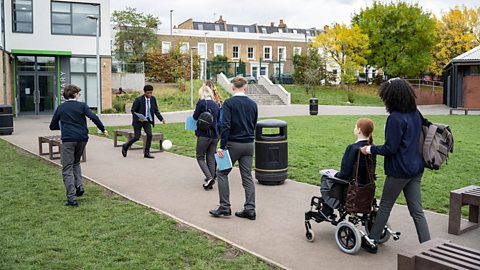
Key points about describing school rules
Use A verb that is usually followed by an infinitive, such as pouvoir (to be able to), vouloir (to want to), and devoir (must). pouvoir, meaning can/to be able to, and devoir, meaning must/to have to, to talk about school rules.
The Used to communicate that something must be done without specifying who should do it, where there is no natural subject (I, you, he, etc.). il faut followed by an infinitive can be used to talk about what must or must not be done.
Vocabulary – Days of the week and times of the day

It is useful to be able to use the days of the week and times of the day when talking about your school week.
For example:
Le jeudi, nous avons maths à midi. – On Thursdays, we have maths at midday.
Mardi, j’ai un cours de piano à une heure. – On Tuesday, I have a piano lesson at 1.00 pm.
Days of the week
| French | English |
|---|---|
| Check your connection, refresh the page and try again. | Monday |
| Check your connection, refresh the page and try again. | Tuesday |
| Check your connection, refresh the page and try again. | Wednesday |
| Check your connection, refresh the page and try again. | Thursday |
| Check your connection, refresh the page and try again. | Friday |
| Check your connection, refresh the page and try again. | Saturday |
| Check your connection, refresh the page and try again. | Sunday |
Note that days of the week in French do not start with a capital letter.

Talking about the time
Useful phrases for telling the time in French include:
| French | English |
|---|---|
| neuf heures | 09:00 |
| neuf heures dix | 09:10 |
| neuf heures et quart | 09:15 |
| neuf heures vingt-cinq | 09:25 |
| neuf heures et demie | 09:30 |
| dix heures moins vingt | 09:40 |
| dix heures moins le quart | 09:45 |
| dix heures moins dix | 09:50 |
| midi | midday |
| minuit | midnight |
To say what time it is now, use il est…. For example:
ll est onze heures. – It is 11.00 am.
To say when things happen, use à. For example:
Les cours finissent à trois heures et demie. – Lessons finish at 3.30 pm.

Did you know?
You can also use à in front of a day of the week or time phrase to mean ‘See you on …’
For example:
À lundi ! - See you on Monday!
À ce soir ! - See you tonight!
À demain ! - See you tomorrow!
Grammar - How to use the verbs ‘pouvoir’ and ‘devoir’

The two keys verbs pouvoir (can/to be able to) and devoir (must/to have to) are modal verbs. This means that they are always followed by an The basic form of the verb. In French, all infinitives end in '-er', '-ir' or '-re'..
For example:
Je peux aller au collège à vélo ou à pied. – I can go to school by bike or on foot.
On doit arriver à l’heure. – We must arrive on time.
How to conjugate the verb devoir:
| French | English |
|---|---|
| Check your connection, refresh the page and try again. | I have to/I must |
| Check your connection, refresh the page and try again. | you (singular, informal) have to/you must |
| Check your connection, refresh the page and try again. | he has to / he must |
| Check your connection, refresh the page and try again. | she has to / she must |
| Check your connection, refresh the page and try again. | one/it has to / one/it must |
| Check your connection, refresh the page and try again. | we have to / we must |
| Check your connection, refresh the page and try again. | you (singular informal or formal) have to/you must |
| Check your connection, refresh the page and try again. | they (masculine or mixed) have to / must |
| Check your connection, refresh the page and try again. | they (feminine) have to / must |
How to conjugate the verb pouvoir:
| French | English |
|---|---|
| Check your connection, refresh the page and try again. | I can |
| Check your connection, refresh the page and try again. | you (singular, informal) can |
| Check your connection, refresh the page and try again. | he can |
| Check your connection, refresh the page and try again. | she can |
| Check your connection, refresh the page and try again. | it/one can |
| Check your connection, refresh the page and try again. | we can |
| Check your connection, refresh the page and try again. | you (singular informal or formal) can |
| Check your connection, refresh the page and try again. | they (masculine or mixed) can |
| Check your connection, refresh the page and try again. | they (feminine) can |
Modal verbs – Mini quiz
Translate the following sentences into French:
I can go.
Je peux aller.
The modal verb je peux is followed by an infinitive in French.
She must listen.
Elle doit écouter.
The modal verb elle doit is followed by an infinitive in French.
Find out more about using modal verbs with infinitives in the Infinitives in French guide.
Listening practice
Click or tap on Start to listen to a podcast of four students from different French-speaking countries talking about their school week. Choose the correct answer for each speaker.
Vocabulary - Talking about school rules
Useful phrases to talk about things you must do at school include:
| French | English |
|---|---|
| apporter un stylo | to bring a pen |
| arriver à l’heure | to arrive on time |
| écouter les profs | to listen to the teachers |
| faire les devoirs | to do homework |
| faire attention en classe | to pay attention in class |
| porter l’uniforme scolaire | to wear school uniform |
| travailler dur | to work hard |

For example:
Il faut toujours apporter un stylo et une règle. You must always bring a pen and a ruler.
On doit travailler dur en cours. We have to work hard in lessons.
Je ne veux pas porter l’uniforme scolaire. I don’t want to wear school uniform.
Useful phrases to talk about things you must not do at school include:
| French | English |
|---|---|
| arriver en retard | to arrive late |
| manger en classe | to eat in class |
| oublier son sac | to forget your bag |
| utiliser un portable | to use a mobile phone |
For example:
On ne doit pas arriver en retard. We mustn’t arrive late.
C’est interdit mais mon amie utilise son portable pendant la récré. It’s forbidden but my friend uses her phone at break.
All Foundation Tier vocabulary listed in this guide can be found on the vocabulary sheet below.
Grammar – Using impersonal verbs for talking about school rules

A useful verb to talk about school rules is il faut (it is necessary). This is an Used to communicate that something must be done without specifying who should do it, where there is no natural subject (I, you, he, etc.). and is always followed by an infinitive.
Il faut usually translates in English as ‘we have to’, ‘we must’, ‘you have to’ or ‘you must’.
For example:
Il faut apporter le bon cahier. – You have to bring the right exercise book.
Il faut respecter cette règle. – We must respect this rule.
You can also use il faut with negatives to say what you must not do.
For example:
Il ne faut pas arriver en retard. – We musn’t arrive late.
Il ne faut jamais vapoter dans les toilettes. – You must never vape in the toilets.
Impersonal verbs - Mini quiz
Choose the correct impersonal verb to complete the following sentences.
Click or tap on Start to begin the activity.
Find out more about using impersonal verbs in the Impersonal verbs and expressions in French guide.
Reading practice

Some French students have posted their opinion of their school rules on an online forum.
Read the posts and answer the questions below in English. Give as many details as possible.
Kadime
Il faut toujours apporter son sac avec des stylos, ses cahiers et d’autres livres. C’est embêtant. J’oublie souvent quelque chose.
Patricia
En général, je suis pour l’uniforme scolaire parce que c’est facile et confortable. Il faut porter un pantalon noir en hiver et un short bleu en été.
Leila
Dans mon collège, il ne faut pas utiliser son portable en classe. Je pense que cette règle est injuste. Je voudrais l’utiliser pour apprendre.
- What must Kadime remember to take to school?
A bag, pens, exercise books and other books.
- What is Kadime’s opinion of this rule and why?
It’s annoying because he often forgets something.
- What is Patricia’s opinion of school uniform and why?
She is for it because it’s easy and comfortable.
- What do they have to wear at Patricia’s school?
Black trousers in winter and blue shorts in summer.
- What are you not allowed to do at Leila’s school?
Use a mobile phone in class.
- What is Leila’s opinion of this rule and why?
She thinks that it is unfair because she wants to use it to learn.
Vocabulary sheet
Click or tap on the image below for a list of useful vocabulary to use when describing school rules.

Higher Tier – Vocabulary – Describing school rules
Useful vocabulary for talking about school rules includes:
| French | English |
|---|---|
| respecter les autres | to respect other people |
| crier | to shout |
| harceler d’autres élèves | to bully other students |
For example;
Il ne faut pas crier en classe. You mustn’t shout in class.
Higher Tier – Grammar – Modal verbs
Use pouvoir and devoir in the perfect tense to talk about something you were able to do or that you had to do in the past. For example:
J’ai pu choisir mes matières. – I was able to choose my subjects.
On a dû aider notre prof. – We had to help our teacher.
Higher Tier - Grammar - Impersonal verbs
Il est interdit de (it is forbidden to) is a useful impersonal expression to use when talking about school rules. It must be followed by an infinitive. For example:
Il est interdit de parler pendant l’examen. – It is forbidden to talk during the exam.
Impersonal verbs can be used with other common An adjective is a word that describes a noun. In French, adjectives have different endings depending on whether the noun they are describing is masculine, feminine, singular or plural. following the same pattern:
- il est followed by an adjective, de and an infinitive.
For example:
Il est important de réviser. – It is important to revise.
Find out more about using impersonal verbs with adjectives in the Impersonal verbs and expressions in French guide.
Higher Tier - Vocabulary sheet
Click or tap on the image below for a list of useful Higher Tier vocabulary to use when talking about yourself and others.
Now you have learned about talking about school rules why not look at the Describing countries and their features guide.
Careers advice and tips from BBC Bitesize
Future careers, further studies and the world of work - we're here to help with advice from experts and from young people who've found their path.

More on Education and work
Find out more by working through a topic
- count3 of 5

- count5 of 5

- count1 of 5