What do you know?
Which of these images do you think has more detail?
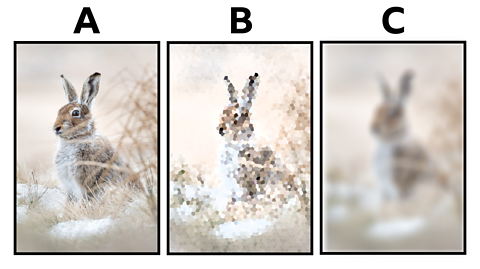
Image A is much more detailed and visually descriptive. Descriptive writing, like these images, transforms an ordinary piece of writing into writing with high definition and detail. This allows the reader to ‘see’ what is being described more vividly.
Introduction to descriptive writing
Key learning points
Descriptive writing can be used to capture, captivate and compel an audience to continue reading.
Understand how to use techniques including: adjectives, the senses, imagery, alliterations and onomatopoeia.
Video about how to make your writing more descriptive
A video about how to use different tools from the writer's toolkit to make your writing more descriptive
Writers use descriptive writing techniques to make a text more interesting, informative and entertaining. Their tools can include:
- Adjectives
- Interesting nouns and verbs
- Similes and metaphors
- Personification
- Sensory language
We can use this toolkit on any piece of text, to bring it to life.
Let’s look at a piece of descriptive narrative writing, starting with the title: My day on the farm.
Hmm, let’s start with a more interesting noun: My adventure on a farm.
And how about an adjective: My ludicrous adventure on a farm.
But what kind of farm?
My ludicrous adventure on a secret city farm. Intriguing!
Upon arrival, I saw a chicken walking around.
But how did the chicken walk? Interesting verb please!
Upon arrival, I saw a chicken parading around.
Much better! Now, how can we make the chicken sound like it’s worth keeping a close eye on? A simile might help. What’s it parading like?
Upon arrival, I saw a chicken parading around like a tiny T-Rex.
This sentence creates a strong image for the reader now, but there’s still more we can do. How about some sensory language? This is used to describe anything you can sense - sights, sounds, textures, smells.
Upon arrival, I saw a chicken parading around like a tiny T-Rex. Each ‘cluck’ that shot from her beak escalated in severity.
I think that clarifies her tone!
Time for the final line: Suddenly, she stopped, went quiet and laid a magical, golden egg.
So, we used the tools:
- Adjectives
- Interesting nouns and verbs
- Similes and metaphors
- Personification
- Sensory language
And here’s the whole thing:
My ludicrous adventure on a secret city farm.
Upon arrival, I saw a chicken parading around like a tiny T-Rex. Each ‘cluck’ that shot from her beak escalated in severity. Suddenly she stopped, went quiet and laid a magical, golden egg.
What is the purpose of descriptive writing?
Writing descriptively brings text to life. A writer could describe a person, location, object, event, emotion, the weather, an action, landscape and much more.
Good descriptive writing allows the reader to imagine, hear and see what is depicted and feel or empathise with the subjects being portrayed in a text.
Through the careful selection of words and use of descriptive writing techniques, writers can paint vivid pictures in a reader’s mind.
Using adjectives and adverbs
One way to conjure up images and to stir a reader's imagination is to use adjectives and adverbs.
Adjectives describe objects, locations (nouns), people and places (proper nouns and pronouns). They are placed before the item or subject described, to modify them. When used appropriately, adjectives add detail and make the text more interesting and appealing to read.
For example: A road. Which becomes a long, winding, mysterious, old road.
Adverbs modify verbs as they describe how an action occurs. This is useful for making writing more dynamic: full of momentum or pace and not just static descriptions.
For example: A dog. Which becomes a dog that barked noisily, happily, and joyfully.
Using the senses
It is important to include all of the five senses in your descriptive writing.
Click on the image below to explore the five senses
Using any of these five senses in conjunction with adjectives and adverbs can improve the quality of your descriptive writing. It is a common technique used in descriptive writing and can transform an ordinary and simple description into something rich and powerful.
Adverts commonly use the senses to make the product sound more appealing.

Which three senses are being used in this sentence?
Crisp colourful leaves floated gently as they fell and crunched underfoot.
Answer:
This description of autumn leaves uses sight (colourful leaves), hearing (crunched) and touch (underfoot).
Using imagery
One of the most popular ways to conjure up imagery is through When words or expressions are used to suggest a meaning that is different from the literal interpretation.. Literary devices can provide imagery that is not an exact literal representation of reality.
- Metaphor – two things are compared without using ‘like’ or ‘as’:
‘That day was a rollercoaster of emotions.’ - Simile – two things are compared using ‘like’ or ‘as’:
‘Her eyes were as blue as the ocean.’ - Oxymoron – opposite contradicting ideas are put together:
‘At the end of the speech there was a deafening silence.’ - Personification – to give something inanimate human qualities:
‘The grass danced in the breeze.’
Figurative language works best for writing designed to engage the reader’s mind. This is writing that requires the reader to think about the description in more detail and analyse it.
Find out more about how to use literary devices in your writing.
Assonance and alliteration
The sound of words can be used to enhance descriptions and to heighten the senses. When the beginning sound of words is repeated in nearby words. is a good way to achieve this. This is why alliteration is commonly used to catch people’s attention through headlines.
Alliteration
You can use these sounds of words to create a mood, tone and describe the senses.
There are three types of alliteration:
- Assonance is to the repetition of vowels sounds (a,e,i,o,u).
‘Audacious Otis obstinately sat in front of the oven.’ - Consonance is the repetition of any consonant sounds.
‘Cathy cuddled the cat kindly, this made her feel content.’ - Sibilance is the repetition of hissing ‘s’ sounds (s, c and sometimes z, f, v).
‘She slides forward, hissing and spitting, slithering on her scaly stomach.’
Find out more about how to use language for effect.
Using onomatopoeia
Onomatopoeia is the use of words to mimic the sound of things. Sometimes these words are explicitly only sound words: Oink, ding dong, crackle, whoosh, bam! Most times sound words are day-to-day words used to mimic sound. Onomatopoeia is a good way to immerse the reader.
- The alarm clocked buzzed.
- The door creaked as Jerome tried to sneak in.
- The metronome ticked to the beat at half speed.
Notice how they are all verbs – action words. This is an effective way to describe something.
Being aware of how everyday verbs, nouns and adjectives can mimic sound will enable you to use onomatopoeia to greater effect than trying to use dramatic sound words exclusively.
Test your knowledge
Solve the Story!
An exciting new series from the Other Side of the Story, designed to help young people strengthen their media literacy skills.

More on Fiction writing
Find out more by working through a topic
- count2 of 8

- count3 of 8

- count4 of 8

- count5 of 8