What you need to know about Lyme disease
Justin Timberlake recently announced that he'd been diagnosed with Lyme disease, putting out a statement to explain the effect this has had on him and his recent world tour.
The announcement prompted a slew of questions online: what is Lyme disease? How can it be cured? And why do so many celebrities seem to get it?
So, here at BBC Bitesize, we've put together a guide to give you the low down on all you need to know about Lyme disease.

1. What is Lyme disease?
Lyme disease, which is sometimes known as Lyme borreliosis, is a bacterial infection spread to humans by blacklegged ticks - also known as deer ticks.
The deer tick, or Ixodes scapularis if you want to sound clever, tends to pick up the infection by feeding on an infected host, and can then spread this to humans when biting them.
Generally a tick has to be attached for a number of hours for the infection spread, so prompt removal of a tick can help greatly reduce the likelihood of contracting Lyme disease.
2. How do you know if you have Lyme disease?
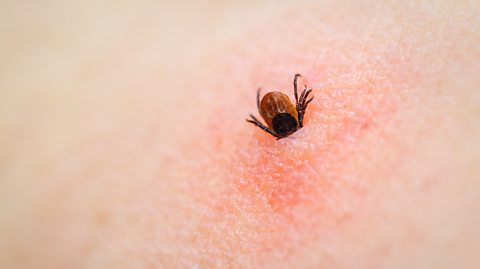
The NHS and CDC (Centres for Disease Control and Prevention) both list a number of symptoms that could be indicative of having contracted Lyme disease.
The most notable of these is a rash that can develop around the area of the initial tick bite. According to the NHS, this rash tends to appear around one to four weeks after the initial bite, though can take up to three months to show up! Whilst not usually hot or itchy, it can sometimes be slightly raised or bumpy.
Another notable aspect of the Lyme disease rash is its shape, often taking on the appearance of a target or bullseye.
Other common symptoms include a headache, high temperature, muscle pain, joint pain, extreme tiredness and loss of energy.
For more information on the various signs and symptoms of Lyme disease, check out the NHS website.
3. How common is Lyme disease in the UK?
As far as the UK is concerned, Lyme disease is pretty uncommon.
According to the UK Health Security Agency (UKHSA), 2024 saw 1,581 laboratory confirmed cases of Lyme disease in the UK - though this is anticipated to be a slight underestimation of the total number of cases, as some are dealt with by GPs without being laboratory confirmed.
Ticks carrying the disease tend to be more prevalent in grassy or wooded areas, particularly during the spring and summer. It should be said though, that the majority of ticks found in the UK do not carry Lyme disease, with approximately 4% of ticks in England and Wales infected with the condition.
In other areas of the world it is more common, such as the US. The US states most affected by Lyme disease tend to be those in the Northeast, upper-Midwest and mid-Atlantic areas of the country.

4. Is Lyme disease curable?
Lyme disease is most effectively treated when caught early, usually via antibiotics prescribed by a GP.
Most people with Lyme disease will begin to feel better after treatment, though the NHS states this can take a little time - in some cases, years.
Other methods of combatting Lyme disease revolve around prevention, as opposed to treatment. This includes regularly checking for tick bites after spending time in grassy or wooded areas, using insect repellant spray and ensuring that you're well covered when spending time outdoors.
5. Can cats and dogs get Lyme disease?
Yes, both dogs and cats can get Lyme disease.
It's more common in dogs than cats, but both acquire the condition in much the same way as humans - being bitten by infected ticks.
According to the RSPCA, symptoms of Lyme disease in pets can include loss of appetite, fever, lameness and joint pain amongst other things. As with humans, this is generally treated via a course of antibiotics which will be prescribed by a vet.
6. Why do so many celebrities have Lyme disease?
There's various reasons why a Lyme disease diagnosis amongst celebrities may appear to be more frequent or common.
Firstly, a general greater awareness around symptoms of Lyme disease coupled with more money with which to pay for healthcare probably accounts for much of the diagnosis amongst famous people.
Another explanation is that many upmarket, desirable in locations in the US - the kind which may appeal to celebs, such as the Hamptons - are also hotspots for cases of Lyme disease.
Notable famous folk to speak out publicly about having contracted Lyme disease include Justin Timberlake, Justin Bieber, Avril Lavigne, Bella Hadid and Miranda Hart.