The summer solstice is just around the corner this year falling on 21 June.
For thousands of years on the morning of the solstice people have watched the sunrise and sunset from one of the world’s most famous monuments - Stonehenge in Wiltshire. It’s believed the stones were deliberately placed as solar markers to track the longest day of the year.
However, the real mystery is how the stones got there in the first place. Not only are they incredibly large, but some are thought to have been transported all the way from South Wales - nearly 250km away!
Research carried out by the Pears Foundation in 2024 revealed school staff thought over half of pupils (55%) brought up conspiracy theories because they were curious about them.
So, with conspiracy theories pointing to aliens, giants and ancient wizards, could any of them be true?
Did giants build Stonehenge?
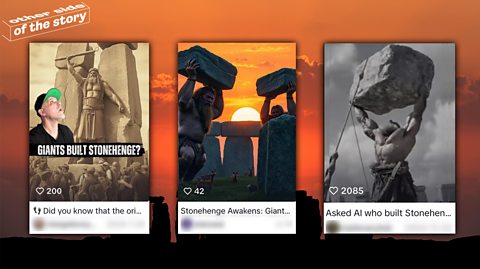
A recent TikTok showed an AI-generated video of giants building Stonehenge, with another user commented it was constructed by the Nephilim (sometimes called giants and referenced in the Bible).
Whilst there may be lots of speculation online, there is no credible evidence to suggest giants built Stonehenge.
Did aliens provide the technology for Stonehenge?
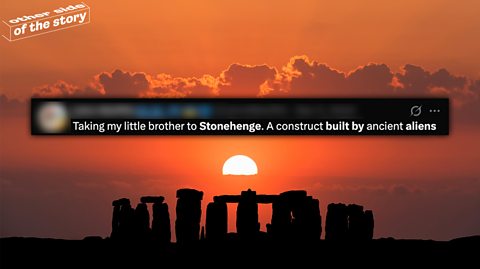
So, what about aliens? Some people believe the tools needed to move and place the huge stones at Stonehenge over 5,000 years ago were far too advanced for ancient humans, which begs the question - was there alien involvement?
An AI-generated TikTok video titled “Exploring the Mysteries of Stonehenge with UFOs” stirred further speculation about alien connections, with another Instagram user posting a video stating, “Stonehenge was built by aliens and the Earth is flat”.
The theory was popularised by author Erich von Däniken in his book Chariots of the Gods. He believed aliens built Stonehenge along with other ancient structures such as the pyramids, claiming it could have been a model of the solar system.
While this theory has fascinated fans of the extraterrestrial, it remains firmly outside the realm of science, with no evidence to support it.
Did Merlin create Stonehenge?
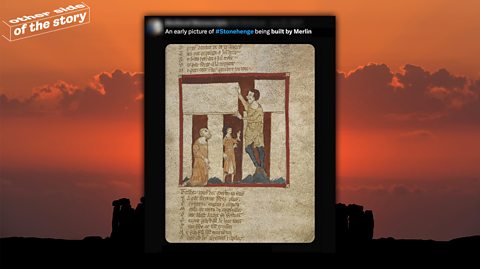
Among the most well-known myths surrounding Stonehenge is the tale of Merlin the legendary wizard who supposedly used his magical powers to transport the enormous stones from Ireland.
Despite archaeological evidence showing that Stonehenge predates Merlin by more than a thousand years, the story continues to thrive especially on social media. One X user shared an image captioned, “An early picture of #Stonehenge being built by Merlin,” while another wrote, “As everyone knows, #Stonehenge was built by Merlin with the help of a giant.”
Though unproven, the legend continues to captivate imaginations, weaving folklore into one of the world’s most fascinating ancient mysteries.
The truth behind Stonehenge?
While many tales and theories have been told about how Stonehenge was built, the mystery remains unsolved. So, what do we actually know?
• Who built Stonehenge? It was built by people from the New Stone Age, called Neolithic people. They lived a very long time ago (around 10,000 BCE to 3,000 BCE) and were some of the first farmers and builders.
• How big is Stonehenge? The outer circle of Stonehenge has 30 standing stones which surround five huge stone arches. The width of the Stone Circle is roughly 33 meters (108 feet) across.
• Where did the Stonehenge stones come from? The larger stones likely came from Marlborough Downs (about 20 miles away), and the smaller "bluestones" from South Wales (over 100 miles away).
While the idea of giants, aliens and wizards seem exciting, there is no evidence to support anything supernatural and is merely a part of folklore.
How to be critical of what you see online
Social media allows conspiracy theories to spread faster and further than ever before, often reaching huge audiences within minutes. They can also create a lot of confusion, making it hard to tell whether something is genuine or completely fake.
Next time you come across a post or story that seems suspicious or too wild to be true, stop and check. Always do your research, look for credible sources, and make sure the information comes from a trustworthy place.

Not sure if the news you’re seeing on social media is true or false? Can you always tell if the things you see online are real or fake? Learn how to get the other side of the story with our quizzes, videos and explainers.