All about the Solar System
Made up of billions of objects, the Solar System has been studied for generations - but there is still so much to learn about it. Full of celestial bodies orbiting the Sun, the Solar System is roughly 4.5 billion years old.
Despite its age and massive size, it is actually a very tiny part of the entire universe. But how many planets are in the Solar System and how were they named?
Here, BBC Bitesize takes a closer look at the planets in our Solar System, where they got their names and other fun facts! You can also test your knowledge and see if you can guess the planet below.

What is a Solar System?
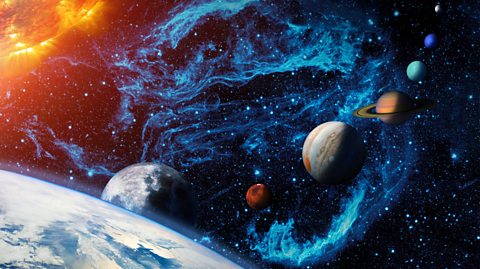
Made up of billions of objects, the Solar System has been studied for generations and today, there is still so much to learn about it. Home to planets, dwarf planets, moons, asteroids and comets, these objects are all held in the Solar System by the gravitational pull of what lies in the centre and what they orbit around – the Sun.
Roughly 4.5 billion years old, despite its age and massive size, the solar system is just in fact a very tiny part of the entire universe.
How many planets are in our Solar System?
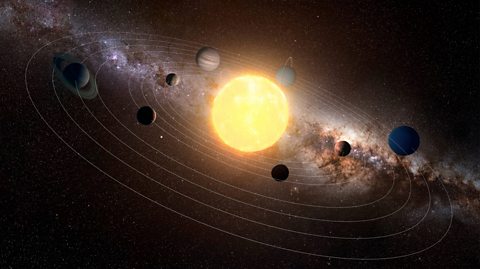
A planet is a celestial body that orbits a star and can be made up of rock, gas or a mix of both. Including Earth, there are eight planets in our Solar System.
In order from distance from the Sun, they are Mercury, Venus, Earth, Mars, Jupiter, Saturn, Uranus and Neptune. The first four planets are terrestrial planets, also known as rocky planets, made up of rock and metals, whereas the latter four planets are known as gas planets or gas giants, as they are made up of gas like hydrogen and helium.
Where do the planets get their names from?
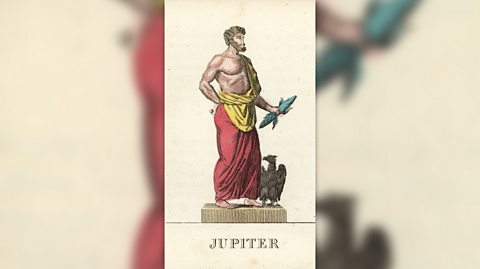
Established in 1919, the organisation responsible for naming newly discovered planets or other astronomical bodies is the International Astronomical Union (IAU). Long before the organisation, the names chosen for many objects in our Solar System were based on Roman or Greek mythology – and this tradition has continued.
This is except for Earth, whose name derives from the Old English word ‘eorþe’ and the German word “erde,” which both mean ground or soil. When it comes to the other seven planets in the Solar System, Mercury is the god of commerce, travel and communication, Venus is the Roman goddess of love, beauty and fertility and Mars is the Roman god of war.
Jupiter was the king of the Roman gods and known as the god of the sky and thunder. As for Saturn, the planet was named after the Roman god of time and agriculture.
The planets discovered in more recent times, Uranus and Neptune were also named following the same tradition. In Greek mythology, Uranus is the deity of the heavens and Neptune is the Roman god of the sea.
Many Greek gods have a Roman counterpart with similar attributes. For example, the Greek god Zeus and Roman god Jupiter are portrayed as having similar roles and power.
Why is Pluto no longer a planet?
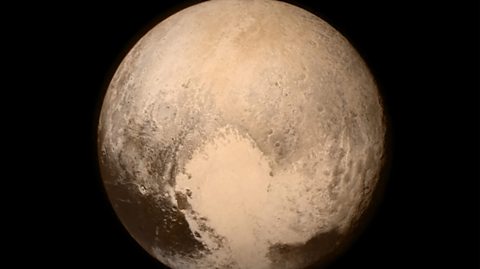
Discovered in 1930, Pluto was previously counted as the ninth planet in our Solar System. Similarly to other planets, Pluto is named after a Roman god – the god of the underworld.
The name was suggested by an 11-year-old schoolgirl from Oxford, Venetia Burney, whose grandfather then passed on the suggestion to Lowell Observatory. The furthest from the Sun and the smallest of the nine planets, after more research and comparing it to other objects in our Solar System, in 2006 Pluto was reclassified by the International Astronomical Union as a “dwarf planet.”
The most well-known dwarf planet in the Solar System – Pluto is not the only one. There are four others recognised in our solar system called Ceres, Haumea, Makemake and Eris.
Can you guess the planet?
How many stars and moons are in our solar system?
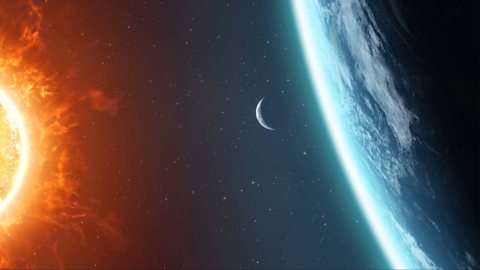
Made up mostly of hydrogen, at the centre of the Solar System is the Sun – which is a huge ball of burning gas. Believed to be around 4.6 billion years old, the Sun is our nearest star, which is why it appears brighter and larger than other stars, and the only star in our Solar System.
The Milky Way is a galaxy containing billions of stars, The Sun being just one of these. If you look at the night sky from a location with little light pollution, you will be able to see millions of stars through the disc of the Milky Way, which is a light-coloured strip across the night sky.
As a star, the Sun doesn’t have any moons - but the planets and their moons orbit the Sun. Natural satellites that orbit a planet, the Earth has just one moon, the Moon, and while it may appear bright in the night sky, it does not produce its own light but instead reflects light from the Sun.
Different planets have different numbers of moons. There are over 400 moons recognised as orbiting planets, as well as hundreds more around dwarf planets and asteroids.
What planets are the hottest, coldest, largest and smallest?
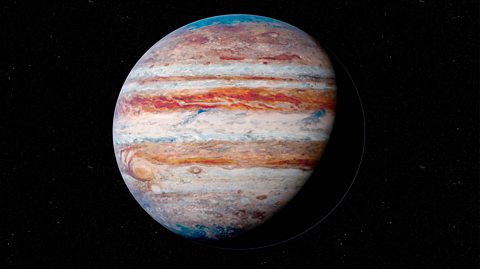
All the planets in our Solar System have different properties and conditions. But which planets are the hottest, coldest, largest and smallest?
The second planet from the Sun – Venus, is the hottest planet in the Solar System. With an average temperature of 460°C, it is hotter than the closest planet to the Sun, Mercury, as Mercury has almost no atmosphere, so does not hold onto its heat.
The coldest planet in the Solar System is Uranus, the first of the ice giants. The coldest recorded temperature on Uranus was -224°C - the coldest temperature recorded on any of the planets, and it is the seventh planet from the Sun.
The largest planet in our Solar System is the fifth planet from the Sun – Jupiter. So huge, the planet is twice as big as all the other planets in the Solar System put together and it has many moons – the largest being Ganymede, which is bigger than Mercury.
As for the smallest planet in the Solar System, it is Mercury, the planet closest to the Sun. It is not much bigger than our Moon and travels very fast around a short orbit.
This article was written in December 2025
