Skara Brae
Created in partnership with Historic Environment Scotland
Skara Brae is a Neolithic village. It is a prehistoric settlement where a farming community lived around 5,000 years ago.
It is a Recognised locations or landmarks of cultural, historical or scientific significance..
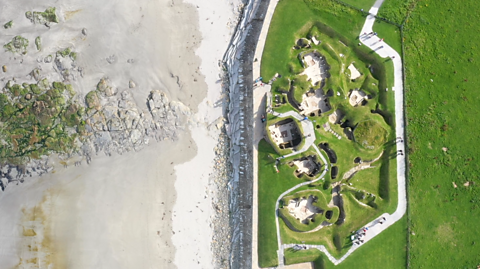
Watch: Discover Skara Brae
Pupils from Stenness Community School in Orkney visited Skara Brae to learn about its history.
Watch below to find out what they discovered.
Hi, we're pupils from Santa Community School, and this is our film about Scara Bray.
Off the very northern tip of Scotland on the islands of Orkney, you can visit a very special ancient village called Sarbury.
It was built about 5000 years ago, which makes it even older than the Pyramids of Egypt.
Scarbury was abandoned around 2500 BC.
It was covered in sand for a long time and no one knew it was there until about 170 years ago, a big storm blew the sand away.
Archaeologists are people who are interested in people and objects from the past.
The houses and objects from Scarbury are very useful for helping them to understand the lives of the people that lived in the period we call the Neolithic.
The Neolithic period lasted from 4000 BC to 2500 BC.
The main walls were built by placing stones on top of each other.
This is called dry stone walling, which doesn't need cement or mortar to stick them together.
The walls themselves were comprised of an inner wall and an outer wall with midden in between.
Midden is household rubbish which decomposes a bit like compost.
The stone houses didn't have any windows and only had one room with a fireplace in the middle.
It wouldn't have been dark as though the fire would have given light and warmth.
They may have burned animal fat for extra light.
By examining the bones and shells left behind from the Neolithic times, we know the villagers ate lots of fish and shellfish, plus meat from cows, sheep and pigs.
Some of the other foods they ate included birds, eggs, wild plants, seeds and hazelnuts.
We know they had pots with lids for storing food.
The lids also kept food safe from beasties and even hungry dogs.
We know there were dogs at Skara Brae because the archaeologists found ancient dog poo in the midden.
The people made their tools from stone, bone and antler because they didn't have any plastic or metal.
Archaeologists think that one of the houses was a workshop where they made pottery and tools.
These days there are no roofs left on the houses, which means that you can look inside and see the stone furniture is still surviving after thousands of years.
We hope you've learned something interesting about Skara Brae and maybe someday you can visit us here on our bonny Islands of Orkney.
This film is a collaboration between the L.A.B Scotland and Historic Environment Scotland.
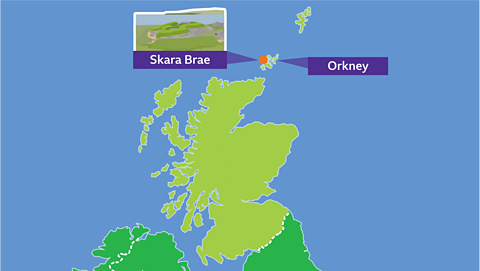
Where is Skara Brae?
Skara Brae is by the sea in the Orkney Islands which are off the north coast of Scotland.
It was discovered in 1850 when a big storm blew away some of the sand covering the Stone Age houses.
What are the houses like?
Take a tour through a house at Skara Brae.
What was inside a Neolithic home?
The dresser would have been the first thing you would see when you came through the door. It was clearly important. What kind of things would they have placed on it?
Well, think of what people display today in their homes - things important to them, things that make statements about them.
Though 5,000 years ago, there weren’t any clocks or picture frames. These beautiful objects are the kind of things that would have been displayed there.
As you sat on the large stone seat directly in front of the dresser, you'd have a clear view of the door and be able to see whoever crawled in.
As they entered, they'd have to look up at you. The door itself is only lockable from the inside. So when you came in here, you’d be able to shut the outside world out, have privacy.
We think a bone, or a piece of wood, could have been used to hold the door in place. But today all that remains are the holes in the stone which held the bar.
Once your guest had arrived and the door was closed, you could offer fresh fish and meat cooked on the fire. And in winter, smoked meat stored in the smoky roof space would be available.
Huge storage jars, too big to be brought in through the door, were buried in the corner of the house. The top of these pots were beautifully decorated and the area where they sat was surrounded by stone to protect them from being bumped and broken.
Who lived at Skara Brae?
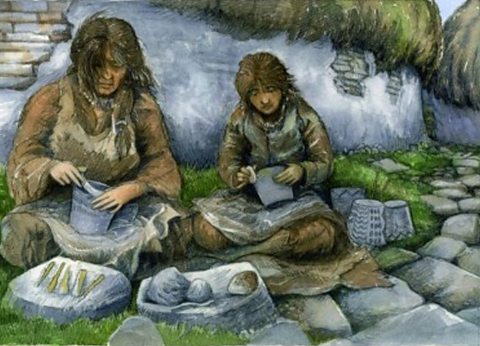 Image source, Historic Environment Scotland
Skara Brae was the home of a Neolithic farming community.
The people who lived here were able to grow some crops.
They kept cows, sheep and pigs. These animals were their main sources of food, providing meat, milk and cheese.
They gathered natural resources from nearby, such as birds eggs, wild herbs and plants.
Image source, Historic Environment Scotland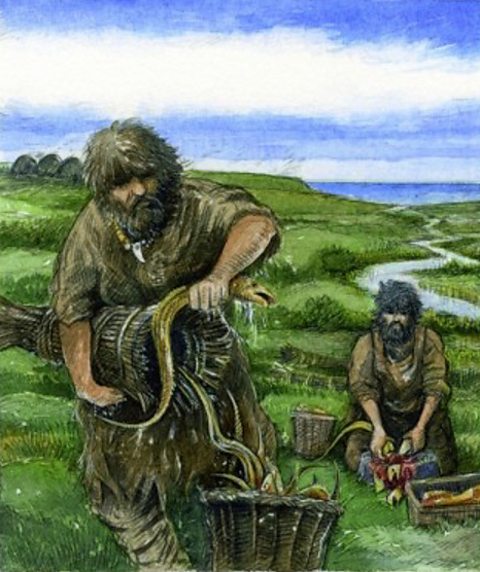 Image source, Historic Environment Scotland
Being near the sea meant the Neolithic people would have been able to catch fish to eat.
They could collect shellfish like winkles and limpets.
Behind Skara Brae is the Loch of Skaill. It's a freshwater loch where the people of Skara Brae could have caught trout and eels.
The Neolithic people hunted. They used the antlers from deer for making tools and jewellery.
Activity 1: Skara Brae quiz
Horrible Histories: Raid and Trade game! game
Play Horrible Histories: Raid and Trade KS2 History
More on Prehistoric
Find out more by working through a topic
- count1 of 21
- count2 of 21
- count3 of 21
- count4 of 21