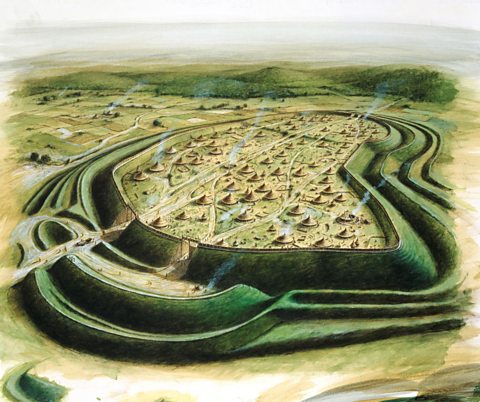
Where did the Celts come from?

The Celts were a number of tribes (groups of people who share similar ideas or culture) that lived in western and central Europe including Britain and Ireland.
They lived in Britain from around 750BC to AD43.
This is during the end of the Bronze Age and through the Iron Age until the Roman invasion of Britain.
Important words
Important words on The Celts.
| Keyword | Definition |
|---|---|
| Barbarians | A group of people believed to be violent or uncivilised. |
| Hide | An animal's skin. |
| Tribe | A group of people who share similar ideas or culture like language, food, clothing and religion. |
| Woad | A plant used to make blue dye. |
Watch: Life in Celtic Britain
Watch the video to learn more about life in Celtic Britain.
JONATHAN WEST: This is Butser Ancient Farm - a 30-year-old project researching the British Iron Age in the time of the Celts. When people come to Butser they learn a lot about the Celts and the Celtic way of life.
Before the Romans came, we're looking at a very different sort of countryside, covered in small settlements. It was made up of fields and woods and pastures. So try and put in your mind this sort of patchwork of different colours of green scattered across the whole countryside.
The Celts were a warrior-based society but they were very very good farmers and this led to an enormous amout of trade. Life in a Celtic village revolved around the production of food. If they weren't able to produce food, they starved. It's very seasonal work and even the building and maintenance of houses depended on doing it at the right time of year.
During the summer, all effort was spent on looking after the crops. In the autumn, that was the time to sort the animals out and decide which ones you wanted to keep through the winter. And during the winter, that was the time to cut the wood. There is very little evidence of Celtic houses in modern times because they were built out of wood and straw and that all rots away to nothing.
At Butser there are all sorts of activities. We learn about the differences between life lived under an empire, which is still very similar to what we do today, and life before the arrival of an empire, when there wasn't a nation. People lived a lot closer to the earth. They used natural materials to do their building and everything was based on farming.
What was their daily life like?

The Celts were a warrior based society. They were good at fighting.
They lived in clans that formed a part of a larger tribe.
Often tribes would fight against each other.
The Celts farmed the land to grow food to eat and to trade with other tribes. Though the warriors were important, they needed to eat too!
Their homes were in small settlements in the countryside.
They kept animals for both food and to make clothing from their hides (an animals skin).
Watch: What were Celtic homes like?
Watch the video to learn more about where the Celt's lived.
PRESENTER: This is Butser Ancient Farm in Hampshire. No Celtic buildings survive, and so these buildings have been constructed using archaeological evidence. This is what archaeologists think Celtic homes might have looked like.
If you live in a country with trees growing everywhere, it makes sense to build with wood. And it seems that that's what the Celts did. Right - here's your DIY guide to building a Celtic house.
First, select some sturdy branches and trim them to make posts. Then put the posts in a circle and hammer them into the ground. Take some thin branches and weave them between the posts. This is called wattling.
A wall like this one could be a bit draughty in the winter. So what would you use to plug up the gaps? Well, there's plenty of soil lying around…
Make a pit of soil. Add some straw and dung and mix with water. Daub the mixture on the wall to fill in the gaps. Finally, for the roof, build a frame from branches and thatch it with straw.
Painting the wall with lime will help it to last longer.
Wood and thatch are materials which, over time, disintegrate. The only evidence which archaeologists used to construct this house, like others, was the pattern of holes left in the ground where the posts once stood. This gave them a plan to work from.
It's impossible now to know exactly who would have occupied a dwelling of this size. Perhaps here you would have found a Celtic chief or maybe the house was used as a community meeting place. We can't know what life was like in this house but we can get some idea from what was written about the Celts.
How do we know about the Celts?

Most of what we know about the Celtic tribes in Britain comes from archaeological evidence and writing by other people.
The Roman Emperor Julius Caesar (100BC-44BC) wrote about the Celts in battle.
He wrote that they painted themselves blue from head to toe using woad (a plant used to make blue dye), and screamed as they ran in to battle.
It's important to remember that his writing was not always accurate.
The Romans described the Celts as barbarians (a group of people believed to be violent or uncivilised) as they wanted to be viewed as the civilised people invading Britain.
The Celts were also described by Greek writers.
The Celts did not write about themselves.
Watch: The Celts throughs the eyes of Greek writers.
Watch the video to learn more about how the Greeks saw the Celts.
"The feast was an occasion when the community could reminisce about the past: about its history and the exploits of its heroes."
"They wear astonishing clothes - dyed tunics displaying every colour."
"Their hair is not only naturally blond, but they also use artificial means to increase its natural quality of colour, for they continually wash their hair in lime wash."
What happened to the Celts?

After the Roman Invasion of Britain in AD43, many Celts became part of the Roman Empire.
Some Celts eventually became Roman citizens.
Many Celts migrated to the north and west of Britain.
Today the Celts live in the countries and places we know as:
- Ireland
- Scotland
- Wales
- Cornwall
- The Isle of Man
- Brittany
Celtic culture continues today through language, music, poetry and literature.
Think like a historian

Have a look at the thinking points below and think about your answer to each question. You could even write them down on a piece of paper or discuss them with somebody else if you want to.
What can we learn about the Celts from Greek and Roman writing?
Why are Greek and Roman descriptions of the Celts important?
Greek and Roman descriptions of the Celts can help us to know:
- What the Celts might have looked like.
- What clothes the Celts might have worn.
- How the Celts might have lived.
Perhaps you thought about some of these things:
- These descriptions tell us what the Greek and Romans thought about different Celtic tribes.
- The Celts did not write about themselves, so Greek and Roman descriptions of them are useful historical sources.
Activity: Celts in Britain quiz
Grown-ups corner
Are you a parent, carer or teacher?
Take a look at some of the links below on KS2 History which are packed full of knowledge, videos, quizzes and activities.
KS2 History: Ancient Voices
BBC Bitesize for Teachers

KS2 History: Iron Age Britain
BBC Bitesize for Teachers

KS2 History: The Romans. 4: The Romans in Britain
BBC Bitesize for Teachers
Horrible Histories: Raid and Trade game! game
Play Horrible Histories: Raid and Trade KS2 History
More on Prehistoric
Find out more by working through a topic
- count5 of 21
- count6 of 21
- count7 of 21
- count8 of 21