|
 |
 | | | | | | ||||||||||||||||||||||||||||||||||||||||||||||||||||||||||||||||||||||||||||||||||||||||||||||||||
| | | You are in: UK: Wales | ||||||||||||||||||||||||||||||||||||||||||||||||||||||||||||||||||||||||||||||||||||||||||||||||||||
|
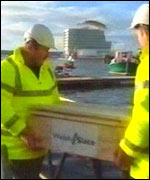
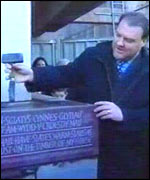
| | Tuesday, 21 January, 2003, 16:12 GMT Slate sees Wales whole  The slate finally arrives in Cardiff Bay
An inscribed slate block completes its transit from its quarry of origin in Bethesda, Gwynedd, to its future home. "Seeing Wales Whole". That was one of the statements which inspired Jonathan Adams, the architect of the Wales Millennium Centre, when he was drawing up the plans for the building. "This gave me the idea of a way of approaching the building," he said. "In the design process, we looked at ways of getting people involved in the creative work."
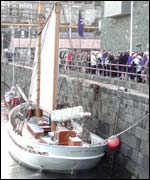
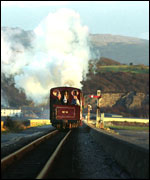
The choice of materials for the building reflects this ambition: the steel from the Panteg works, the glass from Swansea, the spruce from Welsh forests, and, most strikingly, the layered slate of the outer walls. "I was interested in ways of work which have some sort of contextual relevance, and which allow a building to seem more rooted in its environment, and so to be more relevant to the people," he said. It was in order to underline this relevance that the symbolic journey of the foundation stone from its Gwynedd quarry to Cardiff was arranged. Heritage The use of locations such as Blaenau Ffestiniog and Porthmadog, and the imagery of horsepower, trains, and a sailing ship has the effect of touching on some of the main elements of our industrial heritage. But the high winds had meant that the schooner Vilma could not set sail as hoped, so after several days in Porthmadog harbour, and with the day for the laying of the foundation stone approaching, it was time for Plan B.
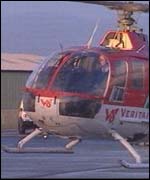
Plan B is not as romantic as a sailing ship, but it's less at the mercy of the weather, and it's about thirty times faster. It's a twin-engined helicopter coming to the rescue like some kind of airborne cavalry. We and our slate cargo set off from Morfa Bychan sands heading directly for Cardiff. What would have been at least 33 hours on a non-stop sea voyage is now a mere hour - with all the scenery. First up is Harlech Castle, part of Edward the First's 13th century ring of stone around Snowdonia, the heartland of Welsh resistance to his invasions. Even by medieval standards, Edward's massive castle-building project was about as un-politically-correct as you can get.
No Welshman was allowed to settle within the walls of the towns which he built around the castles. Even for a 13th Century superpower, the cost of his policy was staggering. This was the Star Wars missile defence programme of its day. Edward had to borrow so much money to finance his conquest that the project kick-started the fledgling European banking industry. It was a case of Vene Vidi Visa. 'Price worth paying' But to him, it was a price worth paying. This would choke off Welsh independence. Permanently. Just over a hundred years later the castle was in the hands of Owain Glyndwr, who wrested freedom back for a brief period at the start of the 15th century. Now it's in the hands of Cadw, a heritage agency answerable to a devolved Welsh government in Cardiff. Nice try, Edward. We pass Cader Idris, where legend has it that anyone who spends a night will wake up in the morning, either blind, mad, or a poet. The contours and land formations below are a history lesson carried out at dizzying speed.
At this height, holiday developments on the coasts look like ephemeral encampments, while ancient forts stand out starkly on hilltop after hilltop. To the west, we pass the railway bridge which spans the Mawddach estuary. By a near-miracle of timing, it actually has a train crossing it as we fly over. If I sound unusually impressed by this it's because trains on mid-Wales lines are pretty rare creatures. Immediately below, the north to south Wales road snakes between the rounded hills. I savour this view. In two decades of making this journey, for once, just for once, I'm not stuck behind a lorry carrying logs. So many of the landscape features seem to be charged with controversy. Those placid-looking reservoirs hide depths of resentment over the communities which were displaced. So do the stretches of empty moorland now used for firing ranges. Then there are the windfarms which loom up as we cross the "Green Desert" of the Cambrian Mountains. Roman road We pass a Roman road traversing east-west over an upland ridge. I bet that too caused some mixed feelings locally in its day. Swinging over the Brecon Beacons, we approach the heartland of industrial Wales, and one of its most inspiring symbols, Tower Colliery. This is the very last deep mine in Wales, saved when the miners who had been made redundant pooled their severance pay to buy it and run it themselves. Next, Penrhys, built in the sixties as a showpiece modern housing estate on a steep hilltop between the Rhondda Fawr and Rhondda Fach valleys. Hilltop locations like this may have been sought after in the Iron Age, but in the late twentieth century, things had moved on, and Penrhys was, shall we say, not quite the success its planners had hoped.
The people of these valleys which produced so much of Britain's wealth deserved more consideration. They still do. Over Pontypridd, and low enough to see the memorial to the authors of the Welsh national anthem, and then we follow the line of the river Taff into Cardiff, and down to where the outline of the Millennium Centre stands out against the glittering waters of the bay. From Cader Idris to Cardiff Bay in an hour, with thousands of years of history laid out below. Inspiring, complex, painful, and very, very beautiful. Now that's what I call "seeing Wales whole". | | See also:  20 Jan 03 | Wales 19 Jan 03 | Wales 18 Jan 03 | Wales 15 Jan 03 | Wales 23 Jan 02 | Wales 22 Jan 02 | Wales 22 Jan 02 | Talking Point Internet links: The BBC is not responsible for the content of external internet sites Top Wales stories now: Links to more Wales stories are at the foot of the page. | ||||||||||||||||||||||||||||||||||||||||||||||||||||||||||||||||||||||||||||||||||||||||||||||||||
 | |
|  E-mail this story to a friend E-mail this story to a friend |
| |
| Links to more Wales stories |
| | | ||
 | ||||
 | | Back to top
| ||
| ---------------------------------------------------------------------------------- To BBC Sport>> | To BBC Weather>> | To BBC World Service>> ---------------------------------------------------------------------------------- © MMIII | News Sources | Privacy |