|
 |
 | | | | | | ||||||||||||||||||||||||||||||||||||||||||||||||||||||||||||||||||||||||||||||||||||||||||||||||
| | | You are in: UK: Wales | ||||||||||||||||||||||||||||||||||||||||||||||||||||||||||||||||||||||||||||||||||||||||||||||||||
|
| | Sunday, 19 January, 2003, 17:05 GMT No sailing in sight for slate  The maritime museum in Porthmadog
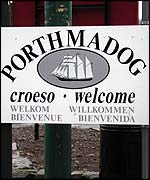
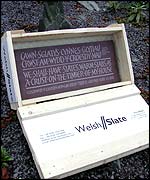
An inscribed slate block is in transit from its quarry of origin in Bethesda, Gwynedd, to its future home. The first thing I bought when I was asked to follow the Millennium Centre's foundation stone on its journey to Cardiff was a packet of sea-sickness tablets. Now, it's doubtful that I'll need them. Not because the weather isn't bad, but because it's so severe that our schooner can't put to sea at all. I wonder if the chemists do refunds? All the experts advise that the gale-force winds and the forecasts of deteriorating conditions mean that putting to sea would be too great a risk. That's absolutely right, of course. But, having prepared myself mentally, and having done a conscientious amount of research on Welsh maritime history over the last few weeks, I must confess to a twinge of disappointment that it's unlikely that I'm actually going to get the chance to experience a journey in a historic ship. So, what do you do on a stormy day in Porthmadog in January while you're waiting for the weather to change? The maritime museum is closed. But I noticed that the tattoo artist in the high street was open. I wonder. An anchor, perhaps?
I'm reassured by the thought that waiting for good weather is an essential part of every mariner's experience. And it does give me time for further research. As someone who is drawn to bookshops as though by some tidal pull, I find myself in Siop Eifionydd, where I pick up a copy of Dilys Gater's Historic Shipwrecks of Wales. I read it at a sitting - I've got plenty of time. And it's sobering stuff. Hazards In studying the background of the slate industry earlier, I had read how, right into the twentieth century, it was an accepted fact that most of the ships carrying slates from Porthmadog would, eventually, be lost with all hands. Now, modern working life isn't perfect, but occupational hazards on that scale do rather put the dangers of office stress into perspective. I should count myself lucky. So far, my only loss on this trip has been my mobile phone, which fell into the harbour as I was rowing ashore from the Vilma. It was, as the Lloyds underwriters say, a total loss. Some of the stories in Dilys Gater's book are quite astonishing. How about this one? Two Anglesey ferries, the Tal-y-Foel and the Abermenai, sank in the 19th Century in the same year. In both cases, everyone on board drowned with the exception of one man - the same man in both cases: Hugh Williams of Bodowyr.
Or this one. The Rev. James Williams, a Cemaes Bay clergyman, who, on July 29, 1835, came to the rescue of the crew of the fishing smack Active, which had run aground off the Anglesey coast. He rode his horse into the raging surf to try to get closer to the stricken vessel, and he managed to throw a hook aboard it, allowing its five crew to be saved. Wrecked I imagine him a bit like the feisty priest played by Gene Hackman in The Poseidon Adventure, who rescues the passengers from a capsized liner. In that film, there's a scene where his group escape from the bowels of the sinking vessel by using a giant Christmas tree as a ladder to safety. On 16 April, 1830, the passengers and crew of the 500-ton emigrant vessel the Newry, which was wrecked in Caernarfon Bay, found a similarly precarious route to safety. The Newry had run aground in mountainous seas, and the captain hit upon the idea of chopping down the mainmast to serve as a bridge to land. Using this flimsy link, 375 of the 400 passengers were saved, in a nerve-wracking operation which lasted 10 hours.
The sinking happened during a once-in-a-century hurricane which sank an incredible 133 ships in British waters in a single night, with the loss of some 800 lives. Vessels More than 450 of that total were on the Royal Charter, from whom only 40 people were saved. The remainder, who were on the last day of a 60-day, 16,000-mile voyage from Australia to Liverpool, died within sight of the horrified and helpless onlookers on the shore. The sheer number of vessels lost off the Welsh coast is astonishing. Everything from fishing boats to oil tankers. On one occasion, a storm off St Ann's Head on the Pembrokeshire coast in November 1866 saw eight vessels run into one another in a deadly nautical pile-up. Of course, nearly all the tragedies have accompanying stories of the selfless heroism of rescuers who risked everything to try to save people from the wrecked vessels. But the overwhelming impression is of the danger that has always attended those who venture out into the waters around the coast of Wales. So, come to think of it, perhaps it's better if we do stay in harbour after all. And you can read more from Grahame Davies on Monday. | | See also:  15 Jan 03 | Wales 23 Jan 02 | Wales 22 Jan 02 | Wales 22 Jan 02 | Talking Point 18 Jan 03 | Wales Internet links: The BBC is not responsible for the content of external internet sites Top Wales stories now: Links to more Wales stories are at the foot of the page. | ||||||||||||||||||||||||||||||||||||||||||||||||||||||||||||||||||||||||||||||||||||||||||||||||
 | |
|  E-mail this story to a friend E-mail this story to a friend |
| |
| Links to more Wales stories |
| | | ||
 | ||||
 | | Back to top
| ||
| ---------------------------------------------------------------------------------- To BBC Sport>> | To BBC Weather>> | To BBC World Service>> ---------------------------------------------------------------------------------- © MMIII | News Sources | Privacy |